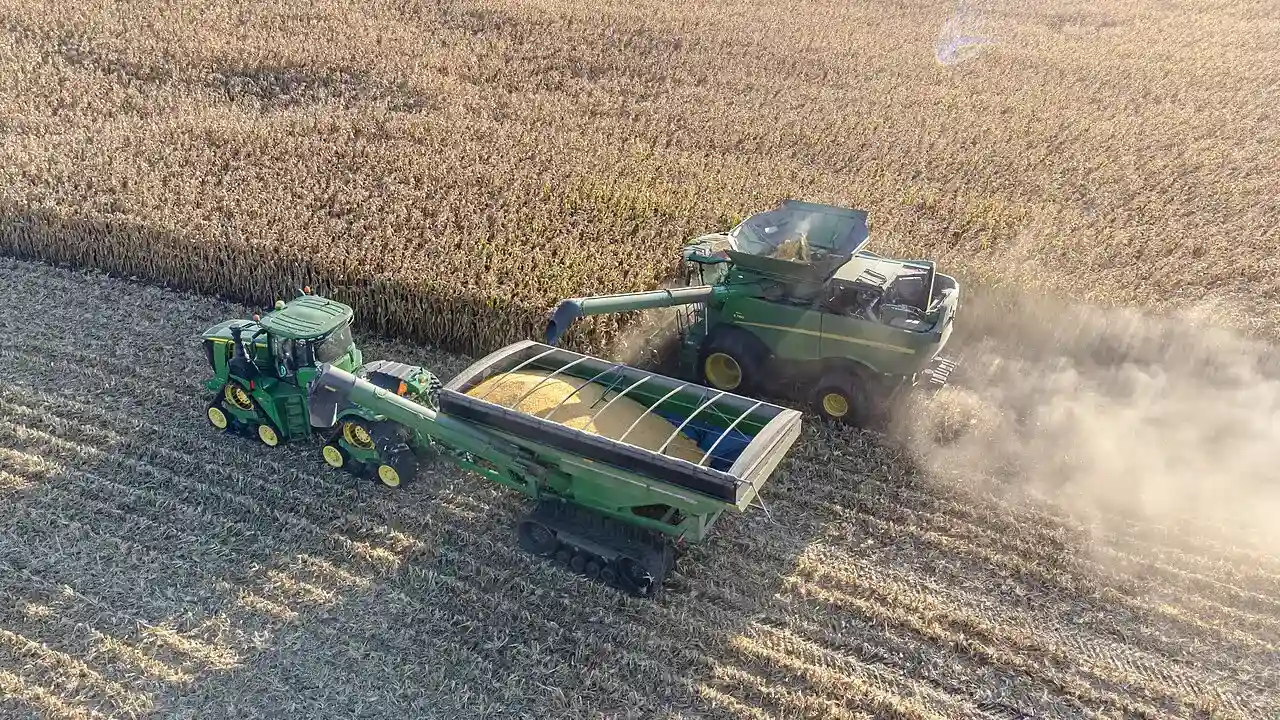
1. Why is this big farm machine called a 'combine'?
2. What pulled the very first wooden combine harvesters before engines were used?
🤯 Mind-Blowing Fact • Grade 2
A single modern combine harvester can gather enough wheat in just nine seconds to bake about seventy loaves of bread!
✨ Word Sparks (Grade 2 Glossary)
Tap 🔊 to hear
reap
To cut down ripe grain stalks in fields
thresh
To beat grain plants so seeds come loose
chaff
Light papery husks around seeds of grain
🪝
Why did harvesting one wheat field once take a whole family weeks of sore backs?
1
Hard Work by Hand
Swish, swish! For thousands of years, farmers swung curved blades by hand under the hot sun. Then they beat stalks with wooden sticks to loosen seeds and tossed everything into the wind to blow husks away.
2
Putting Three Steps Together
In 1834, Michigan inventor Hiram Moore built a rolling machine that combined all three steps! Pulled by teams of horses, its spinning wheels drove cutting blades, a seed-shaking drum, and a cleaning fan.
3
Modern Giants of the Field
Today, powerful diesel engines drive combines with wide front headers swap-ready for wheat, corn, or soybeans. One driver in a cool cab can harvest enough grain in a day for hundreds of thousands of loaves!
1. Who built and tested the first working combine harvester in Michigan in 1834?
2. What job does the big fan inside a combine harvester do?
🤯 Mind-Blowing Fact • Grade 3
Farmers swap out the front header on the same combine—using a spinning reel for wheat and pointed cone dividers to pluck ears of corn!
✨ Word Sparks (Grade 3 Glossary)
Tap 🔊 to hear
winnow
To use moving air to blow away husks
sieve
A screen with holes that sorts small grains
auger
A giant spinning screw inside a metal tube
🪝
What happens inside the belly of a combine harvester in the few seconds between cutting a stalk and pouring clean grain?
1
Reaping, Threshing, and Winnowing
Watch a combine glide across golden prairie wheat like an ocean ship skimming waves! Its name comes from combining three ancient farm tasks—reaping, threshing, and winnowing—into one continuous pass across the field.
2
From Horse Teams to Engines
When Hiram Moore patented his wooden harvester in 1836, ground wheels turned gears as huge mule teams pulled it forward. Over the next century, steam tractors and later self-propelled diesel engines turned the combine into an independent powerhouse.
3
Inside the Spinning Drum
At the front, a wide header cuts stalks and feeds them up an elevator conveyor. Inside, a fast-spinning threshing cylinder rubs grain heads against curved grates so heavy kernels pop free without getting crushed.
4
Shaking Sieves and Clean Kernels
Vibrating and carefully aimed air blasts away lightweight straw and chaff. Clean grain rises into an onboard storage tank until a swinging unloading pours it into a truck.
1. Which three farm tasks are united inside a combine harvester?
2. How can one combine harvester gather very different crops like wheat and corn?
🤯 Mind-Blowing Fact • Grade 4
During World War II in 1944, a fleet of five hundred self-propelled combines called the Harvest Brigade swept north from Texas to Canada, harvesting over a million acres of grain!
✨ Word Sparks (Grade 4 Glossary)
Tap 🔊 to hear
concave
A curved grate surrounding the spinning threshing drum
oscillating
Swinging or shaking steadily back and forth
chassis
The strong base frame supporting a wheeled machine
🪝
How did one rolling factory transform global agriculture from hand sickles to GPS-guided harvests?
1
Breaking History's Harvest Bottleneck
Imagine standing at the edge of an endless amber wheat field while a forty-foot cutter bar sweeps millions of stalks into a roaring machine! In 1800, harvesting just one acre of wheat with hand sickles, wooden flails, and wind baskets demanded dozens of exhausting labor hours before autumn rain spoiled the crop.
2
Hiram Moore's Integrated Vision
While Cyrus McCormick's mechanical reaper sped up cutting in the 1830s, sheaves still had to be bundled and hauled to separate threshing machines. In Kalamazoo County, Michigan, inventor Hiram Moore and partner John Hascall tested a bold machine in 1834—patented in 1836—that linked cutter bar, threshing cylinder, and winnowing fan on one .
3
Precision Mechanics Inside the Chassis
Modern rotary combines feed cut crop material into a lengthwise rotor spinning inside a perforated cage called a . Rubbing friction—not smashing blows—frees fragile seeds of wheat, rice, canola, or soybeans, which fall onto cleaning shoes where calibrated airflow lifts lighter chaff out the rear spreader.
4
Feeding Cities and Precision Farming
By the 1940s, self-propelled combines like Massey-Harris's famous Harvest Brigade kept wartime food supplies flowing. Today's GPS-steered harvesters use optical sensors to measure moisture and yield square meter by square meter, helping farmers grow more food using less fuel and fertilizer.
1. How did Hiram Moore's combine go further than Cyrus McCormick's mechanical reaper?
2. Why do rotary combines use rubbing friction inside a curved concave instead of heavy hammering?
🤯 Mind-Blowing Fact • Grade 5
On steep hillsides, self-leveling combine cleaning shoes tilt automatically inside the machine so gravity never dumps all the grain onto one side of the sieves!
✨ Word Sparks (Grade 5 Glossary)
Tap 🔊 to hear
pneumatic
Operated or sorted using controlled blasts of air
biomass
Total weight of harvested stalks, leaves, and seeds
agronomic
Relating to the science of soil and crops
🪝
How does a 500-horsepower combine separate tiny canola seeds from tons of tangled straw at walking speed without losing even two percent of the crop?
1
A Mobile Processing Plant on Giant Tires
Rolling across vast prairie grain belts beneath late-summer skies, a modern Class 10 combine harvester operates like a self-contained agricultural factory. Spanning up to 15 meters (50 feet) across its front draper header and powered by turbocharged engines exceeding 650 horsepower, the machine ingests more than 100 metric tons of plant material per hour while isolating unbroken kernels with under one percent grain loss.
2
From Mule-Drawn Timber to Self-Propelled Power
When Michigan inventors Hiram Moore and John Hascall earned U.S. Patent X9,893 in June 1836, ground-driven bull wheels turned wooden gears hauled by twenty-to-thirty-horse teams across sprawling farms. Australian blacksmith Headlie Taylor's 1914 Sunshine header harvester and Massey-Harris engineer Thomas Carroll's landmark 1938 self-propelled Model 20 later liberated grain farmers from draft animals and separate tow tractors.
3
Aerodynamics and Centrifugal Separation
Inside contemporary rotary combines, a helical feederhouse auger guides cut stalks into a longitudinal rotor spinning between 250 and 1,200 revolutions per minute inside steel grates. Centrifugal force up to dozens of Gs flings loosened grain outward while operators tune rotor speed and millimeter-accurate concave clearance from the cab—gentle and wide for fragile soybeans or corn, faster and tighter for wheat or tiny canola seeds.
4
Pneumatic Cleaning Shoes and Residue Choppers
Separated kernels and short chaff cascade onto counter-oscillating chaffer and shoe sieves while variable-speed crossflow fans blow upward at calibrated velocities. Because dense grain kernels possess a much higher terminal velocity than hollow papery husks, clean grain drops into a 17,000-liter tank ready for on-the-go auger unloading, while rear choppers spread shredded straw evenly to conserve soil moisture and prevent wind erosion.
5
Agronomic Transformation and Satellite Telemetry
In 1830, harvesting 100 bushels of wheat by sickle and flail demanded roughly 250 hours of grueling manual labor; mechanized combines slashed that requirement below two hours, transforming global food security and urbanization. Modern harvesters integrate centimeter-precise RTK-GPS autosteering, acoustic grain-loss sensors, near-infrared protein analyzers, and self-leveling cleaning shoes that automatically compensate on 20-percent hillside grades.