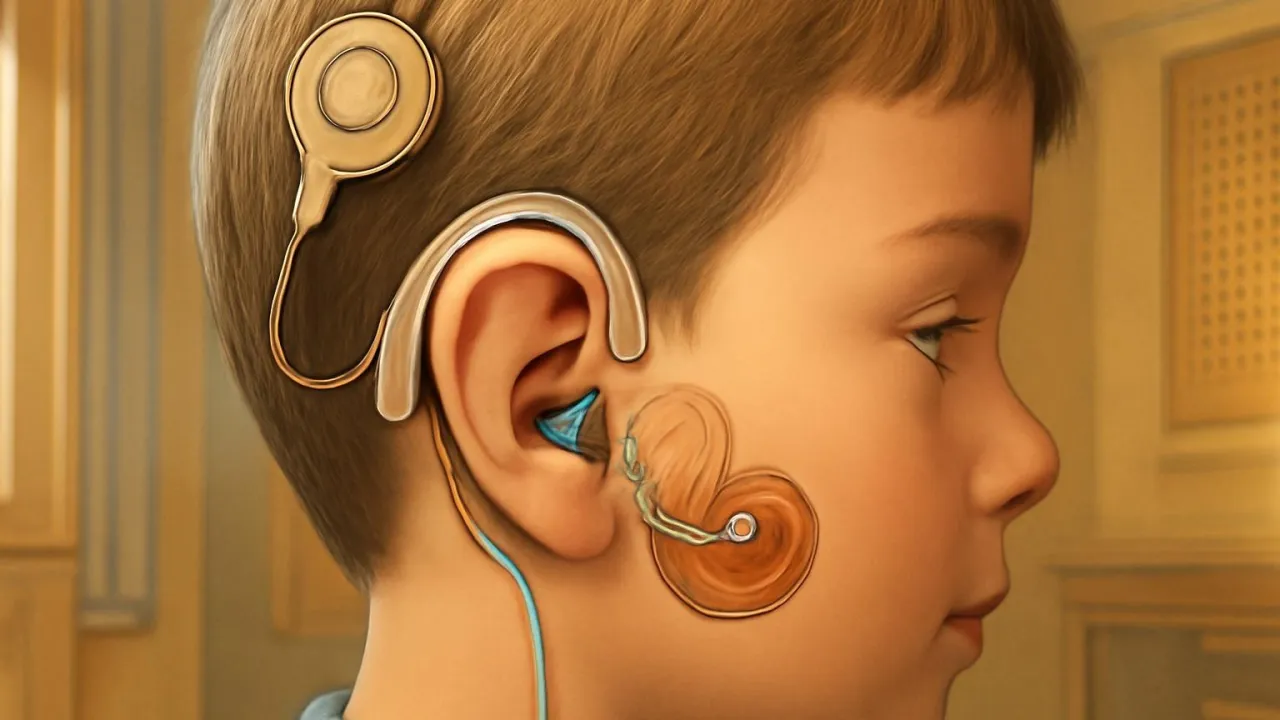
The first words some children ever hear come from a cochlear implant.
✨ Word Sparks (Grade 2 Glossary)
Tap 🔊 to hear
device
A special tool or machine
surgery
A doctor’s operation to help someone
brain
The part of you that thinks and learns
🪝
Can a special device help someone hear music for the first time?
1
Hearing With Help
Some people cannot hear at all, but a cochlear implant can help. This goes inside the ear, and it sends signals to the . The brain learns to understand these new sounds.
2
How It Works
Doctors put the implant in a careful , and it has tiny parts. One part sits behind the ear, and another part goes inside. Together, they help turn sounds into signals.
3
Changing Lives
Many children and adults get cochlear implants. Some hear voices, music, or birds for the very first time. It is a life-changing invention for many families.
1. What does the cochlear implant send to the brain?
2. Which part of the body does the implant help?
🤯 Mind-Blowing Fact • Grade 3
Cochlear implants can help people hear even if their ears are very damaged.
✨ Word Sparks (Grade 3 Glossary)
Tap 🔊 to hear
electrode
A tiny part that carries electricity
vibration
A quick back-and-forth movement
auditory nerve
A nerve that sends sound signals
🪝
Have you ever wondered how science can help people hear again?
1
A New Way to Hear
Imagine hearing music or voices for the very first time. Cochlear implants make this possible for people with severe hearing loss. These devices use special technology to help the brain understand sounds. They can change a person’s world in amazing ways.
2
How the Implant Works
A cochlear implant has two main parts: one sits behind the ear, and one goes inside. The outside part picks up sounds and turns them into electrical signals. The inside part sends these signals to the , which carries them to the brain.
3
The Science of Sound
Normal ears use tiny hair cells to sense , but damaged ears cannot. The cochlear implant uses to copy this job. It creates vibrations with electricity, letting the brain 'hear' even when the ear cannot. This process is called electrical stimulation.
4
Changing Many Lives
Invented by Dr. Graeme Clark in Australia, the first multi-channel cochlear implant was made in 1978. Today, thousands of people around the world use these implants. They help kids learn to talk and enjoy music and laughter. Cochlear implants show how science and engineering can solve big problems.
1. What does the cochlear implant use to send signals?
2. Who invented the first multi-channel cochlear implant?
🤯 Mind-Blowing Fact • Grade 4
Cochlear implants can help people understand speech in noisy places, like playgrounds or busy streets.
✨ Word Sparks (Grade 4 Glossary)
Tap 🔊 to hear
cochlea
A spiral-shaped part of the inner ear
processor
A part that changes sound into signals
stimulation
When something is made active or excited
🪝
What if your brain could learn to hear through electricity instead of sound?
1
From Silence to Sound
For people with profound hearing loss, cochlear implants offer a chance to experience sound again. Instead of making sounds louder, these devices change sound waves into electrical signals. The brain can then interpret these signals as speech, music, or environmental noises. This technology opens new worlds for people who are deaf.
2
Engineering the Implant
A cochlear implant has two main components: an external and an internal electrode array. The processor captures sound and converts it into digital codes, which are sent to the implant. The electrode array, placed inside the , delivers tiny electric pulses to the auditory nerve. This process mimics how healthy hair cells turn vibrations into nerve signals.
3
The Science Behind Hearing
Normally, sound waves cause the eardrum and tiny bones to vibrate, moving hair cells in the . When these cells are damaged, hearing is lost. Cochlear implants bypass the damaged cells by sending electrical directly to the auditory nerve. This allows the brain to perceive sound, even when the ear itself cannot sense it.
4
A Global Impact
Since Dr. Graeme Clark's first successful implant in 1978, over 700,000 people worldwide have received cochlear implants. Children with implants can learn to speak and attend regular schools, while adults regain connections with loved ones. The invention has changed the lives of families and communities around the globe.
2. What part of the ear does the electrode array go into?
🤯 Mind-Blowing Fact • Grade 5
Some people with cochlear implants can recognize melodies, play musical instruments, and even learn new languages through their device.
✨ Word Sparks (Grade 5 Glossary)
Tap 🔊 to hear
tonotopic
Arranged by pitch, like piano keys
neuroplasticity
The brain’s power to learn and change
prosthetic
A device that replaces a body part
🪝
Imagine if your brain could 'hear' by decoding tiny electrical signals—how does this remarkable invention make it possible?
1
The Birth of a Biomedical Breakthrough
In the late 1970s, Dr. Graeme Clark and his team in Australia pioneered the first successful multi-channel cochlear implant, transforming the field of auditory . Unlike traditional hearing aids, which simply amplify sound, cochlear implants bypass damaged hair cells entirely. They convert acoustic energy into electrical signals, which directly stimulate the auditory nerve fibers. This invention gave hope to people with profound sensorineural hearing loss, for whom conventional hearing aids offered little or no benefit.
2
Engineering Marvel: How Cochlear Implants Work
A cochlear implant system consists of an external sound processor, a transmitter, a receiver-stimulator, and an electrode array surgically inserted into the cochlea. The processor captures sound and digitizes it into coded electrical pulses, which are sent wirelessly to the internal receiver. The electrode array, containing up to 22 electrodes, delivers precise electrical stimulation along the cochlea’s spiral, mimicking the (pitch-based) organization of natural hearing. This allows users to perceive a wide range of frequencies, from low rumbles to high-pitched chirps.
3
The Science of Auditory Perception
Normal hearing relies on thousands of microscopic hair cells that convert vibrations into nerve impulses, but cochlear implants replace this biological process with engineered precision. The implant’s electrodes create patterns of electrical resonance that the auditory nerve interprets as sound. Over time, the brain adapts to these new input patterns, a process called , allowing recipients to distinguish speech, music, and environmental sounds. This remarkable adaptation demonstrates the brain’s ability to learn and reorganize itself in response to new sensory information.
4
Global Reach and Lifelong Impact
Since the first commercial cochlear implant in 1982, over 700,000 devices have been implanted worldwide, benefiting both children and adults. Early implantation in children is especially critical, as it supports language development, academic achievement, and social participation. Adults who lose their hearing later in life can regain independence and reconnect with family, friends, and the world around them. The cochlear implant has become a symbol of how biomedical engineering can restore vital human senses and transform lives.
5
Challenges, Innovations, and the Future
Despite their success, cochlear implants face ongoing challenges, such as improving sound quality, music appreciation, and access in low-resource regions. Newer models offer advanced signal processing, wireless connectivity, and even hybrid devices that combine electrical and acoustic hearing. Research continues on gene therapy and regenerative medicine, aiming to one day repair or regrow damaged hair cells. The cochlear implant’s story is a testament to human ingenuity and the ongoing quest to bridge biology and technology for a more inclusive world.