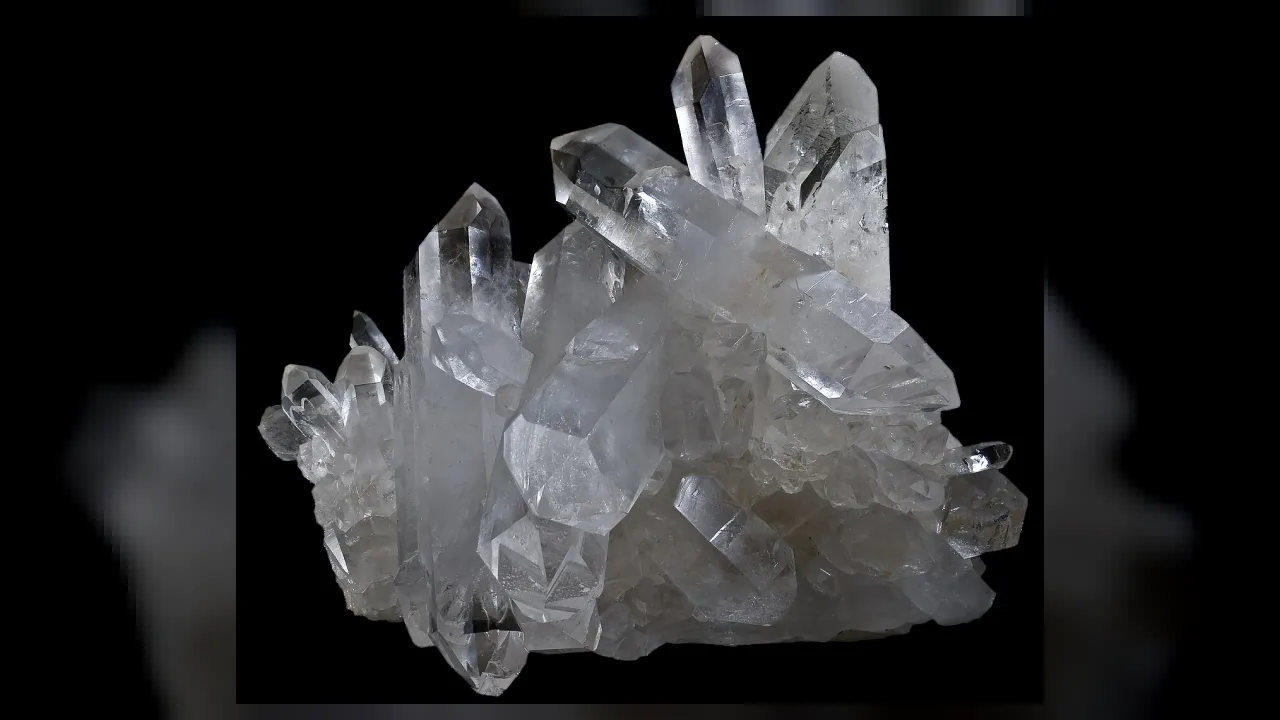
1. Why did ancient Greeks think clear quartz was magical ice?
2. How does a tiny slice of quartz help a wristwatch?
🤯 Mind-Blowing Fact • Grade 2
Rubbing two clear quartz crystals together in the dark creates cold flashes of light called triboluminescence!
✨ Word Sparks (Grade 2 Glossary)
Tap 🔊 to hear
rock crystal
Another geology name for pure clear quartz
crust
Earth's rocky outer layer where we live
cluster
A group of crystals growing together closely
🪝
What happens if you rub two clear quartz pebbles together in a pitch-dark room?
1
Sparks in the Dark
Step into a dark closet with two smooth quartz stones and rub them briskly together. Flash! A soft orange-white glow appears right inside the rocks—without feeling hot at all!
2
Earth's Everywhere Crystal
Geologists also call clear quartz '.' Made from silicon and oxygen—the two most common elements in Earth's —quartz builds beaches of sand, tough granite mountains, and sparkling crystal .
3
Arkansas Crystal Country
In the Ouachita Mountains of Arkansas and along Virginia's Blue Ridge, hot mineral water filled deep cracks millions of years ago, growing clear six-sided points as bright as glass.
1. Which two abundant Earth elements join together to build clear quartz?
2. Which U.S. mountain range is famous for world-class clear quartz crystal mines?
🤯 Mind-Blowing Fact • Grade 3
Inside a quartz wristwatch, a tiny tuning-fork crystal vibrates exactly 32,768 times every single second!
✨ Word Sparks (Grade 3 Glossary)
Tap 🔊 to hear
piezoelectricity
Electricity made by squeezing certain special crystals
double-terminated
Having natural crystal points on both ends
silicon dioxide
The chemical compound that builds pure quartz
🪝
How can squeezing a clear rock create an electric spark?
1
Electricity From a Squeeze
Click a barbecue grill igniter and—zap—a tiny blue spark jumps out without any battery inside! Hidden inside that button sits a tiny crystal of quartz. When a spring-loaded hammer taps the quartz, mechanical pressure squeezes out a quick jolt of electricity.
2
Meet the Piezoelectric Effect
In 1880, brothers Pierre and Jacques Curie discovered this cool superpower and named it , meaning 'pressure electricity.' Even better, it works in reverse: send electricity into quartz and the crystal wiggles at an exact, steady speed!
3
Benchmark Seven on the Mohs Scale
Clear quartz defines level seven on the Mohs Hardness Scale. Because ordinary household dust contains microscopic grains of hard quartz, wiping dry dust roughly across soft plastic lenses can leave tiny scratches.
4
Herkimer 'Diamonds' and Alpine Pockets
In New York State, crystal-clear quartz grows inside rock pockets with sharp points on BOTH ends! Collectors nickname these double-pointed beauties 'Herkimer diamonds,' even though they are pure quartz.
1. Who discovered in 1880 that squeezing quartz crystals produces electricity?
2. What are 'Herkimer diamonds' from New York actually made of?
🤯 Mind-Blowing Fact • Grade 4
Engineers chose 32,768 vibrations per second for quartz watches because dividing 32,768 in half fifteen times in a row lands on exactly 1 tick per second!
✨ Word Sparks (Grade 4 Glossary)
Tap 🔊 to hear
striations
Fine parallel growth lines across crystal faces
oscillator
A part that vibrates at steady intervals
weathering
Natural breakdown of rocks by wind and water
🪝
Why does clear quartz outlast whole granite mountains as they crumble into ocean beaches?
1
Survivor of the Rock Cycle
Stand on a white Virginia ocean beach and scoop up a handful of sparkling sand. Most of those tiny clear grains once sat locked inside towering Appalachian granite mountains! Over millions of years, rainwater and weak carbonic acid dissolved softer feldspar and mica into clay, yet chemically stubborn clear quartz—hardness seven with zero cleavage planes—resisted and rolled down rivers to the sea.
2
Six Sides With Horizontal Growth Lines
Earth science students identify rock crystal by its geometry: six prism faces topped by pyramid-like points. Run your fingernail up and down a natural clear quartz face and you will feel tiny horizontal ridges called —step-by-step growth marks that distinguish natural quartz from cut glass.
3
Tuning Forks for the Digital World
Every smartphone, GPS satellite, and computer motherboard relies on synthetic clear quartz . Sliced with lasers into microscopic tuning forks, quartz vibrates 32,768 times per second—which equals two multiplied by itself fifteen times, letting simple digital circuits count down to one exact one-second pulse!
4
Optical Prisms and Ultraviolet Windows
Ordinary window glass blocks ultraviolet light, whereas pure fused clear quartz lets UV beams pass right through. Scientists craft laboratory lenses, telescope mirrors, and spacecraft windows from ultra-pure quartz.
1. Why is most white continental beach sand made primarily of tiny clear quartz grains?
2. What tiny surface clue on prism faces helps geologists tell natural clear quartz apart from cut glass?
🤯 Mind-Blowing Fact • Grade 5
Studying clear quartz crystals in 1669 inspired Nicolas Steno to discover the first universal law of mineralogy: matching crystal faces always meet at the exact same angle!
✨ Word Sparks (Grade 5 Glossary)
Tap 🔊 to hear
tectosilicate
Three-dimensional framework mineral of linked silicate units
sonar
Underwater navigation using reflected sound waves
interfacial angle
The exact angle where two crystal faces meet
🪝
How does the three-dimensional spiral of silicon and oxygen atoms inside clear quartz power everything from sonar to satellites?
1
Tectosilicate Framework Architecture
At the atomic scale, clear quartz (alpha-quartz below 573 degrees Celsius) is a classic —a three-dimensional framework in which every silicon atom sits inside a four-cornered oxygen pyramid (SiO4 tetrahedron) and every single oxygen atom bridges two adjacent tetrahedra, yielding the clean formula SiO2. Because strong covalent-ionic Si–O bonds extend equally in all directions without weak planes, rock crystal achieves Mohs hardness 7, low thermal expansion, and curved conchoidal fracture rather than cleavage.
2
Steno's Law and Crystallographic History
In 1669, Danish naturalist Nicolas Steno examined misshapen rock crystals from the Alps and made a foundational discovery in mineralogy: even when some crystal faces grow wide and others stay narrow, the angle between corresponding faces of clear quartz is always identical (exactly 120 degrees between adjacent hexagonal prism faces). Steno's Law of Constant launched modern crystallography by proving that fixed internal atomic geometry governs crystal shape.
3
Polar Axes and Piezoelectric Resonance
Because quartz's trigonal helical lattice lacks a center of inversion symmetry, compressing or stretching the crystal shifts positive silicon ions slightly relative to negative oxygen ions, generating a measurable voltage. During World War I, French physicist Paul Langevin sandwiched thin clear quartz plates between steel blocks to transmit and detect underwater ultrasonic waves—inventing modern !
4
Hydrothermal Synthesis for Global Electronics
Natural rock crystal often contains microscopic fluid inclusions or twinning that disrupt electronic vibration. Consequently, engineers dissolve crushed natural lasca quartz inside tall pressurized steel autoclaves at 350 to 400 degrees Celsius to grow flawless synthetic bars by the ton.
5
High-Temperature Polymorph Transitions
Heat alpha-quartz past 573 degrees Celsius and its framework snaps instantaneously into a more symmetrical hexagonal arrangement called beta-quartz—a reversible shift geologists use as a geological thermometer inside cooling granites and volcanic ash.