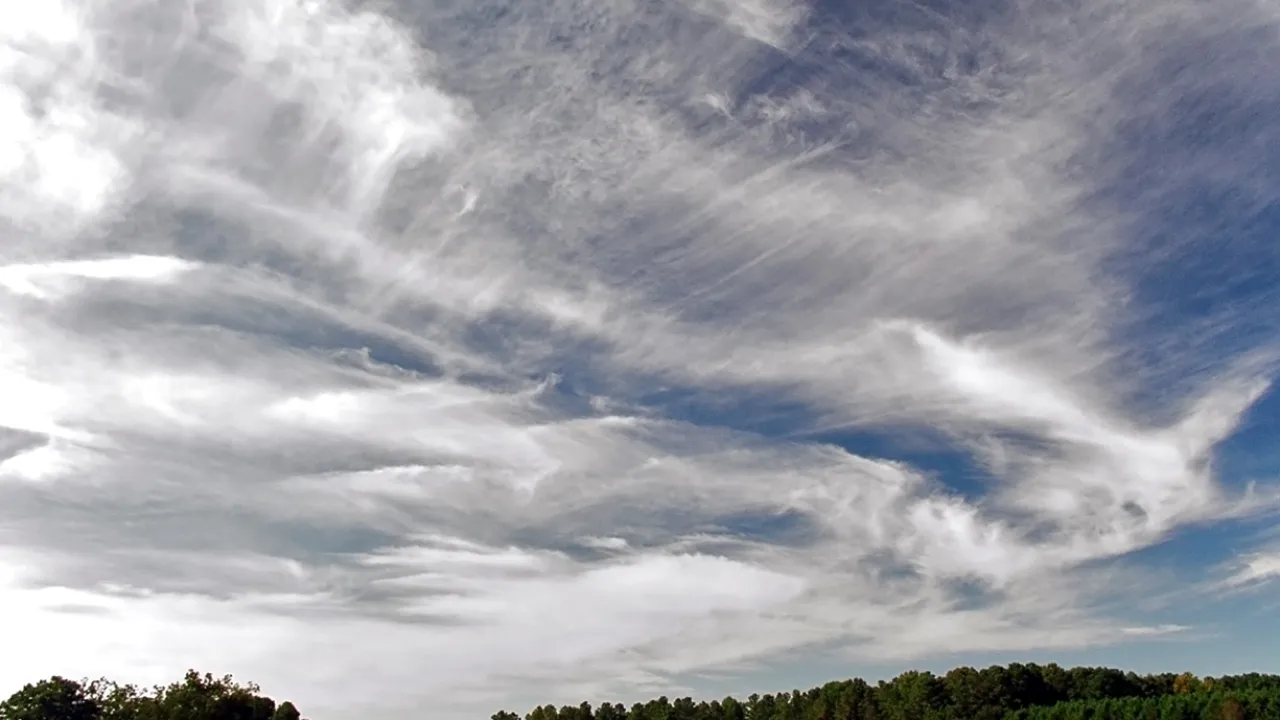
2. What weather clue can lots of spreading cirrus clouds give you?
🤯 Mind-Blowing Fact • Grade 2
Ice crystals inside cirrus clouds can bend sunlight to paint glowing rainbow spots called sundogs!
✨ Word Sparks (Grade 2 Glossary)
Tap 🔊 to hear
front
the meeting line between warm and cold air
sundog
a bright rainbow-colored spot beside the Sun
streamer
a long narrow ribbon blowing in wind
🪝
How can icy clouds float overhead while you wear shorts and sandals below?
1
Curls of Silky White
Tilt your chin toward the highest part of a clear sky, and you might spot delicate white brushed across the blue. Meteorologists call them cirrus clouds, from a Latin word meaning curl of hair.
2
Freezing High Above Summer
Cirrus clouds form more than four miles above the ground, about as high as passenger jets cruise! Even in July, air that high stays colder than minus 40 degrees Fahrenheit, so water vapor freezes straight into tiny ice crystals.
3
Stretched by Fast Winds
Powerful high-altitude winds blow falling ice crystals sideways into long, curved tails. While today stays sunny under thin cirrus clouds, thickening streaks often warn that rain or snow is a day away.
2. Why are cirrus clouds made of ice even during hot summer months?
🤯 Mind-Blowing Fact • Grade 3
Although ice crystals fall out of cirrus clouds, they always evaporate in dry air miles before ever reaching the ground!
✨ Word Sparks (Grade 3 Glossary)
Tap 🔊 to hear
jet stream
a fast river of wind high overhead
warm front
advancing warm air sliding over colder air
filament
a very thin threadlike strand
🪝
How did ancient sailors predict incoming storms just by reading feathery 'mares' tails' in the sky?
1
Highest Clouds of Everyday Weather
Long before weather satellites orbited Earth, sea captains watched wispy white hooks creeping across high blue skies and chanted, 'Mares' tails and mackerel scales make tall ships carry low sails!' Those feathery 'mares' tails' are cirrus clouds, the highest main cloud type in the troposphere.
2
Born Above Twenty Thousand Feet
Forming between 6,000 and 12,000 meters (20,000 to 40,000 feet) up, cirrus clouds live where air is dry and bitterly cold—often minus 40 to minus 60 degrees Celsius. Instead of condensing into liquid droplets, scarce water vapor freezes directly into six-sided ice crystals.
3
Sculpted by the Jet Stream
As heavier ice crystals slowly drift downward, fierce upper-air winds over 100 miles per hour whip them sideways into comma-shaped hooks and silky .
4
Messengers of a Warm Front
When warm, moist air glides up and over retreating cold air, its highest tip forms cirrus clouds first—announcing steady rain or snow 12 to 24 hours ahead!
1. What stretches falling cirrus ice crystals into curved 'mares' tails'?
2. Why don't cirrus clouds ever soak you with a rainstorm right underneath them?
🤯 Mind-Blowing Fact • Grade 4
Jet airplane contrails formed in humid high-altitude air can spread out into human-made cirrus clouds lasting for hours!
✨ Word Sparks (Grade 4 Glossary)
Tap 🔊 to hear
deposition
gas freezing straight into ice without melting
translucent
letting light pass through softly
prism
a clear shape that bends light into colors
🪝
Why do wispy ice clouds sometimes encircle the Sun or Moon with a glowing twenty-two-degree halo?
1
Silky Scouts of Approaching Fronts
Look skyward from a Virginia schoolyard on a crisp autumn afternoon, and you might spot delicate, hooked plumes of white sweeping eastward miles overhead. Those cirrus clouds act as nature's advance scouts. When a broad warm front approaches, buoyant warm air slides gently up a long, sloping ramp of denser cold air. The leading edge reaches 6,000 to 12,000 meters altitude hundreds of kilometers ahead of the surface rainband, freezing into cirrus streaks a full day before umbrellas are needed.
2
Deposition Into Six-Sided Ice Prisms
At upper-tropospheric temperatures below minus 40 degrees Celsius, water vapor skips the liquid phase completely in a process called , crystallizing directly into microscopic hexagonal ice columns, plates, and bullet rosettes. Because high air holds very little moisture, cirrus clouds stay enough for bright sunshine or moonlight to shine right through.
3
Halos, Sundogs, and Sky Optics
Millions of six-sided ice crystals floating in cirrus and thin cirrostratus layers behave like tiny glass ! Sunlight entering one crystal face bends by 22 degrees before exiting another, painting luminous circular halos around the Sun or Moon and vivid rainbow patches called parhelia, or sundogs.
4
Earth's High Thermal Blanket
Covering nearly a quarter of Earth at any moment, thin cirrus clouds let most incoming sunlight warm the ground while trapping outgoing heat below like a delicate greenhouse blanket.
1. How do water vapor molecules turn into cirrus clouds at minus 40 degrees Celsius?
2. How do thin cirrus clouds affect Earth's temperature balance?
🤯 Mind-Blowing Fact • Grade 5
Upside-down 'smiling rainbows' high overhead—called circumzenithal arcs—aren't rainbows at all, but sunlight refracting through flat horizontal ice plates in cirrus clouds!
✨ Word Sparks (Grade 5 Glossary)
Tap 🔊 to hear
wind shear
change in wind speed or direction with height
sublimate
turn directly from solid ice into gas
albedo
fraction of sunlight reflected back into space
🪝
Why do high-altitude ice clouds warm the planet while low puffy water clouds cool it down?
1
Filaments at the Tropopause Ceiling
Scan the upper troposphere between 6,000 and 13,000 meters (20,000 to 43,000 feet), where jetliners cruise near the tropopause, and you enter the icy realm of cirrus clouds. Named in 1802 by Luke Howard from the Latin word for a curling lock of hair, cirrus species—such as hooked cirrus uncinus ('mares' tails') and tangled cirrus fibratus—form wherever synoptic lift, mountain waves, or thunderstorm anvils loft moisture into bitterly cold air between minus 40 and minus 70 degrees Celsius.
2
Homogeneous Freezing, Deposition, and Fall Streaks
Below minus 38 degrees Celsius, even pure supercooled water droplets freeze spontaneously, while water vapor undergoes vapor deposition directly onto ice-nucleating aerosols to build hexagonal columns, plates, and bullet rosettes. As larger crystals—roughly 50 to 500 micrometers long—sediment downward into layers with shifting wind speeds (vertical ), jet-stream gales exceeding 200 kilometers per hour comb those fall streaks into graceful curved virga trails that in drier air below.
3
Hexagonal Prisms and 22-Degree Atmospheric Optics
Unlike spherical water droplets that create 42-degree rainbows behind an observer, hexagonal cirrus ice prisms refract incoming rays toward the observer at a minimum deviation angle of 22 degrees, generating crisp solar halos, circumzenithal arcs, and iridescent parhelia (sundogs).
4
Synoptic Forecasters of Cyclones and Hurricanes
Radiating outward from tropical cyclones or riding hundreds of kilometers ahead of a mid-latitude warm front's sloping frontal surface, thickening cirrus uncinus reliably warns meteorologists of lowering cloud decks and steady precipitation within 12 to 24 hours.
5
Net Radiative Warming in Climate Science
Covering roughly 20 to 30 percent of the globe, optically thin cirrus clouds have low solar —allowing shortwave sunlight to warm Earth—yet strongly absorb and re-emit outgoing longwave infrared radiation at frigid high-altitude temperatures, producing a net greenhouse warming effect.