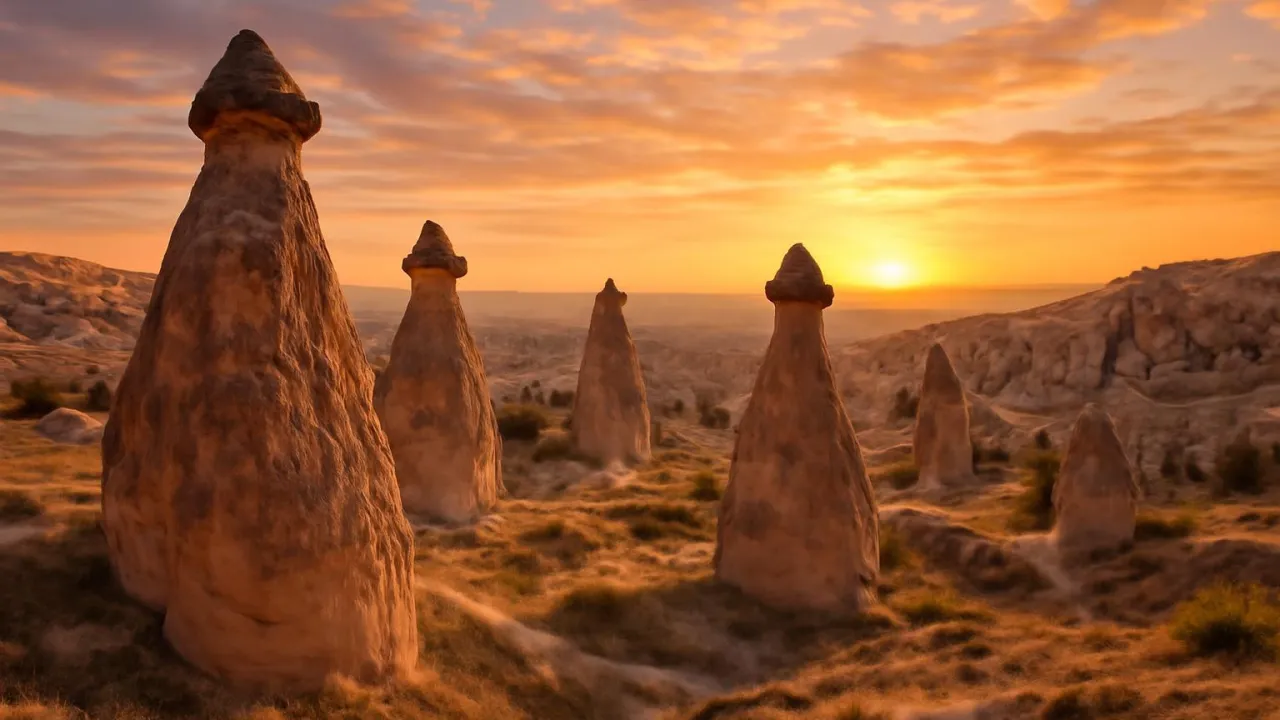
Some people made their homes inside the fairy chimneys long ago!
✨ Word Sparks (Grade 2 Glossary)
Tap 🔊 to hear
ash
Powder left after something burns
erosion
When wind or water wears away rock
visitor
A person who comes to see a place
🪝
Have you ever seen rocks that look like magic towers?
1
Funny Shapes in the Land
The fairy chimneys in Cappadocia look like tall stone cones and hats. They stand together in big groups across the land. People come from all over to see these special rocks.
2
Nature’s Amazing Work
Long ago, volcanoes made soft that turned into rock. Wind and rain slowly wore away the soft parts, leaving the tall chimneys behind. Each chimney is a different shape and size.
3
Exploring the Fairy Chimneys
love to walk around and take pictures of the chimneys. Some rocks have caves where people once lived or hid. The fairy chimneys are a fun place to explore and learn.
2. Why are the fairy chimneys all different shapes?
🤯 Mind-Blowing Fact • Grade 3
Cappadocia’s fairy chimneys can reach up to 130 feet tall!
✨ Word Sparks (Grade 3 Glossary)
Tap 🔊 to hear
tuff
Soft rock made from volcano ash
erosion
When wind or water wears down rock
insulation
Keeps things warm or cool inside
🪝
Can you imagine walking between stone towers taller than a house?
1
A Land of Stone Towers
The fairy chimneys of Cappadocia rise from the ground like magical stone pillars. Some are thin and tall, while others are wide and round. They cluster in valleys, creating a landscape that looks almost like another planet. People travel from far away to see these natural wonders.
2
How Nature Builds the Chimneys
Millions of years ago, volcanoes covered the land with ash and lava. Over time, the soft volcanic rock called was shaped by from wind and rain. Harder rock on top protects the softer rock below, forming the chimney shape. Each year, the chimneys change a little as nature keeps sculpting them.
3
Caves and Hidden Homes
Long ago, people carved homes and churches right into the fairy chimneys. These caves stayed cool in summer and warm in winter because of the rock’s . Some cave homes are still there, showing how people used nature’s creations for shelter. Visitors can explore these ancient rooms and tunnels today.
4
A Place for Adventure
Cappadocia is famous for hot air balloon rides above the chimneys. From the sky, you can see the patterns and colors of the rocks. Hikers and explorers walk through the valleys, discovering new shapes and secret caves. The fairy chimneys inspire stories and art all around the world.
1. What helps protect the soft rock underneath each chimney?
2. Why did people carve homes in the chimneys?
🤯 Mind-Blowing Fact • Grade 4
Some underground cities in Cappadocia could hide thousands of people during ancient times!
✨ Word Sparks (Grade 4 Glossary)
Tap 🔊 to hear
basalt
A hard, dark volcanic rock
fresco
A painting made on wet walls
capstone
The top rock that protects a chimney
🪝
What secrets might you find inside ancient stone towers shaped by nature?
1
A Whimsical Stone Forest
In Cappadocia, Turkey, thousands of fairy chimneys stand like a whimsical stone forest across the valleys. These natural towers are made of soft volcanic tuff, topped with harder caps that shield them from rapid erosion. The landscape’s strange beauty has fascinated travelers, artists, and scientists for centuries. Walking among the chimneys feels like stepping into a storybook world sculpted by wind and time.
2
The Science of Erosion and Formation
The fairy chimneys began forming millions of years ago after massive volcanic eruptions blanketed the region with ash and lava. Over time, water, wind, and temperature changes caused erosion, slowly wearing away the softer tuff but leaving the harder caps. This process created the unique pillar shapes, with each chimney evolving as its gradually erodes. Even today, the landscape keeps changing as nature’s forces continue their work.
3
Human Life Among the Chimneys
Ancient people realized that the soft tuff was easy to carve, so they hollowed out caves for homes, churches, and even entire underground cities. These cave dwellings offered insulation, staying cool in the hot summers and warm in the cold winters of central Turkey. Some fairy chimneys still contain ancient painted on their cave walls. The region’s history is deeply connected to these rock formations, showing how people adapted to their environment.
4
A Landmark of Wonder and Inspiration
Today, Cappadocia’s fairy chimneys are a UNESCO World Heritage Site, attracting visitors from around the globe. Adventurers hike through the valleys, and colorful hot air balloons float above the stone towers at sunrise. The chimneys inspire legends about giants, fairies, and magical lands, making them a symbol of natural creativity. Scientists study the site to learn about volcanic geology and the power of erosion over time.
1. How do the basalt caps affect the fairy chimneys?
2. Why did people build underground cities in Cappadocia?
🤯 Mind-Blowing Fact • Grade 5
The underground city of Derinkuyu in Cappadocia reaches 18 stories deep and could hide up to 20,000 people!
✨ Word Sparks (Grade 5 Glossary)
Tap 🔊 to hear
differential erosion
When soft and hard rocks wear away at different rates
ignimbrite
A tough rock made from volcanic ash flows
ventilation shaft
A tunnel that brings fresh air underground
🪝
If you could travel back in time, what would you discover inside Cappadocia’s mysterious stone towers?
1
A Geological Wonderland
Cappadocia’s fairy chimneys are a breathtaking example of how geology and time shape the Earth’s surface. These stone spires, some soaring over 130 feet (40 meters) high, were sculpted by millions of years of volcanic activity followed by relentless erosion. The region’s tuff, a soft rock formed from volcanic ash, was deposited during eruptions in the Miocene Epoch and then gradually worn away by wind, rain, and temperature changes. The result is a surreal landscape filled with thousands of uniquely shaped towers, cones, and pinnacles.
2
The Physics of Erosion and Capstone Protection
The formation of fairy chimneys demonstrates the powerful effects of , where softer tuff erodes much faster than the harder basalt or capstones perched on top. Water seeps into tiny cracks and freezes, expanding and breaking the rock apart—a process called frost wedging. The capstones act as protective umbrellas, shielding the tuff beneath and allowing the columns to persist for centuries. Over time, as the capstone erodes or falls, the chimney quickly wears down and disappears.
3
Human Ingenuity and Underground Cities
The people of ancient Cappadocia demonstrated remarkable engineering by carving elaborate cave dwellings, churches, and entire underground cities into the soft tuff. These subterranean complexes, such as Derinkuyu and Kaymakli, could shelter thousands of people, complete with , stables, kitchens, and escape tunnels. The rock’s natural insulation provided protection from harsh Anatolian weather and invading armies, making these cities marvels of ancient design and adaptation.
4
Cultural and Scientific Significance
Today, Cappadocia’s fairy chimneys are recognized as a UNESCO World Heritage Site and a global symbol of natural wonder. The region attracts scientists studying volcanic geology, erosion mechanics, and ancient human adaptation. Artists and writers draw inspiration from the whimsical landscape, while tourists flock for sunrise hot air balloon rides and to explore the labyrinth of caves and tunnels. The fairy chimneys continue to teach us about the interplay between Earth’s forces and human creativity.
5
Preservation and the Future
Cappadocia faces challenges from tourism, weathering, and climate change, which threaten the delicate balance that has preserved the fairy chimneys for millennia. Conservationists and local communities are working to protect the site by managing visitor access, restoring damaged structures, and studying erosion patterns. By understanding the science behind these formations and respecting their cultural heritage, we can help ensure that future generations will experience the magic of Cappadocia’s stone towers.