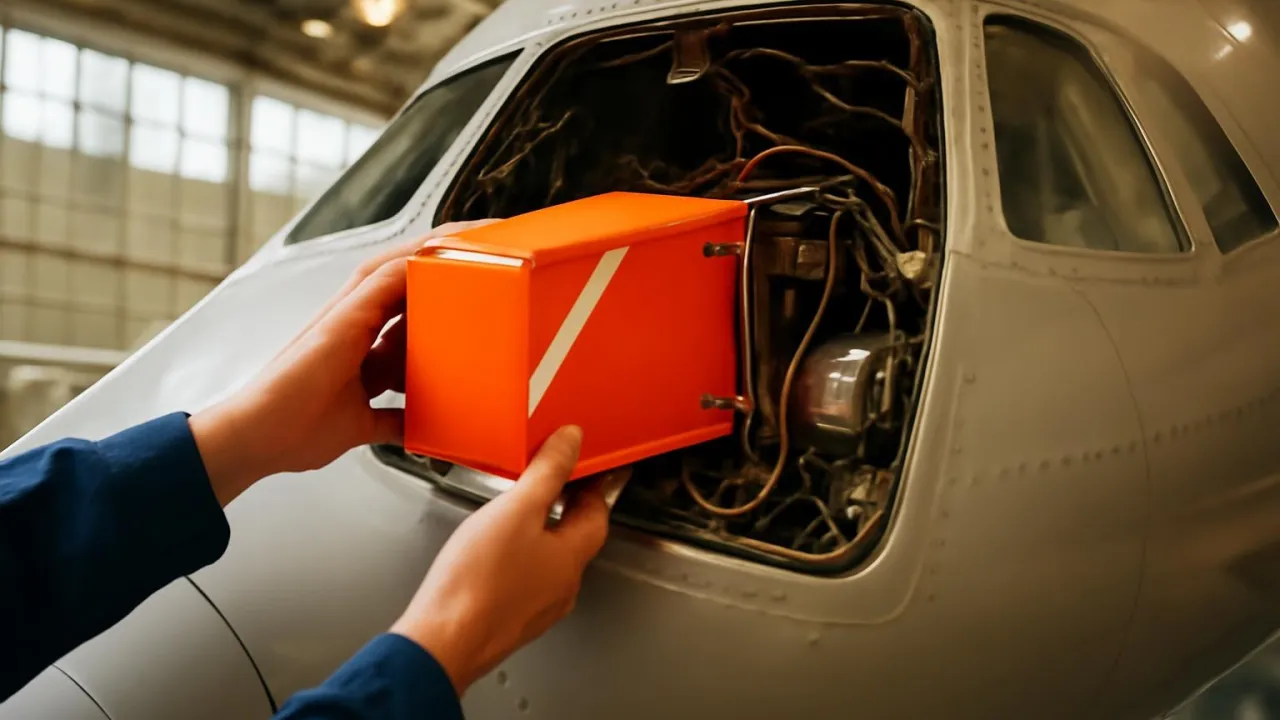
Black boxes can survive fires and deep ocean water!
✨ Word Sparks (Grade 2 Glossary)
Tap 🔊 to hear
record
To save sounds or words
engineer
A person who builds or fixes machines
invention
A new thing people create
🪝
Can you imagine a box that remembers everything on a plane?
1
Listening to the Sky
The black box rides along in every airplane, listening to all the sounds and voices. It the pilots talking and the engines roaring as the plane flies high. People call it a "black box," but it is really bright orange. The color helps people find it if a plane is lost.
2
How It Helps
The black box saves important information about every flight, like speed and direction. If something goes wrong, the box tells helpers what happened. This helps and pilots learn how to make flying even safer.
3
A Smart Invention
Dr. David Warren invented the black box in Australia in 1953. His idea changed how people solve airplane mysteries. Now, every big airplane has a black box to keep its story safe.
Black boxes can survive temperatures over 1,000 degrees Celsius!
✨ Word Sparks (Grade 3 Glossary)
Tap 🔊 to hear
vibration
A quick shaking or moving
impact
A hard hit or crash
altitude
How high something is above ground
🪝
What secrets could a tough orange box tell us about flying?
1
The Airplane’s Memory Keeper
Deep inside every airplane, a special orange box listens carefully to all the action. This device, called the black box flight recorder, captures every sound and word in the cockpit. It also records important flight data, such as speed, , and direction. Even though it is called a black box, its bright color helps searchers find it quickly.
2
How Does It Work?
The black box uses microphones and sensors to gather cockpit voices and airplane data. It stores this information electronically, using special memory chips that can survive crashes. Engineers call these devices flight data recorders and cockpit voice recorders. The box is built to withstand fire, water, and powerful .
3
A Life-Saving Invention
Dr. David Warren invented the black box in Australia after studying airplane accidents. He wanted a way to solve the mystery of what happened during the last moments of a flight. Thanks to his invention, investigators can listen to the recordings and learn what went wrong. This helps make future flights safer for everyone.
4
Changing Air Travel
Black boxes are now required in all large passenger airplanes around the world. They have helped solve hundreds of aviation mysteries and improved safety rules. The technology inside black boxes keeps getting better, storing more data than ever before. The black box is a true hero of the skies.
Some black boxes can send emergency signals from underwater for 30 days!
✨ Word Sparks (Grade 4 Glossary)
Tap 🔊 to hear
resilience
The ability to survive hard things
sensor
A part that detects or measures something
investigator
A person who solves mysteries
🪝
Have you ever wondered how we solve the mystery of airplane accidents?
1
A Hidden Guardian in the Sky
Tucked safely inside the tail of every commercial airplane, the black box flight recorder stands ready for anything. This tough, bright orange device records both the pilots’ voices and vital flight data, including speed, altitude, and direction. Its official names are the Cockpit Voice Recorder (CVR) and Flight Data Recorder (FDR), and both are built to survive extreme conditions. The black box is designed to keep its information safe even after fires, deep ocean dives, or powerful impacts.
2
Engineering for Survival
Black boxes are engineered with layers of heat-resistant and shockproof materials to protect their memory chips. They can withstand temperatures over 1,000 degrees Celsius and pressures found deep underwater. Inside, microphones capture cockpit sounds while gather data about the plane’s every move. This information is stored electronically, so it can be retrieved by after an accident.
3
A World-Changing Invention
Dr. David Warren, an Australian scientist, invented the black box in 1953 after studying mysterious airplane crashes. He realized that recording cockpit sounds and flight data could reveal what went wrong during accidents. His invention was first used in Australia, but soon became a worldwide requirement for commercial planes, saving countless lives by making air travel safer.
4
Global Impact and Future Technology
Today, black boxes are found in airplanes all over the world and have helped solve hundreds of aviation mysteries. They have led to changes in safety rules, pilot training, and airplane design. Modern black boxes can store up to 25 hours of flight data, and new models may even send information by satellite. The black box remains one of history’s most important inventions for travel safety.
1. How do black boxes help improve airplane safety?
2. Where are black boxes usually placed in airplanes?
🤯 Mind-Blowing Fact • Grade 5
Black boxes can survive more than 3,400 times the force of gravity during a crash!
✨ Word Sparks (Grade 5 Glossary)
Tap 🔊 to hear
parameter
A measured detail, like speed or height
insulation
Material that protects from heat or cold
encryption
A secret code that keeps data safe
🪝
Imagine a disaster-proof memory device that holds the final clues of every flight—how does it work?
1
The Unbreakable Witness
Hidden deep within the reinforced tail section of every commercial aircraft, the black box flight recorder stands as aviation’s most reliable witness. This device, actually painted bright orange for visibility, consists of two main components: the Cockpit Voice Recorder (CVR) and the Flight Data Recorder (FDR). The CVR captures every spoken word, alarm, and background noise in the cockpit, while the FDR logs up to 88 critical , including altitude, airspeed, engine performance, and control movements. Both are engineered to survive catastrophic events and preserve vital information for investigators.
2
Engineering for Extreme Survival
Black boxes are constructed with multiple layers of titanium, stainless steel, and high-temperature to protect the internal memory units. They are rigorously tested to withstand impacts up to 3,400 G-forces, temperatures exceeding 1,100 degrees Celsius for one hour, and pressures found at depths of 6,000 meters underwater. Inside, solid-state memory chips store up to 25 hours of flight data and two hours of cockpit audio, ensuring that even after severe crashes, the data remains intact and retrievable.
3
From Tragedy to Invention
The concept for the black box emerged after a series of unexplained airplane crashes in the 1950s. Dr. David Warren, an Australian scientist, proposed recording cockpit conversations and technical flight data to help investigators understand what happened in the moments before an accident. His prototype, developed in 1953, faced initial resistance but was soon recognized as essential for aviation safety. By the late 1960s, black boxes became mandatory on commercial aircraft worldwide, revolutionizing accident investigation.
4
Global Impact and Evolving Technology
Black boxes have been instrumental in solving hundreds of aviation mysteries and shaping international safety regulations. They have led to major improvements in pilot training, aircraft design, and emergency procedures. Modern advancements include deployable recorders, real-time satellite data streaming, and longer recording capacities. Some black boxes are now equipped with underwater locator beacons that emit signals for up to 90 days, aiding recovery efforts even in the deepest oceans.
5
The Future of Flight Data
As aviation technology advances, the role of the black box continues to evolve. Researchers are developing cloud-based flight data streaming and tamper-proof digital to enhance safety and security. The black box’s legacy is its unwavering contribution to learning from past mistakes, ensuring that every flight is safer than the last. Its story is a testament to human ingenuity and our commitment to solving mysteries in the sky.