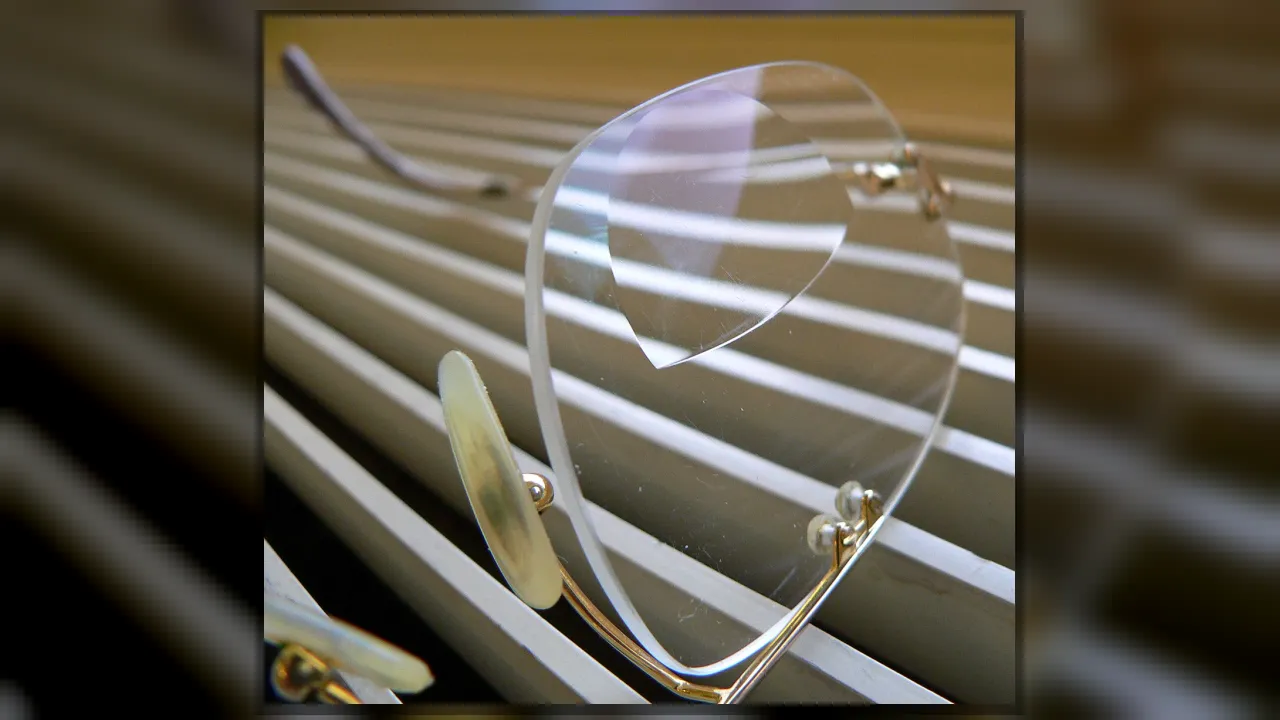
Benjamin Franklin invented bifocals by cutting and combining two different lenses!
✨ Word Sparks (Grade 2 Glossary)
Tap 🔊 to hear
frame
The part that holds the lenses
combine
To put two things together
distance
How far something is from you
🪝
Have you ever needed help to see both your book and the board?
1
Two Lenses in One Frame
Bifocal glasses have two special lenses in each . The top lens helps people see things far away, and the bottom lens helps them read up close. People can look up or down to use the part they need.
2
A Clever Solution by Franklin
Benjamin Franklin invented bifocal glasses in 1784 because he was tired of switching between two pairs. He cut two lenses and joined them together in one , making life much easier for people with vision problems.
3
Helping Eyes Every Day
Today, many people wear bifocals to help them read, write, and see signs. Bifocals are used by teachers, doctors, and even grandparents. They make seeing at any much easier for everyone.
Franklin’s original bifocals were handmade and joined with a thin metal line!
✨ Word Sparks (Grade 3 Glossary)
Tap 🔊 to hear
presbyopia
Eyes can't focus near and far easily
focal length
How much a lens bends light
prototype
The first working model of something
🪝
Imagine if you could read a tiny letter and spot a bird in the sky—all with one pair of glasses!
1
A Double Vision Solution
Bifocal glasses let people see things both near and far without changing glasses. Each lens has two parts: the top for distance and the bottom for close-up reading. This clever design helps people with , a condition where eyes can't focus well at different distances. Bifocals make daily life easier for millions.
2
Franklin’s Inventive Idea
Benjamin Franklin invented bifocals in 1784 by cutting two different lenses in half. He placed the distance lens on top and the reading lens on the bottom, joining them in one frame. Franklin’s changed vision science and inspired new optical inventions. People quickly saw how helpful bifocals could be.
3
How Do Bifocals Work?
Bifocals use lenses with different , which bend light in special ways. The top segment focuses light from far objects onto the retina, while the bottom segment helps focus close-up words. This optical trick lets eyes switch easily between reading and looking far away. The result is clear vision at any distance.
4
Bifocals Around the World
Today, bifocals are worn by people everywhere, from teachers to scientists. They help people read books, drive cars, and see computer screens. Some modern glasses use invisible lines between lens parts, called progressive lenses. Bifocals started a revolution in vision care for all ages.
1. What does the top part of a bifocal lens help you see?
2. What is a prototype?
🤯 Mind-Blowing Fact • Grade 4
Modern bifocals can be made with invisible transitions, so the lens line is nearly impossible to see!
✨ Word Sparks (Grade 4 Glossary)
Tap 🔊 to hear
optical
Related to how light and sight work
segment
A separate part or section
flexibility
How easily something can bend or change
🪝
What if you could instantly switch from reading a book to spotting a friend across the park—without ever changing your glasses?
1
The Science of Split Vision
Bifocal glasses use two distinct lens , each with a different power, fused into one frame. The top segment corrects distance vision, while the lower segment brings close objects, like words on a page, into sharp focus. This design addresses presbyopia, a natural aging process where the eye’s lens loses . Bifocals let people shift their gaze and instantly adjust to any distance.
2
Franklin’s Ingenious Invention
Benjamin Franklin invented bifocals in 1784 because he grew tired of switching between separate reading and distance glasses. He cut his old lenses in half and combined them, creating a single pair that could do both jobs. This clever solution was quickly adopted by others with similar vision problems. Franklin’s invention marked a turning point in engineering and personal convenience.
3
How Bifocals Work: The Physics
Each of a bifocal lens has a different focal length, which determines how light rays bend and focus on the retina. The distance segment has a longer focal length for faraway objects, while the reading segment has a shorter focal length for nearby things. By simply tilting their eyes, wearers use the right segment for the task. This principle is a classic example of physics in everyday life.
4
Bifocals’ Impact on Society
Bifocal glasses have transformed how people work, read, and interact with the world. They are especially important for teachers, doctors, and anyone who needs to see both up close and far away quickly. Today, bifocals and their modern cousins, progressive lenses, are used worldwide. Franklin’s simple idea continues to improve lives centuries later.
Some modern bifocal lenses are digitally designed and precisely laser-cut for each person’s unique vision needs!
✨ Word Sparks (Grade 5 Glossary)
Tap 🔊 to hear
refraction
Bending of light as it passes through something
multifocal
Having more than one focus point
customizable
Can be changed to fit your needs
🪝
Can you imagine inventing a device that lets people see both their favorite book and a distant mountain—without ever removing their glasses?
1
A Revolutionary Leap in Vision Science
Bifocal glasses represent a pivotal advancement in optical engineering, allowing individuals with presbyopia to achieve clear vision at multiple distances. By integrating two lens powers into a single frame, bifocals solve the problem of the eye’s natural loss of flexibility with age. This innovation not only improved daily life for millions but also set the stage for future developments in lens technology.
2
Franklin’s Methodical Approach
In 1784, Benjamin Franklin, frustrated by the constant need to switch between his reading and distance glasses, devised a practical solution. He carefully cut his existing lenses into halves and combined the top segment for distance with the bottom for reading, creating the first bifocal prototype. Franklin’s design was quickly recognized for its ingenuity and was soon adopted by others facing similar vision challenges.
3
Optics and Physics: How Bifocals Work
The bifocal lens operates on the principle of , where each segment bends light rays at a specific angle to focus images on the retina. The upper segment, with a longer focal length, corrects distance vision, while the lower segment, with a shorter focal length, brings near objects into sharp focus. This dual-function lens is a clear demonstration of applied optical physics in everyday life.
4
Evolution and Global Impact
Bifocals quickly spread throughout Europe and America, dramatically improving quality of life for people with presbyopia. Over time, designers developed trifocals and progressive lenses, which offer even smoother transitions between focal points. Today, advanced manufacturing techniques allow for seamless lens integration, making bifocals nearly invisible and highly for each wearer’s needs.
5
Bifocals in the Modern World
Modern bifocals and their successors are used by millions, from scientists and surgeons to artists and teachers. These lenses enable people to read, drive, and use digital devices efficiently, regardless of age. Franklin’s invention remains a cornerstone of vision science, demonstrating how a simple yet ingenious solution can have a lasting global impact.