The Bessemer process made steel so fast, it changed how cities grew!
✨ Word Sparks (Grade 2 Glossary)
Tap 🔊 to hear
converter
A big pot that changes metal
skyscraper
A very tall city building
impurities
Tiny things that make metal weak
🪝
Have you ever heard metal sizzle and roar in a giant pot?
1
The Roaring Converter
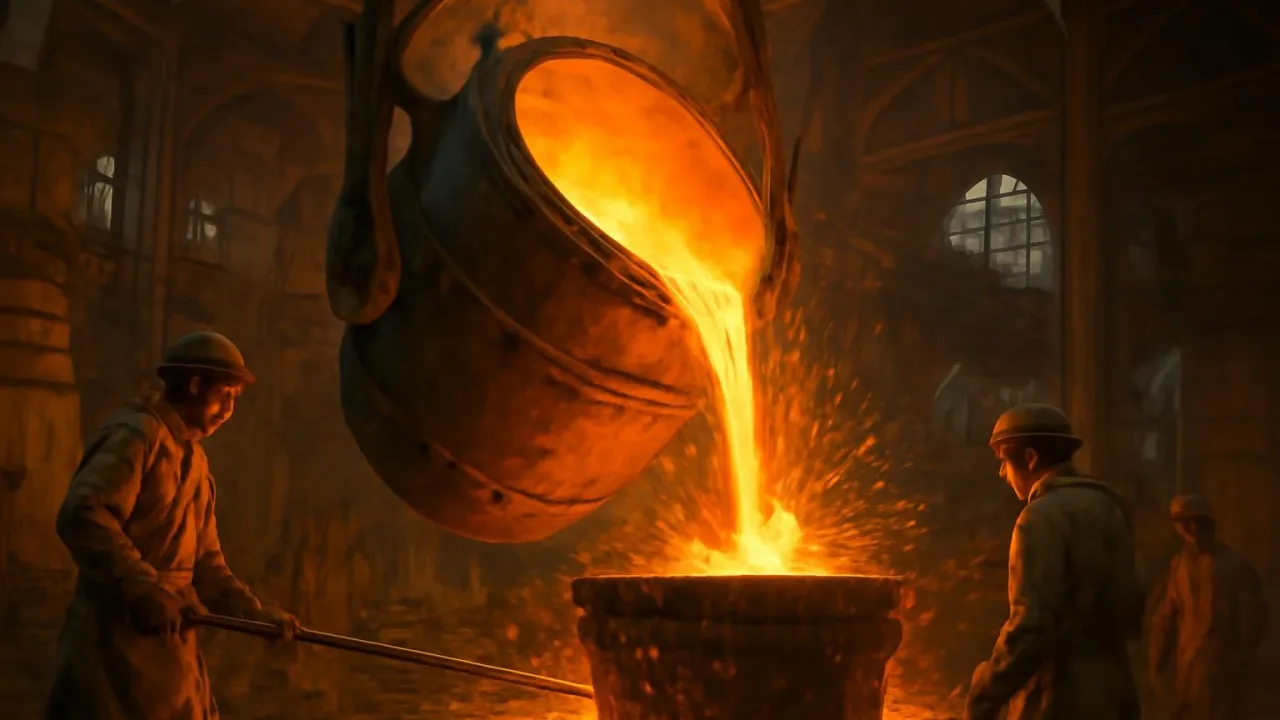
In a huge factory, workers pour melted iron into a giant pot. This pot is called a , and it can tip and spin. When the converter moves, it makes loud, sizzling sounds.
2
Air Makes Steel Strong
Powerful blasts of air shoot through the melted iron. The air burns away things that make iron weak, so it turns into strong steel. This new steel is much better for building things.
3
A New Age of Building
People use this strong steel to build tall and long bridges. Trains and ships become safer and faster with steel parts. The world changes as cities grow with steel.
The Bessemer converter could turn 30 tons of iron into steel in just 20 minutes!
✨ Word Sparks (Grade 3 Glossary)
Tap 🔊 to hear
molten
Hot metal turned into liquid
oxidation
A change when air meets hot metal
converter
A big pot for changing metals
🪝
Can you imagine a blast of air turning glowing iron into super-strong steel?
1
The Sizzling Steel Mill
Inside a busy mill, workers pour iron into a huge Bessemer . The converter is a giant metal vessel that can tilt and spin. As the iron glows orange, a loud roar fills the air. The heat and light make the whole room shimmer.
2
How Air Changes Metal
Powerful air blasts are forced through the iron from below. The air burns away impurities like carbon and sulfur, which make iron brittle. This chemical change creates steel, which is much stronger and more flexible. The process is called , and it happens very quickly.
3
A World Built on Steel
The Bessemer process made steel cheaper and easier to make everywhere. Builders used this strong steel to create tall skyscrapers, sturdy bridges, and fast trains. Cities grew upward, and new inventions became possible. The world changed as steel became the backbone of industry.
4
A Spark of Invention
Henry Bessemer invented this process in England in 1856. He wanted to make better cannons for the army, but his invention changed much more. The Bessemer inspired engineers to build bigger and safer structures. Today, modern steelmaking still uses ideas from Bessemer’s blast of air.
1. What does oxidation do in the Bessemer process?
2. Why did cities grow taller after the Bessemer process?
🤯 Mind-Blowing Fact • Grade 4
Bessemer’s process made steelmaking 10 times faster than older methods!
✨ Word Sparks (Grade 4 Glossary)
Tap 🔊 to hear
impurities
Things in metal that make it weak
oxidation
A reaction with air that changes things
Industrial Revolution
A time when machines changed the world
🪝
What if a single invention could make cities soar and railroads stretch across continents?
1
A Revolution in the Mill
In 1856, Henry Bessemer introduced a dramatic new way to make steel in Sheffield, England. Inside the mill, workers poured molten iron into a massive tilting converter, which could hold up to 30 tons. As the vessel tipped, a thunderous blast of air rushed through the glowing liquid. Sparks flew and burned away, transforming the iron into tough, flexible steel.
2
The Science of Steelmaking
The Bessemer process uses to remove unwanted elements from iron. When air is forced through the molten metal, it reacts with like carbon and sulfur, causing them to burn off as gases. This chemical reaction happens quickly and raises the temperature even more. The result is steel—much stronger and less brittle than iron alone.
3
Changing How the World Builds
Before Bessemer, steel was rare and expensive, so most buildings and bridges used weaker iron. The new process made steel affordable and easy to produce in huge amounts. Engineers could now design skyscrapers, long bridges, and powerful locomotives. The Bessemer process helped launch the and changed the shape of modern cities.
4
A Lasting Impact
Bessemer’s invention spread quickly to America, Europe, and beyond, fueling rapid growth in industry. His converter inspired new steelmaking methods, like the open-hearth process, that are still used today. The strong, reliable steel created by Bessemer’s blast of air supports everything from sports stadiums to space rockets. His spark of innovation truly reshaped the world.
1. How did the Bessemer process make steel stronger?
2. What did engineers build with the new steel?
🤯 Mind-Blowing Fact • Grade 5
At its peak, a single Bessemer converter could produce enough steel in a day to build an entire railroad bridge!
✨ Word Sparks (Grade 5 Glossary)
Tap 🔊 to hear
metallurgy
The science of making and shaping metals
exothermic
A reaction that gives off heat
urbanization
When more people move to cities
🪝
Imagine the thunderous roar and dazzling sparks as air transforms molten iron into the backbone of modern civilization.
1
The Industrial Breakthrough
In the mid-1800s, steel was rare, costly, and slow to produce, limiting the ambitions of engineers and architects. Henry Bessemer, a British inventor, revolutionized in 1856 by developing a process that could rapidly convert tons of molten iron into high-quality steel. Inside vast steel mills, workers poured glowing iron into a tilting Bessemer converter, a massive pear-shaped vessel lined with heat-resistant clay. When the converter tipped upright, a deafening blast of air surged through the liquid metal, igniting a spectacular display of sparks and flames.
2
The Science of Air and Iron
The Bessemer process relies on the principle of oxidation, where oxygen from the air reacts with impurities in the molten iron. Elements like carbon, silicon, and sulfur are burned away as gases, leaving behind much purer steel. This reaction not only removes unwanted elements but also raises the temperature, keeping the metal molten without extra fuel. The process is so efficient that a single converter could transform 25 to 30 tons of iron into steel in less than half an hour—a feat never before possible.
3
Engineering Marvels Rise
The availability of cheap, strong steel sparked an explosion of innovation in construction and transportation. Architects could now design skyscrapers that soared above city skylines, while engineers built suspension bridges spanning rivers and valleys. Railroads expanded across continents, using durable steel rails and engines. Even ships, tools, and everyday machines became stronger, safer, and more reliable thanks to Bessemer steel.
4
Global Impact and Evolution
Bessemer’s invention spread rapidly across Europe and North America, transforming economies and societies. The process inspired further advancements, such as the open-hearth and basic oxygen methods, which improved steel quality and production rates. By making steel affordable and plentiful, the Bessemer process fueled the Industrial Revolution, , and the rise of modern industry. Its influence is still seen in the steel frameworks of today’s cities and the infrastructure that connects the world.
5
A Legacy of Innovation
Though newer steelmaking techniques have replaced the original Bessemer converter, the core idea—using air to refine metal—remains vital in . Bessemer’s breakthrough demonstrated how scientific understanding and engineering creativity can reshape the world. Today, steel is essential for everything from bridges and skyscrapers to medical devices and space exploration. The thunderous air blast that once echoed in 19th-century mills continues to inspire new generations of inventors and builders.