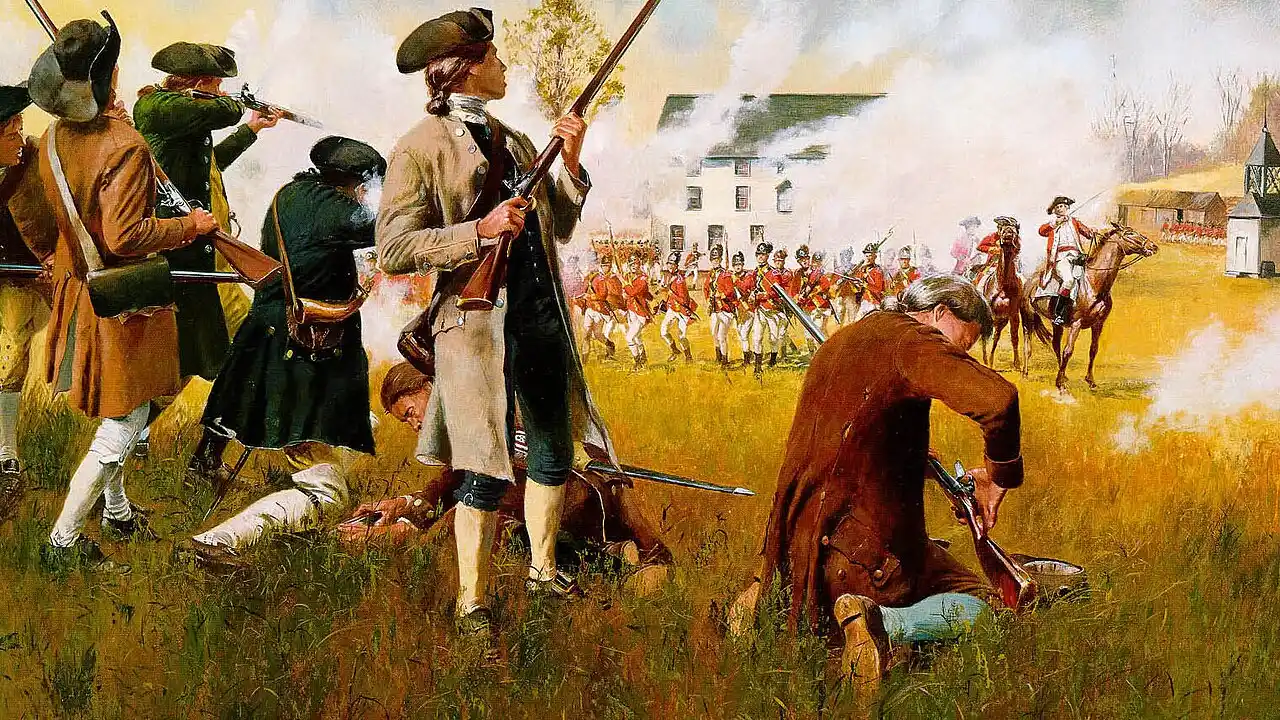
1. Who rode through the night to warn Massachusetts towns before the battle?
2. Why were the colonial helpers called Minutemen?
🤯 Mind-Blowing Fact • Grade 2
Poet Ralph Waldo Emerson later called the opening gunfire of April 19, 1775, 'the shot heard round the world'!
✨ Word Sparks (Grade 2 Glossary)
Tap 🔊 to hear
militia
Local citizens trained to protect their home community
signal
A light or sound sending a secret message
revolution
A big struggle to form a new government
🪝
How could a single musket shot in a small Massachusetts village echo around the entire world?
1
Two Lanterns by Sea
Late on the night of April 18, 1775, two glowing lanterns shone from Boston's Old North Church steeple. That secret meant British troops were rowing across the water before marching toward Concord to seize colonial supplies.
2
Midnight Riders Spread the Word
Silversmith Paul Revere and William Dawes galloped along moonlit lanes, waking farmers and town leaders. By sunrise on April 19, local called Minutemen stood waiting on grassy Lexington Green.
3
Standing Firm at North Bridge
Nobody knows who fired first at Lexington, yet fighting soon reached Concord's Old North Bridge, beginning the American Revolutionary War.
1. What did two lanterns shining in Boston's Old North Church tower mean?
2. Which major conflict began at Lexington and Concord on April 19, 1775?
🤯 Mind-Blowing Fact • Grade 3
When a British patrol captured Paul Revere between Lexington and Concord, Dr. Samuel Prescott jumped his horse over a stone wall in the dark and finished delivering the warning to Concord!
✨ Word Sparks (Grade 3 Glossary)
Tap 🔊 to hear
regulars
Full-time trained soldiers in an official army
skirmish
A short, sudden fight between small groups
retreat
Pulling troops back away from an opposing force
🪝
Why did seven hundred British soldiers march secretly out of Boston under cover of darkness in April 1775?
1
Midnight Alarm Across Middlesex
Church bells clanged and signal riders spurred swift horses past stone walls across Massachusetts on the night of April 18, 1775. Patriots had learned that British General Thomas Gage had ordered seven hundred red-coated to march twenty miles inland to Concord and capture hidden colonial gunpowder.
2
Paul Revere, Dawes, and Prescott
After hanging two signal lanterns in Boston's Old North Church, Patriots watched Paul Revere and William Dawes ride out by separate routes to warn Samuel Adams and John Hancock in Lexington. Joined by young doctor Samuel Prescott, they alerted countryside militia before British patrols stopped Revere—leaving Prescott to carry the warning all the way to Concord.
3
Sunrise on Lexington Green
At dawn on April 19, Captain John Parker lined up roughly seventy-seven Lexington militiamen across the town green. Amid tense shouts, an unknown musket fired, sparking a brief before the British column marched onward.
4
Turning Point at Concord's Bridge
Forewarned colonists hid most supplies in time and gathered four hundred strong at Concord's North Bridge, forcing the British troops into a long, exhausting back to Boston.
1. Who jumped his horse over a stone wall to finish warning Concord after Paul Revere was stopped?
2. Why were British soldiers marching to Concord on April 19, 1775?
🤯 Mind-Blowing Fact • Grade 4
News of Lexington and Concord traveled down the Atlantic coast by horseback chain of riders, reaching Philadelphia in five days and Williamsburg, Virginia, in just ten days!
✨ Word Sparks (Grade 4 Glossary)
Tap 🔊 to hear
munitions
Military supplies such as gunpowder and equipment
imminent
About to happen very soon
orator
A skilled, persuasive public speaker
🪝
How did Virginia orator Patrick Henry's March 1775 prediction that 'the next gale that sweeps from the north will bring to our ears the clash of resounding arms' come true in less than four weeks?
1
Rising Tensions From Boston to Virginia
Imagine standing inside St. John's Church in Richmond, Virginia, on March 23, 1775, hearing Patrick Henry warn fellow Patriots that peaceful petitions to Parliament had failed and fighting in New England was . Just twenty-seven days later, along moonlit roads outside Boston, Massachusetts, an organized network of Patriot riders raced to prove him right.
2
Intelligence Network in Motion
Learning that British Lieutenant Colonel Francis Smith was ferrying seven hundred troops across the Charles River to seize Patriot stored at Concord, Dr. Joseph Warren dispatched silversmith Paul Revere and tanner William Dawes on the night of April 18. Two lanterns hung briefly in Boston's Old North Church alerted Charlestown lookouts across the water. Dozens of express riders spread outward, awakening town militias and Minutemen companies.
3
Lexington Green to Old North Bridge
At chilly daybreak on April 19, Captain John Parker's outnumbered Lexington militia faced Major John Pitcairn's advance guard on Lexington Common. Nobody knows which side fired the sudden opening shot, yet eight colonists fell before British columns pressed five miles west to Concord. Finding most cannon and flour already hidden in nearby woods, British detachments clashed with four hundred militia under Major John Buttrick at Concord's North Bridge.
4
Sixteen Miles Back to Boston
Along the sixteen-mile Battle Road back toward Boston, thousands of colonial militiamen arrived from surrounding towns. Within weeks, delegates at the Second Continental Congress appointed Virginian George Washington to command this new Continental Army.
1. Which Virginia Patriot predicted in March 1775 that news of fighting would soon sweep south from New England?
2. What major decision did the Second Continental Congress make soon after Lexington and Concord?
🤯 Mind-Blowing Fact • Grade 5
Prince Estabrook, an African American Minuteman in Captain John Parker's company, was wounded on Lexington Green at dawn on April 19, 1775, and recovered to serve for years in the Continental Army!
✨ Word Sparks (Grade 5 Glossary)
Tap 🔊 to hear
vanguard
Leading group marching at the front of an army
couriers
Fast messengers carrying urgent news between places
siege
Surrounding a fortified place to cut off supplies
🪝
How did Massachusetts towns assemble nearly four thousand citizen-soldiers in a single afternoon without telegraphs, radios, or telephones?
1
Imperial Crisis Boils Over in Spring 1775
By mid-April 1775, ten months after Parliament's Coercive Acts closed Boston Harbor, Massachusetts operated under rival authorities: Royal Governor General Thomas Gage inside Boston and the Patriot Provincial Congress meeting in Concord. Ordered by London to disarm colonial resistance, Gage quietly mobilized roughly seven hundred grenadier and light-infantry regulars on the night of April 18 to row across the Charles River and march eighteen miles inland to destroy military stores stockpiled at Concord.
2
The Patriot Alarm System
Far from relying on a lone horseman, Massachusetts Patriots had engineered a sophisticated county-wide alarm system. At Dr. Joseph Warren's direction, sexton Robert Newman hoisted two lanterns briefly in Old North Church's steeple—signaling movement 'by sea' across the Back Bay—while Paul Revere rowed past a British warship to Charlestown and William Dawes rode across Boston Neck. Joined past Lexington by Concord physician Samuel Prescott, they triggered church bells, signal drums, and secondary across dozens of Middlesex villages.
3
Dawn Confrontation on Lexington Common
Around 5:00 a.m. on April 19, Captain John Parker assembled approximately seventy-seven Lexington militiamen—including free and enslaved African American Patriot Prince Estabrook, who was wounded that morning—on the triangular town green. Confronted by Major John Pitcairn's , Parker ordered his men to stand firm without firing unless fired upon. An unidentified pistol or musket discharged, triggering British volleys that killed eight colonists and wounded ten.
4
Concord's North Bridge and Battle Road
Pressing on to Concord, British search parties discovered Patriots had already relocated buried cannon and barrels of musket balls. Seeing smoke rising from burning gun carriages in town and fearing Concord was being torched, 400 colonial militiamen marched down Punkatasset Hill to the North Bridge under Major John Buttrick, exchanging volleys that forced British regulars to fall back.
5
From Local Militia to Continental Nation
During the grueling sixteen-mile British withdrawal through Menotomy and Cambridge, nearly 3,800 militiamen converged along stone walls and orchards, surrounding Boston by nightfall in a that transformed scattered colonial grievances into a continental struggle for independence.