🇺🇸 U.S. HISTORY
🏛️ Naval & Civil War Milestone • March 8–9, 1862
VA History & Social Science SOL K.1, 1.2, 2.4, VS.1–VS.10, USI & USII
Battle of the Ironclads (Hampton Roads)
When Metal Warships Changed World Naval History Forever
Grade 1 • Early Reader • 74 words
⏳ Era / StatehoodMarch 8–9, 1862 • American Civil War
🗺️ Region / CapitalHampton Roads Waters, Virginia
📜 Key MilestoneUSS Monitor vs. CSS Virginia Ended in a Draw
⚡ Historical SparkProved wooden warships were outdated and launched the age of steel navies
🤯 Mind-Blowing Fact • Grade 1
Sailors nicknamed the flat USS Monitor 'a cheesebox on a raft' because of its round spinning tower!
✨ Word Sparks (Grade 1 Glossary)
Tap 🔊 to hear
ironclad
A steam warship covered in thick iron
harbor
Safe deep water near land for ships
turret
A round spinning metal tower holding cannons
🪝
Can a heavy ship covered in iron float on water?
1
Goodbye Wooden Ships
Splash and clang! For hundreds of years, big navy ships were built out of wood. Then builders bolted thick iron plates onto two steam ships.
2
Two Strange Shapes
The two iron ships met in Virginia waters called Hampton Roads. One ship looked like a floating barn roof. The other looked like a round cheesebox on a raft!
3
A Loud Tie Game
For four hours, heavy cannonballs bounced right off their metal sides! Neither ship won, and wooden warships were soon history.
1. What happened when cannonballs hit the two ironclad ships?
2. Who won the famous four-hour battle between the two ironclads?
🤯 Mind-Blowing Fact • Grade 2
The USS Monitor featured the first rotating gun turret on an American warship, letting sailors aim without turning the whole boat!
✨ Word Sparks (Grade 2 Glossary)
Tap 🔊 to hear
armor
Protective metal plating covering a ship
hull
The main floating body of a boat
draw
A contest that ends in an even tie
🪝
What happened the very first time two metal-plated warships met in Virginia?
1
Building Ships of Iron
Clang, clang, clang echoed across the shipyards in 1862! During the Civil War, the Confederacy rebuilt a burned wooden ship named the Merrimack with four-inch iron plates and renamed it the CSS Virginia. Meanwhile, the Union built an all-metal ship called the USS Monitor.
2
Duel in Hampton Roads
On March 9, 1862, the two ironclads steamed toward each other in Hampton Roads near Norfolk and Newport News, Virginia. Thousands of spectators watched from shore as cannonballs clanged harmlessly against both armored .
3
Changing Navies Everywhere
After four hours, both ships steamed away undefeated. Overnight, countries around the world realized wooden warships were outdated and began building modern metal navies!
1. Which two ironclad warships faced each other at Hampton Roads in 1862?
2. Why was the Monitor's round turret such a smart invention?
🤯 Mind-Blowing Fact • Grade 3
Today you can visit the actual recovered iron turret of the USS Monitor at The Mariners' Museum in Newport News, Virginia!
✨ Word Sparks (Grade 3 Glossary)
Tap 🔊 to hear
blockade
Using ships to close off a harbor
revolving
Turning smoothly in a circle around a center
frigate
A fast medium-sized warship from sailing days
🪝
Why did crowds gather along Virginia's shoreline on March 9, 1862, to watch two strange steamships circle each other?
1
Where Rivers Meet the Bay
Stand on the breezy shore of Hampton Roads, Virginia, where the James, Nansemond, and Elizabeth rivers flow toward the Chesapeake Bay! During the Civil War, the Union Navy blockaded Virginia's ports here to stop supplies from moving in or out.
2
Shock on March 8
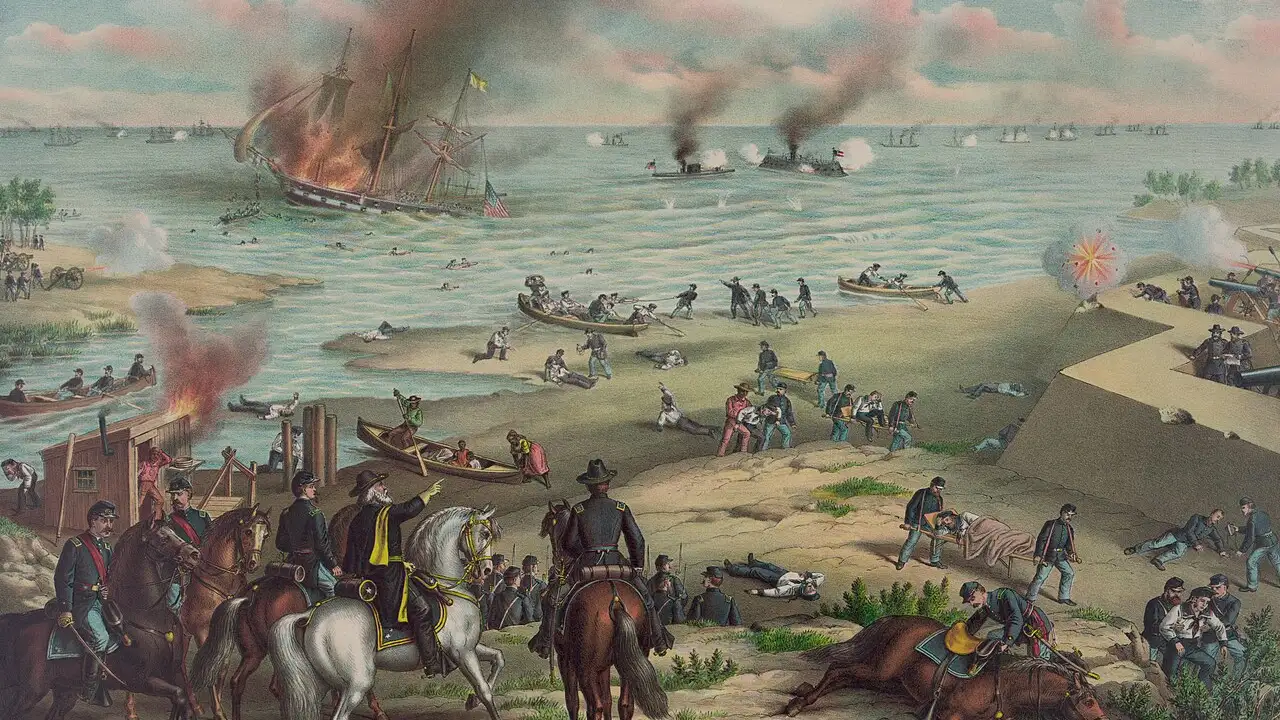
Inside Portsmouth's shipyard, engineers raised the sunken wooden USS Merrimack, armored it with sloped iron rails, and christened it CSS Virginia. On March 8, 1862, it steamed out and easily defeated two tall wooden Union warships while their cannonballs bounced off its iron sides.
3
Enter the USS Monitor
That very night, Swedish-American inventor John Ericsson's brand-new ironclad, the USS Monitor, arrived from New York. Sitting barely eighteen inches above the waves, it carried two huge cannons inside a iron turret.
4
Four Hours That Changed the Sea
At dawn on March 9, the Monitor and Virginia traded thunderous shots at close range for four hours. Neither ship sank the other, ending the battle in a draw—and ending the era of wooden warships across the globe.
1. From which burned wooden ship was the ironclad CSS Virginia rebuilt?
2. Why did the Union Navy keep ships stationed in Hampton Roads during the Civil War?
🤯 Mind-Blowing Fact • Grade 4
John Ericsson packed over forty patented inventions onto the USS Monitor—including the first flushing marine toilets below the waterline on a warship!
✨ Word Sparks (Grade 4 Glossary)
Tap 🔊 to hear
strategic
Crucially important for achieving a larger goal
obsolete
Out of date and replaced by newer technology
salvage
To rescue and reuse parts from a wreck
🪝
How did an engineering race between shipyards in Virginia and New York revolutionize naval architecture in just a hundred days?
1
A High-Stakes Shipbuilding Race
Imagine sparks flying day and night in two rival shipyards during the winter of 1861–1862! At Gosport Navy Yard in Portsmouth, Virginia, engineers bolted two layers of two-inch rolled iron—forged at Richmond's Tredegar Iron Works—over the salvaged steam hull of the USS Merrimack to create the CSS Virginia. Hundreds of miles north in Brooklyn, inventor John Ericsson raced to assemble the iron-hulled USS Monitor in barely one hundred days.
2
Wooden Fleets Meet Iron Power
On March 8, 1862, the CSS Virginia steamed into Hampton Roads—the waterway between Norfolk and Newport News—and sank the wooden warships USS Cumberland and USS Congress, proving unarmored timber hulls could no longer survive against iron rams and rifled shells.
3
Clash of Two Designs on March 9
Overnight, the nimble USS Monitor arrived to shield the grounded wooden frigate USS Minnesota. For four intense hours on March 9, the deep-draft Virginia and shallow-draft Monitor circled within yards of each other. Ericsson's steam-driven rotating turret allowed the Monitor's two eleven-inch Dahlgren guns to fire in any direction.
4
A Global Naval Turning Point
Neither vessel pierced the other's armor, resulting in a tactical draw that preserved the Union blockade. Newspapers from London to Paris declared wooden battle fleets overnight.
1. Where were the heavy iron armor plates for the CSS Virginia rolled and forged?
2. Even though the March 9 duel ended in a tactical draw, what strategic result occurred in Hampton Roads?
🤯 Mind-Blowing Fact • Grade 5
Discovered 240 feet underwater off Cape Hatteras in 1973, the wreck of the USS Monitor was designated the very first National Marine Sanctuary in United States history!
✨ Word Sparks (Grade 5 Glossary)
Tap 🔊 to hear
casemate
An armored sloped enclosure protecting a ship's guns
freeboard
Height of a ship's deck above the waterline
doctrine
Guiding principles used by navies or governments
🪝
Why do naval historians regard four hours of inconclusive gunfire in Virginia's Hampton Roads on March 9, 1862, as the birth of the modern battleship?
1
Strategic Crossroads at Hampton Roads
Gaze across Hampton Roads—one of the world's largest natural ice-free harbors, formed where the James, Nansemond, and Elizabeth rivers empty into Chesapeake Bay! In 1862, Union control of Fort Monroe and the harbor choked Confederate maritime trade while threatening Norfolk and Portsmouth. Breaking that blockade demanded a technological leap beyond wind-powered wooden ships of the line.
2
Two Radical Engineering Visions
Working from the burned hull and steam engines of the scuttled frigate USS Merrimack at Gosport Navy Yard, engineers John Luke Porter and John Mercer Brooke designed a 275-foot ironclad, CSS Virginia, clad in four inches of sloped Tredegar iron and armed with ten guns plus a 1,500-pound cast-iron bow ram. Conversely, Swedish-born engineer John Ericsson built the 179-foot USS Monitor in Brooklyn with minimal and a revolutionary nine-foot-high, eight-inch-thick cylindrical turret housing two eleven-inch smoothbore Dahlgren cannons.
3
Two Days That Shook Naval Doctrine
On March 8, CSS Virginia rammed and sank USS Cumberland and set USS Congress ablaze, demonstrating the helplessness of wooden hulls. Arriving by moonlight, Lieutenant John Lorimer Worden positioned USS Monitor beside the stranded USS Minnesota. Starting around 8:30 a.m. on March 9, the two ironclads maneuvered at point-blank range for four hours—Virginia hampered by her 22-foot draft, Monitor darting through shallower shoals while spinning her steam-geared turret.
4
Fates of Both Historic Vessels
Remarkably, neither ironclad survived 1862! Confederate crews destroyed CSS Virginia near Craney Island in May 1862 after evacuating Norfolk so her deep hull could not ascend the James River, while USS Monitor foundered in a violent December gale sixteen miles off Cape Hatteras, North Carolina.
5
Deep-Sea Archaeology and Legacy
Rediscovered in 1973 under 240 feet of Atlantic water—becoming America's first National Marine Sanctuary—the Monitor yielded its iconic revolving turret and steam engine in the early 2000s, where conservationists preserve them today at Newport News, overlooking the very waters where armored naval warfare began.