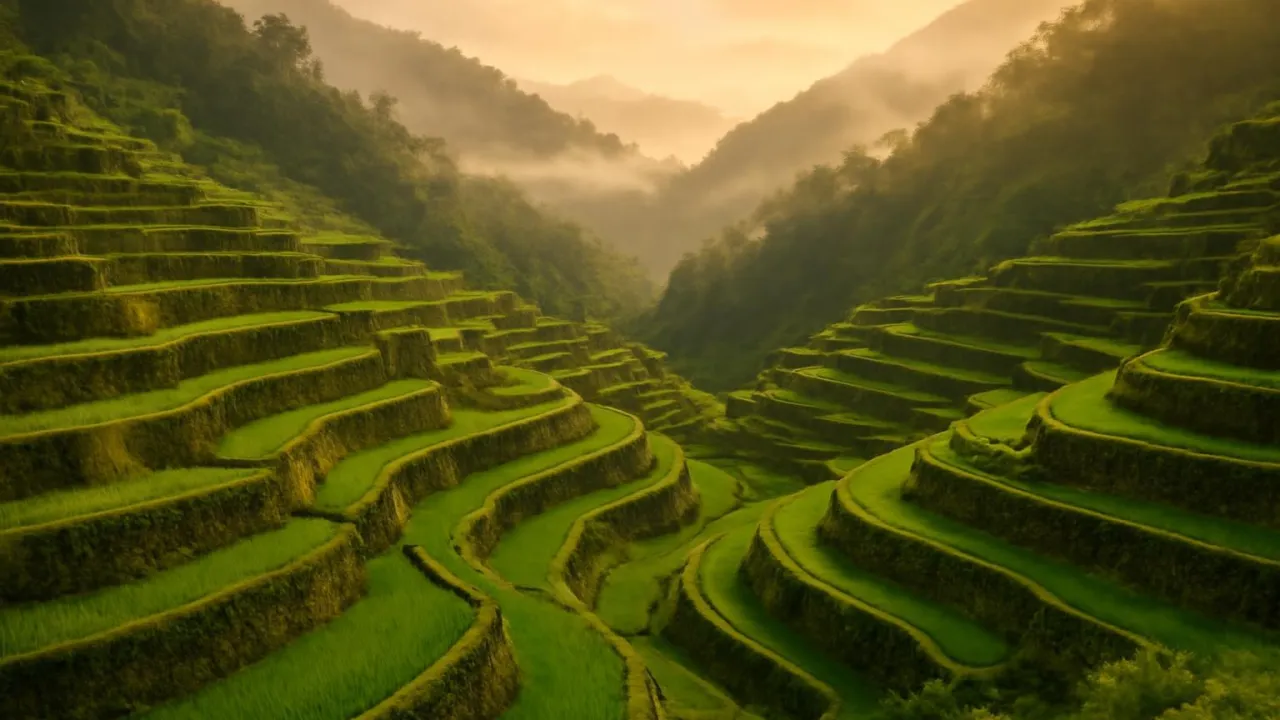
The terraces stretch over 12,400 acres (5,000 hectares) across the mountains!
✨ Word Sparks (Grade 3 Glossary)
Tap 🔊 to hear
terrace
A flat step built on a hill
monument
A special place made by people
erosion
When soil washes away from rain
🪝
What would it feel like to walk above the clouds on giant green stairs?
1
A Mountain Covered in Steps
The Banaue Rice look like a staircase reaching up the mountains of Ifugao. Each terrace is a wide, flat step carved by hand into steep hills. These terraces were built over 2,000 years ago by the Ifugao people. Today, they still shine bright green during the rice-growing season.
2
How Terraces Help Farmers
stop rainwater from rushing down the hills too fast. The stone walls hold soil and water in place, creating perfect fields for rice. Water flows from mountain streams and fills each level, moving gently from one to the next. This clever system helps rice plants grow strong and healthy.
3
A Living Monument
The are a living to teamwork and tradition. Families pass down farming skills from parents to children. People use simple tools and careful steps to plant, tend, and harvest rice. The terraces are part of the Ifugao’s culture and daily life.
4
A Place to Explore
Visitors come from all over the world to see the . They hike along narrow paths and watch clouds drift between the green steps. The view is breathtaking, especially when sunlight shines on the misty hills. The Banaue Rice Terraces are a wonder of nature and human engineering.
If you stacked all the terraces end to end, they would circle half the Earth!
✨ Word Sparks (Grade 4 Glossary)
Tap 🔊 to hear
irrigation
Moving water to help plants grow
heritage
Traditions passed down in families
erosion
Soil wearing away from wind or rain
🪝
Imagine hearing the gentle splash of water as it trickles down ancient green steps high in the mountains.
1
A Human-Made Mountain Marvel
The Banaue Rice Terraces are a breathtaking example of ancient engineering in the Philippines. Carved by the Ifugao people over 2,000 years ago, these terraces transform steep mountain slopes into wide, flat steps. Each terrace is bordered by stone and mud walls that prevent soil from sliding downhill. This design allows rice to be grown in places where flat land is rare.
2
Ingenious Water Systems
Farmers channel water from mountain springs using bamboo pipes and small canals. The water flows from the highest terrace, filling each level before reaching the next. This gravity-powered system keeps the soil moist and prevents . Because of this, rice can thrive even during dry months.
3
A Living Heritage
The terraces are more than just farmland—they’re a living passed down through generations. Ifugao families teach their children how to plant, tend, and harvest rice using traditional methods. Festivals and songs celebrate the planting and gathering seasons, keeping the culture alive.
4
Global Wonder and Challenge
Today, the Banaue Rice Terraces attract visitors from around the world who hike the winding trails and admire the misty views. However, the terraces face challenges like , climate change, and fewer young people choosing farming. Protecting this wonder means blending old traditions with new solutions for the future.
1. Why are stone and mud walls important for the terraces?
2. What challenge do the terraces face today?
🤯 Mind-Blowing Fact • Grade 5
The Banaue Rice Terraces are visible from space and are among the world’s largest hand-built structures.
✨ Word Sparks (Grade 5 Glossary)
Tap 🔊 to hear
hydrology
The science of how water moves
sustainable
Able to last and not harm nature
retaining wall
A wall that holds soil in place
🪝
What secrets do ancient mountain engineers hide in the green stairways of the Banaue Rice Terraces?
1
A Masterpiece of Ancient Engineering
High in the Cordillera Mountains of the Philippines, the Banaue Rice Terraces form a breathtaking tapestry of green steps carved into steep slopes. Constructed by the Ifugao people more than 2,000 years ago, these terraces demonstrate advanced knowledge of soil mechanics, , and agriculture. Each terrace is carefully shaped with stone and mud walls engineered to withstand heavy monsoon rains and the force of gravity. The design allows for efficient use of limited land, transforming rugged mountainsides into productive farmland.
2
Gravity-Driven Irrigation and Soil Conservation
The terraces’ irrigation system is a marvel of gravity-powered engineering. Water is diverted from mountaintop springs through a network of bamboo aqueducts, channels, and ditches. As water flows from the highest terrace, it is distributed evenly across each level, ensuring that every rice paddy receives adequate moisture. The stone not only prevent soil erosion but also absorb and slowly release water, maintaining stable growing conditions. This system reduces the risk of landslides and preserves the fertility of the soil over centuries.
3
A Living Cultural Landscape
The Banaue Rice Terraces are considered a living cultural landscape by UNESCO, reflecting the harmonious relationship between humans and nature. Ifugao families pass down agricultural knowledge, rituals, and songs that celebrate the rice cycle. Traditional farming techniques, such as synchronized planting and communal work, help maintain both the terraces and the community’s cultural identity. Festivals, dances, and oral histories keep the spirit of the terraces alive, connecting past and present generations.
4
Global Significance and Modern Challenges
Recognized as a proposed UNESCO World Heritage Site, the terraces draw thousands of visitors each year who marvel at their scale and beauty. However, the terraces face significant threats from climate change, increased rainfall, and the migration of young people to cities. Erosion, landslides, and the abandonment of traditional farming put the terraces at risk. Conservation efforts now combine ancient wisdom with scientific research to protect this agricultural wonder for future generations.
5
Quantitative Marvels and Enduring Legacy
Spanning over 12,400 acres (5,000 hectares) and rising up to 4,920 feet (1,500 meters) above sea level, the Banaue Rice Terraces are sometimes called the 'Eighth Wonder of the World.' If all the terraces were laid end to end, they would stretch more than halfway around Earth’s equator. Their enduring legacy is not just in their size but in the engineering and cultural traditions they represent. The terraces remind us that ingenious solutions can arise when people work with, rather than against, the land.