1. What moves right at the very tip of a ballpoint pen while you write?
2. What problem did old dip pens and early fountain pens often cause?
🤯 Mind-Blowing Fact • Grade 2
In Britain, Australia, and Argentina, millions of people still call any ballpoint pen a 'biro' in honor of inventor László Bíró!
✨ Word Sparks (Grade 2 Glossary)
Tap 🔊 to hear
editor
A person who checks stories for newspapers
chemist
A scientist who studies how materials mix
paste
A thick smooth mixture that flows slowly
🪝
How did watching a roaring newspaper press inspire the pen sitting on your desk?
1
Clues in a Print Shop
Whirrr, thump! In the 1930s, Hungarian newspaper László Bíró hated how his fountain pen scratched paper and left wet ink blots. Yet huge newspaper rollers printed thousands of crisp pages that dried right away!
2
Two Brothers Team Up
Thick newspaper ink refused to flow through a narrow fountain-pen slit. So László and his brother György Bíró placed a tiny spinning steel ball inside a snug brass tip and patented their pen in 1938.
3
A Built-In Bottle Cap
While rolling across paper, the ball coats itself with ink from a narrow tube inside. When you stop writing, that snug ball acts like a tight stopper so the ink inside never dries out!
1. What gave László Bíró the idea to use thick, fast-drying ink?
2. Why doesn't the ink inside a ballpoint pen dry out when you set it down?
🤯 Mind-Blowing Fact • Grade 3
Look near the middle or cap of many plastic ballpoint pens—tiny air holes equalize pressure so ink flows smoothly and make vented caps safer if accidentally swallowed!
✨ Word Sparks (Grade 3 Glossary)
Tap 🔊 to hear
altitude
Height high up above sea level
viscous
Thick and sticky instead of thin and watery
precision
Made to exact measurements without tiny flaws
🪝
Why did airplane pilots during World War II urgently ask for this brand-new kind of pen?
1
Trouble High in the Clouds
Imagine charting a map inside a bumpy airplane two miles above the ground when your fountain pen suddenly burps dark ink everywhere! Dropping air pressure high in the sky made watery fountain-pen ink expand and leak.
2
From Leather Marker to Fine Lines
American tanner John Loud had patented a rough roller-ball marker for leather hides in 1888, yet it was too coarse for letters. After fleeing Europe to Argentina, László and György Bíró perfected smooth capillary paste ink and tiny sockets by 1943.
3
Flying With the Royal Air Force
Britain's Royal Air Force ordered thirty thousand Bíró pens because thick paste ink stayed neat even in unpressurized cockpits high above the clouds.
4
Pencils Get Company Everywhere
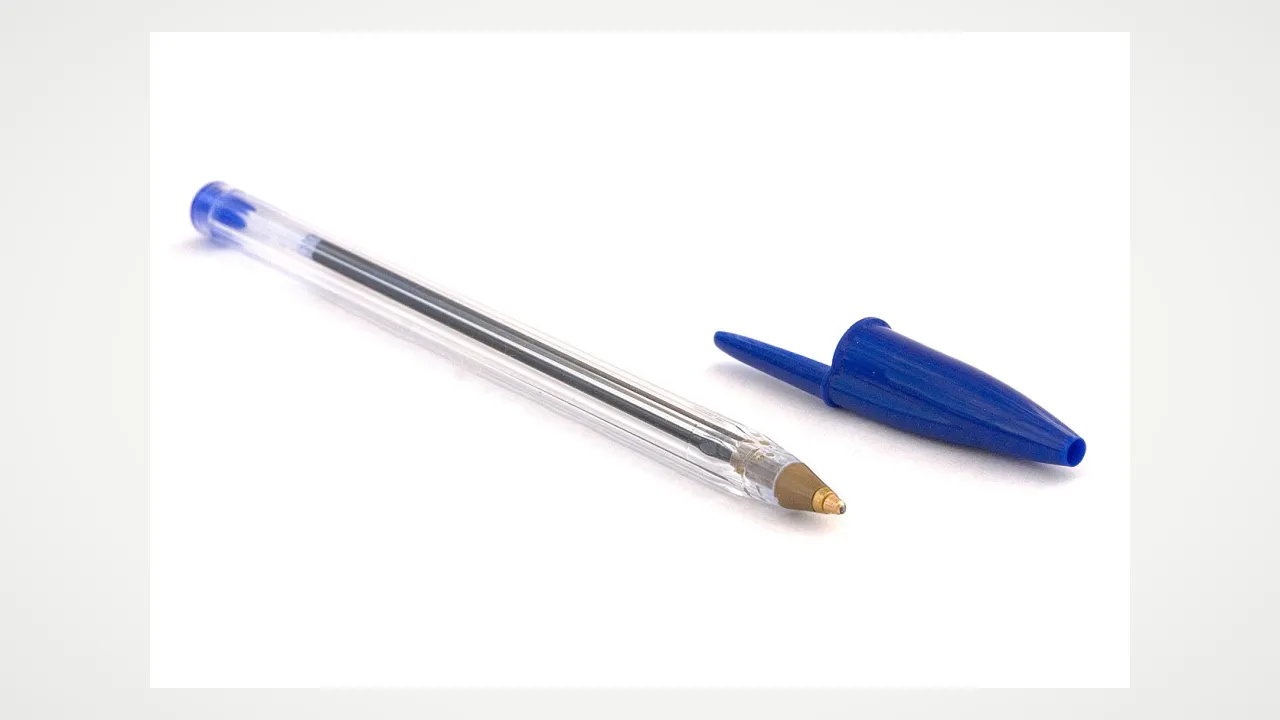
In 1950, French manufacturer Marcel Bich licensed Bíró's patent and used Swiss watchmaking machines to shape microscopic balls to razor-exact sizes. Affordable pens like the clear six-sided BIC Cristal soon put effortless writing into every backpack on Earth!
1. Why did Britain's Royal Air Force order 30,000 Bíró ballpoint pens for flight crews?
2. How did Marcel Bich make ballpoint pens affordable for students everywhere in 1950?
🤯 Mind-Blowing Fact • Grade 4
Since 1950, more than one hundred billion clear hexagonal BIC Cristal pens have been made—making this humble invention part of the permanent design collection at New York's Museum of Modern Art!
✨ Word Sparks (Grade 4 Glossary)
Tap 🔊 to hear
tungsten carbide
An ultra-hard metal compound resisting heavy wear
capillary action
Liquid pulling itself through super-narrow spaces
vacuum
An empty space with air pulled out
🪝
Why does a pen barrel costing pennies need a metal tip harder than steel and engineered to watchmaker tolerances?
1
Fifty Years of Failed Prototypes
Press a ballpoint tip against notebook paper and a sphere smaller than a poppy seed spins thousands of times per page! Although John J. Loud patented a roller-ball marker in 1888 and hundreds of inventors tried similar ideas, every design failed the same frustrating test: thin ink flooded past the ball, while thick ink clogged solid.
2
Bíró's Breakthrough in Buenos Aires
Hungarian journalist László Bíró and his chemist brother György solved both sides of the puzzle between 1938 and 1943 after emigrating to Argentina—where Argentina still celebrates Inventors' Day on László's birthday, September 29! Chemist Fran Seech later refined glycol-based quick-drying inks that stayed fluid inside the reservoir yet bonded instantly to paper cellulose.
3
Shear-Thinning Physics and Tungsten Carbide
Ballpoint ink exhibits a remarkable property called thixotropy or shear-thinning: sitting still inside the plastic tube, it acts like a thick gel that refuses to drip, but the spinning friction of the ball temporarily thins it into a silky liquid! By the 1960s, engineers replaced steel spheres with ultra-hard —nearly as hard as diamond—machined within microns of perfection.
4
Vent Holes and Everyday Design
Notice the tiny pinhole drilled into the side of a clear BIC barrel? As ink travels downward through gravity and , outside air must enter behind it; otherwise a partial inside the barrel would lock the ink in place!
1. What does 'shear-thinning' allow ballpoint pen ink to do?
2. Why do many ballpoint pen barrels have a tiny pinhole in the side?
🤯 Mind-Blowing Fact • Grade 5
Grinding tungsten-carbide pen balls to nanometer smoothness requires tumbling them between diamond-coated plates for days—because even a scratch one-hundredth the width of a hair would make your pen skip!
✨ Word Sparks (Grade 5 Glossary)
Tap 🔊 to hear
non-Newtonian
Changing thickness depending on stirring or rubbing force
viscosity
How thickly a liquid resists flowing easily
micrometer
One-millionth of a meter in tiny length
🪝
How do non-Newtonian fluid rheology, micron-scale clearance gaps, and sintered tungsten carbide make a fifty-cent pen an engineering marvel?
1
Precision Tribology on Your Desk
Beneath the unassuming cap of an everyday ballpoint pen operates a miniature triumph of fluid mechanics, surface chemistry, and metallurgy. A spherical ball measuring 0.5 to 1.0 millimeters across spins at up to several thousand revolutions per minute inside a machined brass or stainless-steel socket whose annular clearance gap measures mere —narrower than a single human red blood cell.
2
Non-Newtonian Rheology Solves the Leak Paradox
Between John J. Loud's 1888 hide-marking patent and László and György Bíró's 1938–1943 breakthroughs, over three hundred roller-tip patents failed because ordinary Newtonian liquids either leaked past the socket gap or clogged dry. Modern oil-based ballpoint pastes—dissolving concentrated dyes in benzyl alcohol or phenoxyethanol with synthetic resins—act as shear-thinning fluids whose drops sharply under rapid rotational shear inside the socket and rebounds instantly onto paper.
3
Sintered Tungsten Carbide Spheres
Everyday notebook paper contains microscopic mineral fillers such as kaolin clay, titanium dioxide, and calcium carbonate that gradually grind softer steel spheres out of round. Contemporary pen tips employ sintered tungsten-carbide balls—approaching 9.0 on the Mohs hardness scale—lapped with fine diamond paste for days until surface roughness falls below ten nanometers, preventing skipping or fiber tearing across kilometers of writing.
4
Pressurized Cartridges and Gel Hybrids
Standard open-tube refills depend on outside atmospheric pressure pushing down behind the ink column alongside five or six narrow capillary feed channels coined into the socket seat. In 1965, American inventor Paul C. Fisher sealed visco-elastic thixotropic ink ahead of compressed nitrogen gas at 35 pounds per square inch—creating the famed Space Pen tested by NASA for Apollo 7 in 1968.
5
Democratizing Global Literacy and Art
Scaled to billions of precision-molded pens per year by Marcel Bich starting in 1950—and later joined by low- rollerballs and Japanese biopolymer gel pens in 1984—rotary-sphere capillary pens banished messy inkwells from classrooms, banks, aircraft cockpits, and field research stations across every continent.