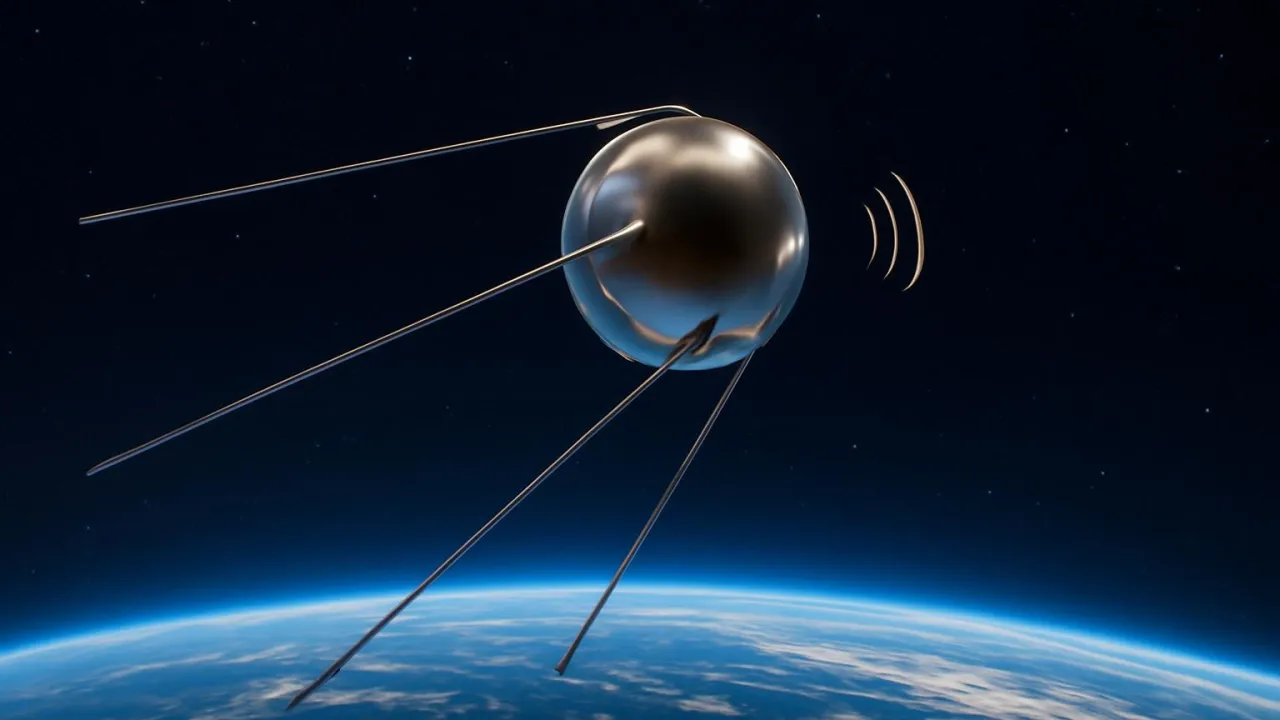
Sputnik’s radio beeps could be heard by anyone with a simple radio.
✨ Word Sparks (Grade 2 Glossary)
Tap 🔊 to hear
antenna
A stick that sends signals
signal
A message sent through air
explore
To find out about new things
🪝
Can you imagine a shiny ball flying above Earth?
1
The First Space Traveler
Sputnik was the first artificial satellite ever. It was a metal ball with four long . It traveled high above our planet, sending out steady beeping sounds. People all over the world listened to its .
2
How Sputnik Worked
Sputnik used batteries to power its radio. The helped send the beeps down to Earth. Scientists tracked its path as it orbited every hour and a half. It showed what humans could do in space.
3
A Race Begins
Sputnik started a race between countries to space. People wanted to build bigger and better rockets. This race led to new inventions and space travel. It all began with one shiny beeping ball.
Sputnik’s metal shell was only 2 millimeters thick—thinner than a pencil!
✨ Word Sparks (Grade 3 Glossary)
Tap 🔊 to hear
transmitter
A machine that sends signals out
gravity
The force that pulls things down
resonance
When something vibrates with a matching sound
🪝
What would you think if you heard mysterious beeps from outer space?
1
Sputnik’s Surprising Arrival
One night in 1957, people around the world heard a strange beeping sound on their radios. That sound came from Sputnik, the very first artificial satellite to orbit Earth. Sputnik looked like a shiny metal sphere with four thin antennas sticking out. Its launch amazed and shocked people everywhere.
2
How Sputnik Worked
Sputnik used batteries to power its radio , which sent out beeps as it traveled. The antennas helped the signal reach far distances, even through Earth’s atmosphere. As Sputnik orbited, it moved at nearly 18,000 miles per hour. Scientists called this path an orbit, where keeps satellites circling our planet.
3
A New Era in Space
Sputnik’s launch started the Space Age and a fierce space race between countries. Engineers and scientists rushed to design new rockets and satellites. Sputnik proved that humans could send machines beyond Earth’s surface. It inspired many young people to study science and engineering.
4
Lasting Impact
Sputnik orbited Earth for three months before burning up in the atmosphere. Its success showed how radio signals could travel through space using vibration and . Today, thousands of artificial satellites help us communicate, study weather, and explore faraway planets. Sputnik’s beeps changed the world forever.
Sputnik’s signal was so strong that amateur radio operators worldwide could hear its beeps.
✨ Word Sparks (Grade 4 Glossary)
Tap 🔊 to hear
electromagnetic wave
Energy that moves through space as light or radio
innovation
A new idea or invention
physics
The science of how things move
🪝
Imagine hearing beeps from a tiny metal ball flying above Earth—what would you think?
1
A Beeping Start to the Space Age
On October 4, 1957, the world changed forever when the Soviet Union launched Sputnik 1 into orbit. Its steady beeping, heard on radios worldwide, signaled the arrival of the first human-made object to circle Earth. Sputnik was a polished metal sphere about 23 inches wide, with four long antennas trailing behind. The satellite’s launch marked the beginning of the Space Age and sparked curiosity and competition around the globe.
2
Engineering the First Satellite
Sputnik’s design was simple but revolutionary for its time, relying on battery power to run its radio transmitter. The four antennas were carefully angled to maximize the strength and reach of its radio signals. As Sputnik orbited at nearly 18,000 miles per hour, it completed a full circle around Earth every 96 minutes. This engineering feat demonstrated how objects could remain in orbit by balancing speed and gravity.
3
The Science Behind Sputnik’s Beep
Sputnik’s radio beeps traveled through the atmosphere using , a form of energy that moves at the speed of light. The transmitter inside Sputnik vibrated to create these signals, which were picked up by radios as a rhythmic beep. This use of vibration and resonance allowed people everywhere to hear proof that something was flying high above them. The satellite’s success proved that communication from space was possible.
4
A Global Impact
The launch of Sputnik sparked a wave of scientific research and inspired new generations to study engineering and . It led to the rapid development of more advanced satellites and space missions by many countries. The Space Race that followed pushed technology forward, resulting in inventions like weather satellites, GPS, and even the first trip to the Moon. Sputnik’s beeping ball became a symbol of human curiosity and .
Sputnik’s radio beeps helped scientists study Earth’s upper atmosphere by tracking changes in the signal.
✨ Word Sparks (Grade 5 Glossary)
Tap 🔊 to hear
ionosphere
A layer of Earth’s atmosphere that reflects radio waves
elliptical orbit
A stretched, oval-shaped path around Earth
inertia
The tendency of an object to keep moving
🪝
What if you were the first person to hear a signal from outer space—would you believe your ears?
1
Sputnik’s Launch: A Historic Leap
On October 4, 1957, a powerful rocket thundered into the sky, carrying a polished metal sphere called Sputnik 1. As the first artificial satellite ever launched, Sputnik instantly transformed humanity’s relationship with space. Its rhythmic beeping, transmitted on two radio frequencies, was detected by scientists and amateur radio operators around the globe. The launch was led by Sergei Korolev and a team of Soviet engineers, marking the start of the Space Age and igniting a technological rivalry known as the Space Race.
2
Engineering a New Frontier
Sputnik 1 measured 58 centimeters (about 23 inches) in diameter and weighed 83.6 kilograms (184 pounds). Its four whip-like antennas, each over two meters long, were precisely angled to optimize the transmission of radio signals. Inside, two radio transmitters powered by silver-zinc batteries generated electromagnetic waves at 20.005 and 40.002 MHz. The satellite orbited Earth at a speed of 29,000 kilometers per hour, completing one revolution every 96 minutes at an altitude ranging from 215 to 939 kilometers.
3
The Physics of Orbit and Communication
Sputnik’s successful orbit depended on Newton’s laws of motion and gravity. The rocket’s velocity was carefully calculated so that the satellite’s balanced the pull of Earth’s gravity, creating a stable . The radio beeps were produced by rapidly vibrating electronic circuits, generating electromagnetic resonance that could travel through the . This allowed the signals to be received by simple radios across continents, demonstrating the practicality of long-distance space communication.
4
A Catalyst for Global Change
Sputnik’s launch had a profound impact on science, technology, and international relations. The United States responded by accelerating its own space program, leading to the creation of NASA and a surge in STEM education. The satellite’s success inspired the rapid development of weather satellites, communications networks, and space exploration missions. Sputnik’s achievement symbolized the power of innovation and the limitless possibilities of scientific discovery.
5
Sputnik’s Legacy in the Modern World
Although Sputnik 1 orbited Earth for only 92 days before burning up in the atmosphere, its legacy endures in every modern satellite and space mission. Today, thousands of artificial satellites circle our planet, enabling global communications, navigation, weather forecasting, and scientific research. Sputnik’s simple beeping ball proved that humans could reach beyond Earth and set the stage for decades of exploration, cooperation, and technological advancement.