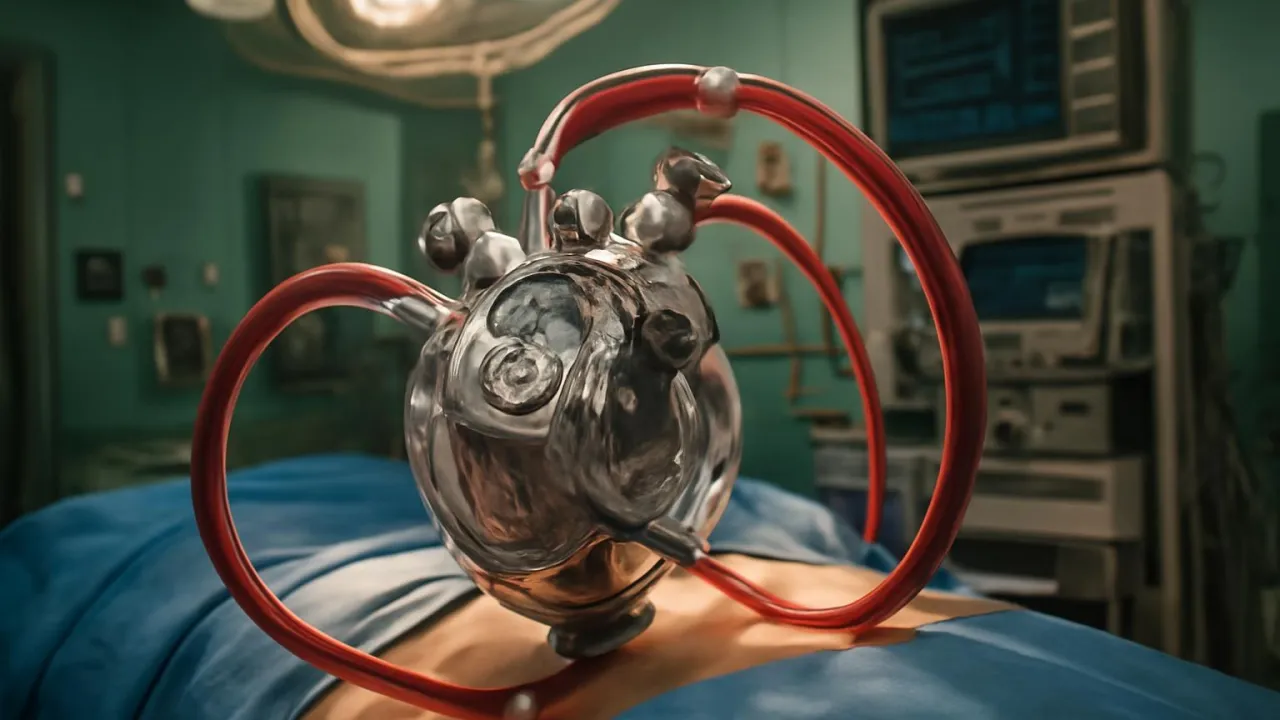
Some artificial hearts are powered by batteries you can carry in a backpack.
✨ Word Sparks (Grade 2 Glossary)
Tap 🔊 to hear
valve
A door that opens and closes
motor
A part that makes things move
plastic
A strong, bendy material
🪝
Have you ever wondered if a heart could be made by people?
1
A Heart That Doctors Build
Imagine hearing a soft whirr inside your chest! Some people get a machine heart when their real heart stops working. This heart is made by doctors and uses metal and parts.
2
How It Works
The artificial heart pumps blood just like a real one does. It uses tiny and special to move blood through the body. People with these hearts can walk, talk, and play again.
3
Why It Matters
The first artificial heart was used in 1982 to save a man's life. Since then, many lives have been saved by this amazing invention. Doctors keep making better hearts every year.
Modern artificial hearts can pump over 7,000 liters of blood every day.
✨ Word Sparks (Grade 3 Glossary)
Tap 🔊 to hear
vibration
A fast shaking movement
transplant
Moving something from one body to another
engineer
A person who builds and designs things
🪝
What would it feel like to have a heart that hums with electricity?
1
A Heart Made by Hands
Some people’s hearts become too weak to pump blood on their own. Scientists and doctors invented the artificial heart to help those people live. The artificial heart is a machine that sits inside the chest and takes over the heart’s job. It uses electricity and moving parts to keep blood flowing.
2
How Does It Work?
The artificial heart uses motors and valves to create strong , pushing blood through the body. It copies the rhythm of a real heart, so the blood moves smoothly. The valves open and close to control the direction of the blood. Some artificial hearts use batteries that must be charged every day.
3
A Medical Breakthrough
The first artificial heart was successfully implanted in 1982 by Dr. William DeVries. The patient, Barney Clark, lived for 112 days with the Jarvik-7 heart. Since then, artificial hearts have saved many lives while patients wait for a real heart . Each new model becomes lighter, quieter, and lasts longer.
4
Changing Lives Around the World
Artificial hearts are used in hospitals in many countries. They give hope to people with heart failure. Doctors and work together to improve the design using new materials. The invention of the artificial heart shows how science and kindness can work together.
Some artificial hearts can pump more than 100,000 times every single day.
✨ Word Sparks (Grade 4 Glossary)
Tap 🔊 to hear
prosthetic
A device that replaces a body part
biomedical
Using science to help the human body
pulse
A beat or thump you can feel
🪝
Imagine hearing a gentle mechanical hum where your heartbeat used to be—how does a machine keep you alive?
1
The Birth of the Artificial Heart
When a human heart can no longer pump blood, doctors sometimes turn to an incredible invention: the artificial heart. The first successful artificial heart, called the Jarvik-7, was implanted in 1982 by Dr. William DeVries. It was designed by Dr. Robert Jarvik and based on earlier prototypes by Dr. Paul Winchell. This device gave hope to patients with severe heart failure who had no other options.
2
Engineering a Mechanical Miracle
An artificial heart is made from strong plastic and metal, using mechanical valves and electric motors. These parts work together to mimic the heart’s natural pumping action, pushing blood through the body with rhythmic . The valves open and close in a precise sequence, creating a steady flow and preventing blood from moving backward. The whole system is powered by batteries, which can be worn outside the body and connected by special wires.
3
How It Changes Lives
Artificial hearts are used as a temporary solution for people waiting for a heart transplant. They can keep someone alive for months, or even years, until a donor heart becomes available. This invention has saved thousands of lives worldwide and continues to improve as engineers develop lighter, quieter, and more reliable models. Some modern artificial hearts can even adjust their pumping speed to match the body's needs during rest or activity.
4
A Global Impact
The invention of the artificial heart has inspired scientists and doctors in many countries to work together. It has led to new research in engineering and materials science. Today, artificial hearts are used in hospitals around the world, helping people live longer and healthier lives. The story of the artificial heart shows how creativity and compassion can lead to life-saving technology.
1. Why are artificial hearts often used before a transplant?
2. What powers most artificial hearts today?
🤯 Mind-Blowing Fact • Grade 5
The longest a patient has survived with a total artificial heart is over 4 years.
✨ Word Sparks (Grade 5 Glossary)
Tap 🔊 to hear
biocompatible
Safe for use inside the human body
fluid dynamics
The science of how liquids move
prosthetic
A device that replaces a missing body part
🪝
If your heart could be replaced with a machine, how would it keep you alive every second of the day?
1
From Dream to Reality: The Artificial Heart’s Story
Picture a world where a machine can take over the most important job inside your body—pumping life-giving blood. That’s exactly what the artificial heart does, and its journey began with inventors like Dr. Paul Winchell and Dr. Robert Jarvik. The first successful permanent artificial heart, the Jarvik-7, was implanted in 1982, marking a turning point in cardiac medicine. Before this, only temporary pumps existed, but the Jarvik-7 could fully replace a failing heart’s function for months at a time.
2
Engineering Marvel: How the Artificial Heart Works
An artificial heart is a complex device composed of plastics, titanium, and advanced polymers. It contains two ventricles, each with mechanical valves that open and close in precise sequence to mimic the heart’s natural rhythm. Electric motors or pneumatic pumps create pressure, pushing blood through the body at rates of up to 7,000 liters per day. The device relies on external or internal batteries, which are connected via sterile tubes or wireless transmission. Engineers must carefully balance durability, size, and blood compatibility to prevent clots and infection.
3
The Physics of Pumping Life
Artificial hearts use principles of and pressure gradients to move blood efficiently. As the motor-driven diaphragm or piston contracts, it creates a pressure difference, drawing blood in through one-way valves. When the chamber expands, the valves close, and blood is forced out into the arteries. The design must minimize turbulence and shear forces to protect delicate blood cells. Some models even adjust their pumping rate automatically, using sensors to detect changes in the patient’s activity and oxygen needs.
4
Medical Impact and Global Reach
Artificial hearts have become vital in advanced cardiac care, especially for patients with end-stage heart failure. They are most often used as a bridge to transplant, giving patients precious time while waiting for a donor heart. In rare cases, they serve as a permanent solution when transplantation is impossible. Over 2,000 artificial hearts have been implanted worldwide, and survival times continue to improve as technology advances. The invention has also spurred new research in tissue engineering and regenerative medicine.
5
The Future: Toward a Fully Biological Solution
Scientists are now exploring ways to combine artificial hearts with living cells, creating hybrid devices that can repair themselves and grow with the patient. Some researchers are developing soft robotic hearts that better mimic the natural contraction and relaxation of muscle tissue. Others are using 3D printing to create custom-fit heart parts for each patient. The artificial heart’s story is still being written, showing how engineering, biology, and compassion can work together to save lives and push the boundaries of what’s possible.