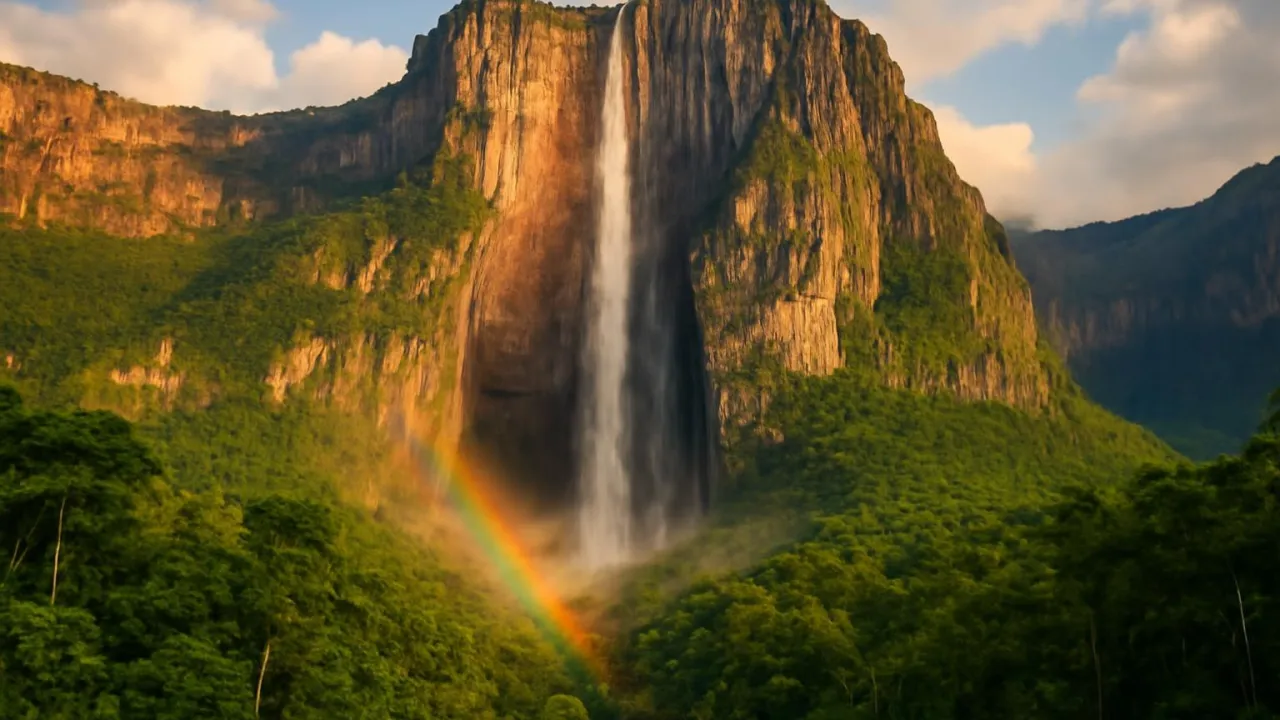
The water at Angel Falls falls for almost one full kilometer!
✨ Word Sparks (Grade 2 Glossary)
Tap 🔊 to hear
cliff
A high, steep rock edge
skyscraper
A very tall city building
jungle
A thick, wild forest
🪝
What would it feel like to stand in the cool mist of the world’s tallest waterfall?
1
The Tallest Waterfall
Angel Falls drops water from a giant . The waterfall is taller than many , and the water crashes down with a loud roar. People can hear the falls from far away.
2
A Rainforest Adventure
Angel Falls is in a thick rainforest in Venezuela. Visitors ride boats and hike through the to reach the falls. Bright birds and butterflies fly all around the misty air.
3
Magic in the Mist
When sunlight hits the spray, rainbows appear over the water. The mist cools your skin, and the ground feels wet. Many people take pictures of this natural wonder.
The water at Angel Falls free-falls for 807 meters before touching the rocks below!
✨ Word Sparks (Grade 3 Glossary)
Tap 🔊 to hear
tepui
A flat-topped mountain in South America
erosion
When water or wind wears away rock
vibration
A fast, shaking movement
🪝
Imagine standing in a jungle, hearing a roaring sound—what could be making it high above the trees?
1
A Waterfall Above the Clouds
Angel Falls drops water from the edge of a towering mountain called a . Its uninterrupted plunge is the longest on Earth, making a thunderous roar as water crashes below. Mist rises high into the air, sometimes reaching the treetops. The falls are so tall that water turns to spray before reaching the river.
2
A Rainforest Journey
The falls are hidden deep in Venezuela’s Canaima National Park, surrounded by dense rainforest. Visitors travel by boat and hike through muddy trails to reach the viewpoint. Colorful birds and frogs live in the trees and near the riverbanks. The rainforest is always humid, filled with the sound of rushing water.
3
How Angel Falls Formed
Angel Falls flows from the top of Auyán-, a flat-topped mountain formed from ancient rock. Over millions of years, rainwater eroded the cliff, carving a path for the waterfall. The water vibrates as it falls, creating a misty spray and echoing sound. The falls are named after Jimmie Angel, a pilot who flew over them in 1933.
4
A Wonder of the World
Angel Falls is a UNESCO World Heritage Site, famous for its breathtaking beauty. People come from all over the world to see its powerful drop and shimmering rainbows. Scientists study the unique plants and animals living around the falls. The waterfall inspires stories and art in Venezuela and beyond.
Angel Falls is so tall that water sometimes evaporates into mist before it even reaches the ground!
✨ Word Sparks (Grade 4 Glossary)
Tap 🔊 to hear
plateau
A high, flat area of land
resonance
A deep, echoing sound
biodiversity
Many different living things in one place
🪝
What if you could stand on the edge of a mountain and watch water tumble nearly a kilometer straight down?
1
The Epic Drop of Angel Falls
Angel Falls begins at the summit of Auyán-tepui, a massive sandstone formed over two billion years ago. The waterfall’s main drop measures an astonishing 807 meters, making it the tallest uninterrupted waterfall in the world. As water leaps from the cliff, it accelerates, breaking into a fine spray before reaching the river far below. The constant vibration of falling water creates a deep, echoing rumble that can be heard throughout the rainforest.
2
A Hidden Rainforest Treasure
Located in Venezuela’s remote Canaima National Park, Angel Falls is surrounded by lush, tropical rainforest. Visitors must travel by small plane, canoe, and on foot to reach the site, making the journey an adventure in itself. The region is home to rare orchids, colorful toucans, and unique amphibians found nowhere else. The mist from the falls creates a cool, humid microclimate that supports this incredible .
3
Geology and Water Power
The flat-topped tepui mountains are made of ancient quartzite, slowly shaped by erosion over millions of years. Rainwater collects on the , then pours over the cliff, carving channels and deepening the drop. The force of the falling water produces acoustic , a powerful sound that echoes across the valley. During the rainy season, the waterfall grows wider and even more dramatic.
4
A Global Icon
Angel Falls was named after American aviator Jimmie Angel, who first flew over it in 1933. It is now a UNESCO World Heritage Site, recognized for its natural beauty and scientific importance. The falls attract explorers, scientists, and tourists from all over the world, inspiring art, films, and local legends. Angel Falls remains a symbol of Venezuela’s wild, untamed nature and the wonder of our planet’s water cycle.
1. How does Angel Falls help support rainforest life?
2. What makes the tepui mountains special?
🤯 Mind-Blowing Fact • Grade 5
Angel Falls is nearly 20 times taller than Niagara Falls and is visible from over 30 miles away on clear days!
✨ Word Sparks (Grade 5 Glossary)
Tap 🔊 to hear
quartzite
A very hard rock formed from sand
acoustic resonance
Loud sounds made by vibrating air and rock
endemic
Found only in one special place
🪝
What secrets could you uncover by tracing a single drop of rainwater from the top of a prehistoric plateau to the roaring river below?
1
A Geological Marvel: The Birth of Angel Falls
Angel Falls originates atop Auyán-tepui, one of the oldest geological formations on Earth, dating back over two billion years to the Precambrian era. The plateau is composed primarily of and sandstone, resistant rocks that have withstood eons of weathering and erosion. Rainwater accumulates on the flat summit, eventually seeking the path of least resistance over the cliff’s edge. Over countless millennia, this persistent flow has carved deep grooves and channels, shaping the waterfall’s dramatic vertical drop.
2
The Physics of a Record-Breaking Plunge
Angel Falls boasts a total height of 3,212 feet (979 meters), with a single uninterrupted drop of 2,648 feet (807 meters)—the tallest on the planet. As water leaves the plateau, gravity accelerates it rapidly, causing the stream to break into fine droplets and mist due to air resistance. The phenomenon of occurs as the falling water vibrates the air and surrounding rock, producing a thunderous soundscape that can be detected kilometers away. During the wet season, the volume of water increases dramatically, amplifying both the visual and auditory spectacle.
3
A Biodiversity Hotspot in Canaima National Park
Situated in Venezuela’s Canaima National Park, a UNESCO World Heritage Site, Angel Falls is surrounded by one of the world’s richest ecosystems. The constant spray from the falls creates a unique microclimate, supporting rare orchids, bromeliads, and amphibians found only on tepui summits. The rainforest below teems with toucans, jaguars, and hundreds of butterfly species, all adapted to the humid, misty environment. Scientists study these habitats to understand evolution and conservation in isolated, ancient landscapes.
4
Cultural Significance and Exploration
Long before Jimmie Angel’s 1933 flight brought global attention, local Pemon Indigenous communities called the falls Kerepakupai Merú, meaning 'waterfall of the deepest place.' The falls have inspired myths, art, and exploration for generations, symbolizing the wild heart of Venezuela. Reaching Angel Falls requires a challenging journey by light aircraft, riverboat, and jungle trek, making it a destination for adventurers and scientists alike. Ongoing conservation efforts aim to protect this fragile environment from tourism impacts and climate change.
5
A Global Icon of Natural Wonder
Angel Falls stands as a testament to the planet’s geological and ecological history, captivating visitors with its immense scale and beauty. Its nearly one-kilometer plunge is so high that much of the water evaporates or turns to mist before hitting the rocks below. The falls play a crucial role in the local water cycle, feeding rivers and sustaining rainforest life. As one of the world’s most iconic natural landmarks, Angel Falls continues to inspire awe, scientific discovery, and a deeper appreciation for Earth’s ancient wonders.