1. What happens when you clap inside the amphitheatre?
2. What shape is the amphitheatre?
🤯 Mind-Blowing Fact • Grade 2
This amphitheatre is almost as tall as a 10-story building!
✨ Word Sparks (Grade 2 Glossary)
Tap 🔊 to hear
stadium
A big place for crowds
stone
A hard, solid rock
ancient
Very, very old
🪝
What would it feel like to stand where crowds once cheered?
1
A Giant Stone Stadium
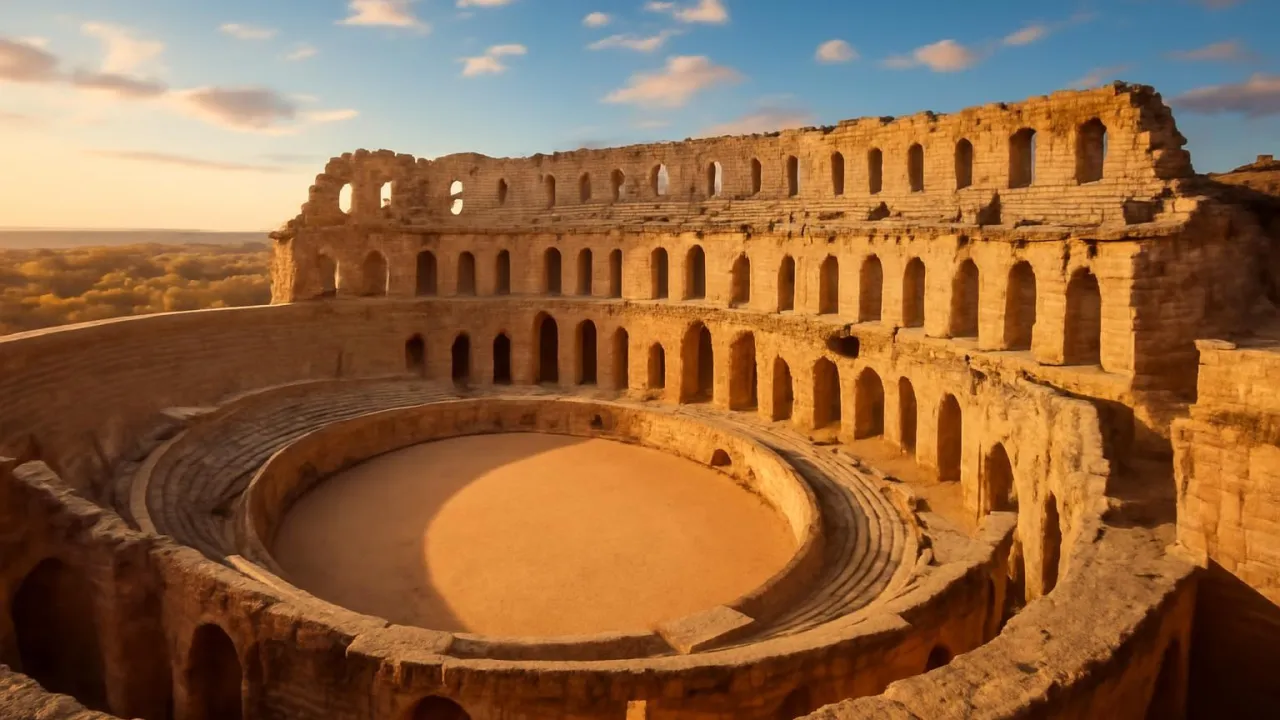
The Amphitheatre of El Jem is shaped like a huge circle. It was built from big blocks of , stacked high and strong. People long ago watched shows and games here.
2
Echoes and Arches
If you shout, your voice echoes around the arena. The tall arches make the sound bounce back to your ears. This made it easy for crowds to hear the action.
3
Visitors from Everywhere
Today, people from all over the world come to visit. They walk under the arches and take photos of the . The amphitheatre still stands in the hot Tunisian sun.
The amphitheatre’s arena is longer than a football field!
✨ Word Sparks (Grade 3 Glossary)
Tap 🔊 to hear
acoustic
How sound moves in a place
gladiator
A fighter in Roman shows
limestone
A pale rock used for building
🪝
Imagine your footsteps echoing where gladiators once battled—can you picture the crowd’s roar?
1
A Marvel of Ancient Engineering
The Amphitheatre of El Jem was built almost 1,800 years ago by the Romans. Its oval shape and tall stone arches made it strong and beautiful. Workers used blocks, stacking them without any modern machines. The amphitheatre could hold up to 35,000 people at once.
2
How Sound Travels Here
The arena’s design creates amazing effects. When someone speaks or claps, vibrations bounce off the curved walls. This makes sounds travel far, so even people sitting high could hear. The arches and open roof helped the crowd’s cheers fill the air.
3
A Place for Spectacles
In Roman times, crowds gathered to watch games and wild animal shows. The arena floor was covered with sand to soak up spills and noise. Today, visitors walk where ancient fans once cheered and performers amazed the crowd.
4
A Landmark for All
El Jem’s amphitheatre is now a UNESCO World Heritage Site. People visit from around the world to see its grand arches and learn its history. The sun makes the golden stones glow in the Tunisian landscape. It remains the largest ancient amphitheatre in Africa.
1. Why did Romans build the amphitheatre in an oval shape?
2. What helped sounds travel in the arena?
🤯 Mind-Blowing Fact • Grade 4
Some original Roman stairways and underground tunnels are still safe to explore today!
✨ Word Sparks (Grade 4 Glossary)
Tap 🔊 to hear
symmetry
When both sides match perfectly
tier
A level or row of seats
preservation
Keeping something safe and lasting
🪝
What secrets can the ancient stones of El Jem reveal if you listen closely?
1
Stone Giants of the Roman World
Rising above the Tunisian plains, the Amphitheatre of El Jem stands as a testament to Roman engineering. Built around 238 CE, it was constructed entirely from limestone blocks, some weighing several tons each. The amphitheatre’s oval design, with three of arches, allowed it to seat about 35,000 spectators. Its massive size made it the largest Roman amphitheatre in Africa and one of the biggest in the world.
2
Acoustics and Architecture
The amphitheatre’s architecture was carefully planned to create powerful acoustics. The curved walls and tiered seating allowed sound vibrations to travel efficiently, so even whispers could be heard far away. The arches acted like giant sound reflectors, bouncing cheers and shouts throughout the arena. Engineers used geometry and to make sure everyone could see and hear the action.
3
Life in the Arena
In ancient times, the arena hosted gladiator battles, animal hunts, and dramatic performances. The floor was covered with sand to absorb blood and noise, while underground passages allowed animals and fighters to appear dramatically. Today, visitors can walk through these same tunnels and stand where Roman crowds once gathered in excitement.
4
A Lasting Legacy
Now protected as a UNESCO World Heritage Site, the Amphitheatre of El Jem is a symbol of Tunisia’s rich history. Its helps us understand Roman society, architecture, and entertainment. Tourists from all over the globe visit to admire its golden stones and learn about its past. The amphitheatre continues to inspire awe, connecting us to ancient times through its enduring presence.
1. How did Roman engineers help everyone hear inside the amphitheatre?
2. What can visitors explore today at El Jem?
🤯 Mind-Blowing Fact • Grade 5
Engineers estimate the amphitheatre used over 100,000 cubic meters of stone—enough to build a small town!
✨ Word Sparks (Grade 5 Glossary)
Tap 🔊 to hear
vault
A curved ceiling made of stones
erosion
Wearing away by wind or water
conservationist
A person who protects old places
🪝
If you could step into the arena at El Jem, what echoes of history would you hear beneath your feet?
1
A Colossal Monument of Roman Africa
The Amphitheatre of El Jem rises dramatically above the plains of Tunisia, representing one of the grandest feats of Roman architecture outside Italy. Constructed around 238 CE during the reign of Emperor Gordian, it was built entirely from locally quarried limestone and assembled without mortar, relying on precise stone-cutting and gravity. The amphitheatre’s elliptical design measures 427 feet (131 meters) long and 345 feet (105 meters) wide, with the outer wall soaring 118 feet (36 meters) high. Its sheer scale allowed it to accommodate up to 35,000 spectators, rivaling the famous Colosseum in Rome.
2
Advanced Engineering and Acoustics
Roman engineers designed the amphitheatre with a sophisticated understanding of acoustics and crowd management. The three-tier system of arches and distributed weight evenly, preventing collapse even after centuries of and earthquakes. The precise geometry of the oval arena and the careful placement of stone seats allowed sound waves to be reflected and amplified, ensuring that even the faintest voice could be heard throughout the structure. Underground passages, trapdoors, and lifts enabled dramatic entrances for gladiators and animals, adding to the spectacle.
3
Life and Spectacle in the Ancient World
During its peak, El Jem’s amphitheatre was the center of public entertainment, hosting gladiatorial contests, wild animal hunts, and even mock naval battles when the arena was flooded. The sand-covered floor absorbed blood and noise, while a complex system of corridors and cages beneath the arena allowed for surprise appearances. These events were not just for amusement; they demonstrated Roman power and unity, bringing together people from across the region.
4
Survival, Preservation, and Global Importance
Despite centuries of neglect, earthquakes, and stone removal for other buildings, much of El Jem’s amphitheatre remains intact. Its preservation is a testament to Roman engineering and the dedication of modern . In 1979, it was designated a UNESCO World Heritage Site, highlighting its value as a record of ancient urban life, architectural innovation, and cultural exchange between Africa and Rome.
5
Legacy and Modern Inspiration
Today, the amphitheatre continues to inspire architects, historians, and visitors from around the world. It serves as a venue for concerts and festivals, demonstrating the enduring power of its design and acoustics. The structure’s resilience and beauty remind us of the ingenuity of ancient civilizations and the importance of preserving our shared heritage. Exploring El Jem offers a tangible connection to the past, inviting each visitor to imagine the voices and stories that once filled its sunlit arena.