🇺🇸 U.S. HISTORY
🏛️ Founding Era Advisor, Writer & Second First Lady • 1744–1818
VA History & Social Science SOL K.1, 1.2, 2.4, VS.1–VS.10, USI & USII
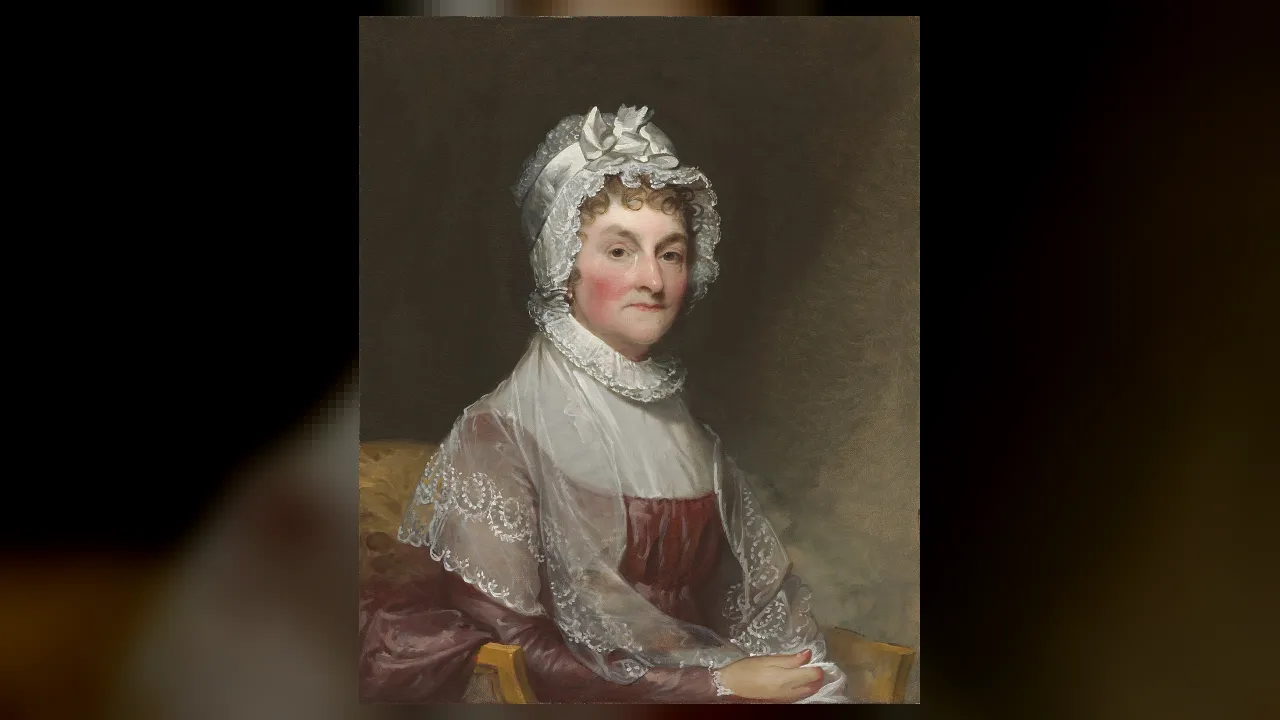
Abigail Adams
Founding Thinker Who Urged America to Remember the Ladies
Grade 1 • Early Reader • 70 words
⏳ Era / Statehood1744–1818 • American Revolution & Early Republic (First Lady 1797–1801)
🗺️ Region / CapitalWeymouth & Quincy, Massachusetts & Washington, D.C.
📜 Key MilestoneWrote over 1,100 historic letters & championed women's rights and education
⚡ Historical SparkAdvised President John Adams, opposed slavery, and urged Founders to 'Remember the Ladies'
🤯 Mind-Blowing Fact • Grade 1
When Abigail Adams moved into the unfinished White House in November 1800, she hung laundry to dry inside the giant East Room to keep clothes clean!
✨ Word Sparks (Grade 1 Glossary)
Tap 🔊 to hear
quill
A bird feather used as a pen
advisor
A wise helper who gives good counsel
White House
The home where the U.S. President lives
🪝
How did letters written with a feather pen help shape a brand-new country?
1
A Girl Who Loved Books
Long ago, most girls did not go to school. Young Abigail read stacks of books in her father's big library at home!
2
Remember the Ladies
Her husband, John Adams, went away to help start America. Abigail ran their Massachusetts farm and wrote smart letters asking leaders to make fair laws for women too.
3
Moving Into the White House
When John became the second president, Abigail became the very first First Lady to live in the brand-new !
1. How did young Abigail Adams learn so much when girls could not attend formal schools?
2. Which famous house did Abigail and John Adams move into first in November 1800?
🤯 Mind-Blowing Fact • Grade 2
Abigail Adams melted down some of her own pewter dinner spoons to help make musket supplies for American minutemen defending Massachusetts!
✨ Word Sparks (Grade 2 Glossary)
Tap 🔊 to hear
correspondence
Letters written back and forth between people
finances
Managing money, savings, and farm accounts
pewter
A soft gray metal used for dishes
🪝
Why did John Adams call his wife Abigail his 'Dearest Friend' and most trusted partner?
1
Running the Farm During War
Imagine watching smoky battle clouds rise over Bunker Hill right from a hilltop near your Massachusetts home! While John Adams traveled to Philadelphia and Europe for nearly ten years during the American Revolution, Abigail raised four children, educated them at home, and managed the family farm and .
2
More Than a Thousand Letters
John and Abigail mailed over 1,100 letters back and forth, beginning them with 'My Dearest Friend.' In March 1776, months before the Declaration of Independence, Abigail wrote urging Congress to 'Remember the Ladies' with fairer laws and better schools for girls.
3
Mother and Wife of Presidents
Abigail served as First Lady when John became our second president, and their son John Quincy Adams later became America's sixth president!
1. What famous three-word request did Abigail Adams write to John Adams in March 1776?
2. Which son of Abigail and John Adams grew up to become the sixth President of the United States?
🤯 Mind-Blowing Fact • Grade 3
For more than 200 years, Abigail Adams was the only woman in American history to be both the wife of one U.S. President and the mother of another—until Barbara Bush in 2001!
✨ Word Sparks (Grade 3 Glossary)
Tap 🔊 to hear
parsonage
A house provided for a church minister
inflation
When prices of everyday goods rise quickly
republic
A country governed by elected citizen leaders
🪝
What happens when a First Lady cares so deeply about fair government that critics nickname her 'Mrs. President'?
1
An Eager Mind in Weymouth
Picture a cozy Massachusetts in the 1750s where young Abigail Smith curls up beside the hearth reading William Shakespeare, ancient Roman history, and Enlightenment thinkers! Although colonial schools rarely admitted girls, her minister father and grandmother encouraged her curiosity. When she married young lawyer John Adams in 1764, part of their wedding luggage was a horse-cart loaded with books!
2
Witness to Revolution
In June 1775, holding seven-year-old John Quincy's hand atop Penn's Hill in Braintree, Massachusetts, Abigail watched cannon smoke billow from the Battle of Bunker Hill and opened her doors to refugees and hungry soldiers. Managing farm harvests and wartime skillfully, she kept the household thriving throughout John's long diplomatic missions.
3
Championing Women's Education and Abolition
Across more than 1,160 surviving letters with John, Abigail shared frank political counsel. On March 31, 1776, she urged Congress to 'Remember the Ladies, and be more generous and favorable to them than your ancestors!' She also spoke out firmly against slavery, writing that all humans shared equal desire for freedom, and insisted a needed educated mothers and daughters as much as educated sons.
4
First Resident of the White House
Serving as First Lady from 1797 to 1801, Abigail moved into the damp, unfinished Executive Mansion in Washington, D.C., in November 1800, establishing dignified traditions for every president's family to follow.
1. From where did Abigail Adams and young John Quincy Adams watch the smoke of the Battle of Bunker Hill in June 1775?
2. What view did Abigail Adams consistently express about slavery and girls' education in her letters?
🤯 Mind-Blowing Fact • Grade 4
While managing family finances during the Revolution, Abigail Adams bought government war bonds at her own wise judgment—earning steady returns that paid for the Adams family estate, Peacefield, in Quincy, Massachusetts!
✨ Word Sparks (Grade 4 Glossary)
Tap 🔊 to hear
coverture
Old law placing wives' property under husbands
bond
A certificate lending money to support government
blockade
Ships closing a harbor to stop trade
🪝
Why do historians treasure the 1,160 letters between Abigail and John Adams as one of the richest windows into the Founding of the United States?
1
Intellectual Partnership From the Start
Unfold a crisp rag-paper letter dated March 31, 1776, from Braintree, Massachusetts, addressed to Delegate John Adams at the Second Continental Congress in Philadelphia. Its author, thirty-one-year-old Abigail Smith Adams, writes amid epidemic smallpox, British naval , and spring farm planting—yet her mind focuses squarely on constitutional justice. Self-educated in her father Reverend William Smith's extensive Weymouth library, Abigail married John in 1764, forging an intellectual and civic partnership unmatched in Founding-era correspondence.
2
'Remember the Ladies' and Moral Consistency
Anticipating by three months Congress's July 1776 break with Britain, Abigail challenged lawmakers drafting new republican laws to reform English ''—under which married women could neither control property nor vote: 'In the new Code of Laws which I suppose it will be necessary for you to make I desire you would Remember the Ladies... Do not put such unlimited power into the hands of the Husbands.' Equally forthright against human bondage, she questioned how colonists could proclaim liberty while tolerating slavery, and later in 1797 defended a young free African American servant named James whom she enrolled in a Philadelphia evening school.
3
Economic Steward and European Diplomat
While John served nearly a decade in Philadelphia, Paris, Amsterdam, and London, Abigail managed the Quincy homestead, invested wisely in depreciated government —securing the family's financial independence despite a married woman's legal constraints—and joined John in Paris and London from 1784 to 1788, befriending young Thomas Jefferson and mentoring his daughters.
4
Shaping the Presidency and White House
During John's presidency (1797–1801), Abigail read cabinet drafts, monitored newspapers, and in November 1800 inaugurated life inside the unfinished President's House along the Potomac, lighting thirteen fireplaces against Potomac dampness while reminding citizens that learning and virtue must be cultivated in every generation.
1. What colonial legal rule was Abigail Adams challenging in her March 1776 'Remember the Ladies' letter?
2. What action did Abigail Adams take in Philadelphia in 1797 when a schoolmaster questioned admitting a free Black youth named James to evening classes?
🤯 Mind-Blowing Fact • Grade 5
Despite English common law giving husbands legal ownership of all household property, Abigail Adams kept an informal fund of returns from her shrewd bond investments that she proudly called 'my own pocket money,' using it generously to aid neighbors in need!
✨ Word Sparks (Grade 5 Glossary)
Tap 🔊 to hear
extant
Still surviving and preserved today
acumen
Sharp judgment in making smart decisions
ardor
Warm enthusiasm and eager dedication
🪝
How did Abigail Adams apply the natural-rights logic of 1776 to challenge coverture, slavery, and unequal female education decades ahead of organized reform movements?
1
Self-Directed Enlightenment Scholarship in Colonial Massachusetts
Step into the study at Peacefield in Quincy, Massachusetts, where bound volumes of John Locke, Charles Rollin, Montesquieu, and Alexander Pope line shelves consulted daily by Abigail Smith Adams. Born in Weymouth in November 1744 to Congregationalist minister William Smith and Elizabeth Quincy, frail childhood health kept Abigail from dames' schools, yet open access to family libraries cultivated formidable literary precision. Marrying Braintree attorney John Adams in October 1764, she became not merely confidante to a Founding Father, but an incisive political analyst whose more than 1,160 letters with John constitute an unrivalled primary chronicle of the Revolutionary and Federalist eras.
2
Natural Rights Applied to Coverture and Slavery
Managing household agriculture amid the Siege of Boston—witnessing the smoke of Bunker Hill from Penn's Hill alongside young John Quincy in June 1775 and inoculating herself and four children against deadly smallpox in July 1776—Abigail recognized early the universal reach of republican principles. Writing to John at Philadelphia on March 31, 1776, she turned Patriot arguments directly against English common-law coverture: 'Remember all Men would be tyrants if they could. If particular care and attention is not paid to the Ladies we are determined to foment a Rebellion, and will not hold ourselves bound by any Laws in which we have no voice, or Representation.' With equal moral clarity, she denounced slavery in 1774 as an 'iniquitous Scheme' irreconcilable with fighting for colonial liberty, and in 1797 confronted prejudice in Philadelphia to keep her free Black apprentice James Freeman enrolled in evening school.
3
Fiscal Acumen and Diplomatic Courts (1778–1788)
Throughout John's ten-year diplomatic absences in France, the Dutch Republic, and Great Britain, Abigail liquidated imported European Dry goods to hedge runaway Continental currency inflation, acquired Vermont land, and invested shrewdly in depreciated federal loan certificates that subsequently redeemed at par under Alexander Hamilton's funding plan—even specifying a personal stipend in her own control despite coverture! Joining John at Auteuil outside Paris (1784) and at the Court of St. James's in London (1785–1788), she navigated European statecraft while forming a warm bond with Thomas Jefferson and caring temporarily for his young daughter Polly.
4
Counselor to the Second President and Inaugurating the White House
During John's turbulent presidency (1797–1801) amid the Quasi-War with France, John relied more heavily on Abigail's political judgment than on his divided cabinet—prompting partisan rivals to dub her 'Mrs. President.' In November 1800, traversing muddy Virginia and Maryland roads to the unfinished federal capital on the Potomac, she became the first First Lady to inhabit the Executive Mansion, hosting diplomatic receptions with dignified republican simplicity while practical enough to dry laundry in the unplastered East Room.
5
'Learning Is Not Attained by Chance'
Retiring to Peacefield in 1801, she renewed family correspondence with Thomas Jefferson in 1804 before John and Jefferson's famous reconciliation, and mentored her son John Quincy Adams—warning him as a teenager that 'Learning is not attained by chance, it must be sought for with and attended to with diligence.'