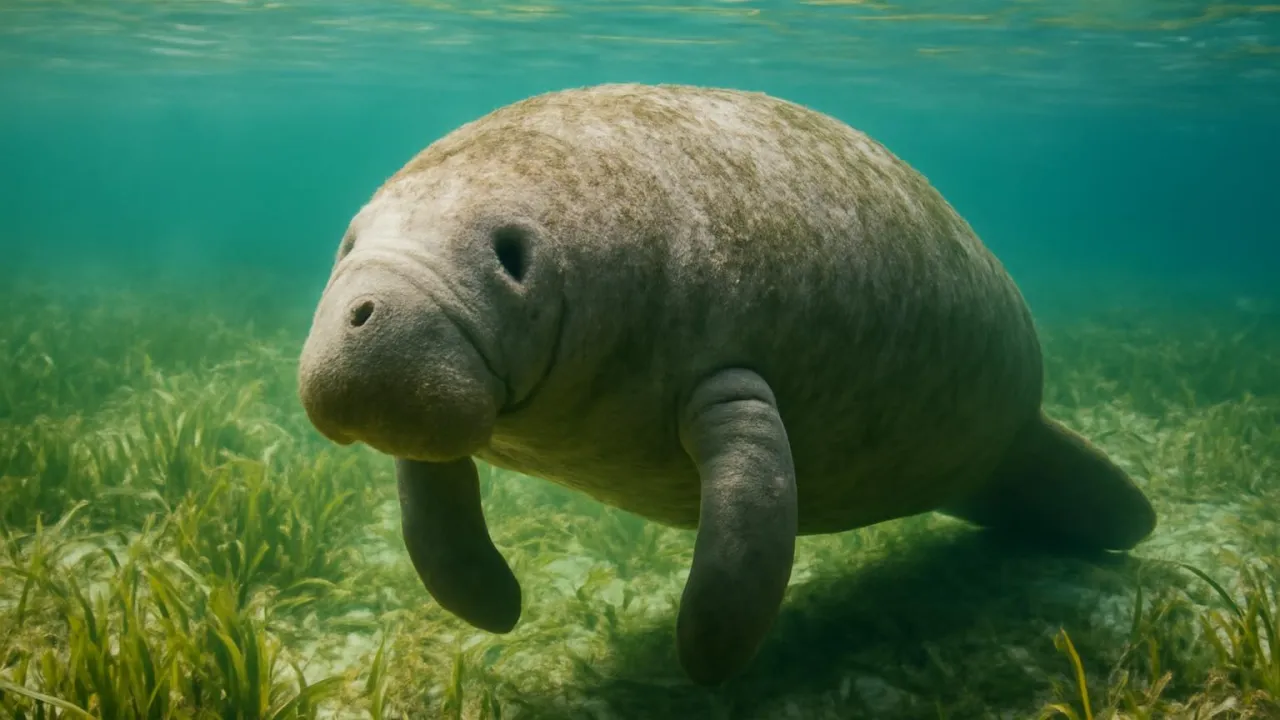
Manatees can hold their breath underwater for 20 minutes while resting!
✨ Word Sparks (Grade 2 Glossary)
Tap 🔊 to hear
herbivore
An animal that eats only plants.
estuary
A place where rivers meet the ocean.
breath
Taking air in and out to live.
🪝
Have you ever seen a gentle giant swimming slowly in the sea?
1
Slow and Big Swimmers
West Indian manatees are large animals that swim very slowly in warm water. They use their big flat tails to push through the water. Their bodies are round and covered with rough skin. Manatees can grow up to 13 feet long and weigh over 1,000 pounds.
2
Eating Underwater Plants
Manatees eat mostly sea grasses and other water plants that grow near the shore. They use their lips to grab plants and chew with strong teeth. These animals spend many hours each day eating to get enough food. They are peaceful that do not hunt other animals.
3
Where They Call Home
These manatees live in warm coastal waters of the Caribbean and southeastern United States. They prefer shallow bays, rivers, and estuaries where plants grow. Manatees breathe air and come up to the surface often. They can hold their underwater for up to 20 minutes.
Manatees replace their teeth continuously to chew tough plants all their lives!
✨ Word Sparks (Grade 3 Glossary)
Tap 🔊 to hear
camouflage
Colors and shapes that help animals hide.
herbivore
An animal that eats only plants.
metabolism
How the body uses energy to live.
🪝
Did you know manatees are sometimes called sea cows because they eat plants?
1
Gentle Giants of the Water
West Indian manatees are large aquatic mammals that move slowly through warm coastal waters. Their broad, paddle-shaped tails help them swim gracefully but slowly. Manatees have thick, wrinkled skin that protects them and helps with . These gentle giants can weigh more than 1,000 pounds and grow up to 13 feet long.
2
Plant-Eating Herbivores
Manatees are that feed mainly on sea grasses and aquatic plants. They use their flexible lips to grasp plants and chew with large molars that replace themselves throughout life. This adaptation helps manatees process tough, fibrous plants for nutrients. Their slow matches their gentle lifestyle and diet.
3
Breathing and Habitat
Manatees breathe air and surface every few minutes but can hold their breath for up to 20 minutes while resting. They live in shallow bays, rivers, and estuaries where warm water supports abundant plant life. These habitats provide food and shelter from predators like sharks and crocodiles. Manatees rely on their slow movements and to avoid danger.
4
Role in the Ecosystem
Manatees help keep aquatic plant growth balanced by grazing on sea grasses, which supports healthy ecosystems. Their feeding creates open spaces that allow other animals to thrive. Manatees also serve as indicators of water quality, as they need clean environments to survive. Protecting manatees helps preserve coastal habitats for many species.
Manatees’ unique teeth move forward like a conveyor belt to help them eat tough plants!
✨ Word Sparks (Grade 4 Glossary)
Tap 🔊 to hear
estuary
Where rivers meet the ocean's salty water.
biodiversity
Many different kinds of living things together.
conservation
Protecting animals and nature from harm.
🪝
How do gentle giants like manatees shape the health of coastal waters?
1
Slow Swimmers with Big Tails
West Indian manatees use their large, paddle-shaped tails to swim slowly but steadily through warm coastal waters where they live. Their thick, wrinkled skin provides camouflage that helps them blend with underwater plants and avoid predators. These mammals grow up to 13 feet long and weigh over 1,000 pounds, making them one of the largest sea herbivores.
2
Plant-Eating and Teeth Adaptations
Manatees are herbivores that feed on sea grasses and aquatic plants found in shallow bays and estuaries. They have special molars that move forward and fall out as new teeth grow in the back, allowing them to chew tough plants continuously. This dental adaptation is essential for processing fibrous vegetation and obtaining nutrients needed for survival.
3
Ecosystem Roles and Habitat
By grazing on sea grasses, manatees help maintain healthy aquatic ecosystems by preventing overgrowth that could harm other species. Their feeding creates open spaces that support fish and invertebrates, contributing to . Manatees live in warm coastal waters of the Caribbean and southeastern United States, where clean water and abundant plants are vital for their survival.
4
Human Impact and Conservation
Manatees face threats from boat collisions, habitat loss, and pollution caused by human activities along coasts. efforts include protected areas, boat speed limits, and rescue programs to help injured animals. Protecting manatees also preserves coastal ecosystems that benefit many other species and people who depend on healthy marine environments.
1. Why are manatees important to coastal ecosystems?
2. What human actions threaten manatees?
🤯 Mind-Blowing Fact • Grade 5
Manatees’ dense bones help them stay underwater while grazing without floating to the surface!
✨ Word Sparks (Grade 5 Glossary)
Tap 🔊 to hear
polyphyodonty
Teeth that keep growing and replacing themselves.
bioindicator
An animal that shows how healthy its home is.
buoyancy
How animals float or sink in water.
🪝
What makes the West Indian manatee a unique marine mammal in coastal ecosystems?
1
Taxonomy and Scientific Classification
The West Indian manatee, scientifically named Trichechus manatus, belongs to the order Sirenia, which includes only herbivorous marine mammals. It is divided into two subspecies: the Florida manatee and the Antillean manatee. These mammals are closely related to elephants and share some anatomical features such as dense bones. Their evolutionary history dates back millions of years adapting to aquatic herbivory.
2
Physiological Adaptations and Mechanics
Manatees have thick, dense bones that reduce and help them stay submerged while grazing underwater. Their large lungs extend along the body, aiding in buoyancy control and allowing them to hold breath for up to 20 minutes. Their paddle-shaped tails provide propulsion, while their forelimbs have nails and are used for steering and manipulating food. Continuous tooth replacement, called , enables them to chew abrasive aquatic plants efficiently.
3
Conservation Status and Human Impact
The West Indian manatee is classified as vulnerable due to threats such as boat strikes, habitat degradation, and water pollution. Conservation efforts include protected marine areas, boat speed regulations, and rehabilitation centers. Public education and legal protections have helped stabilize some populations, but ongoing habitat loss remains a significant challenge for their survival.
4
Ecological Role and Environmental Importance
Manatees play a critical role in maintaining healthy seagrass beds by grazing, which promotes plant diversity and prevents overgrowth. Their feeding activities increase nutrient cycling and create habitats for fish and invertebrates. As , manatees reflect the health of coastal ecosystems, signaling changes in water quality and habitat conditions essential for many marine species.
5
Quantitative Comparisons and Interesting Facts
Adult West Indian manatees can reach lengths of 13 feet and weigh up to 1,300 pounds, making them among the largest herbivores in marine environments. They swim at speeds up to 5 miles per hour but usually move slowly to conserve energy. Manatees can dive to depths of 20 feet and hold their breath for up to 20 minutes while resting. Their body temperature remains steady around 86°F, requiring warm water habitats to survive.