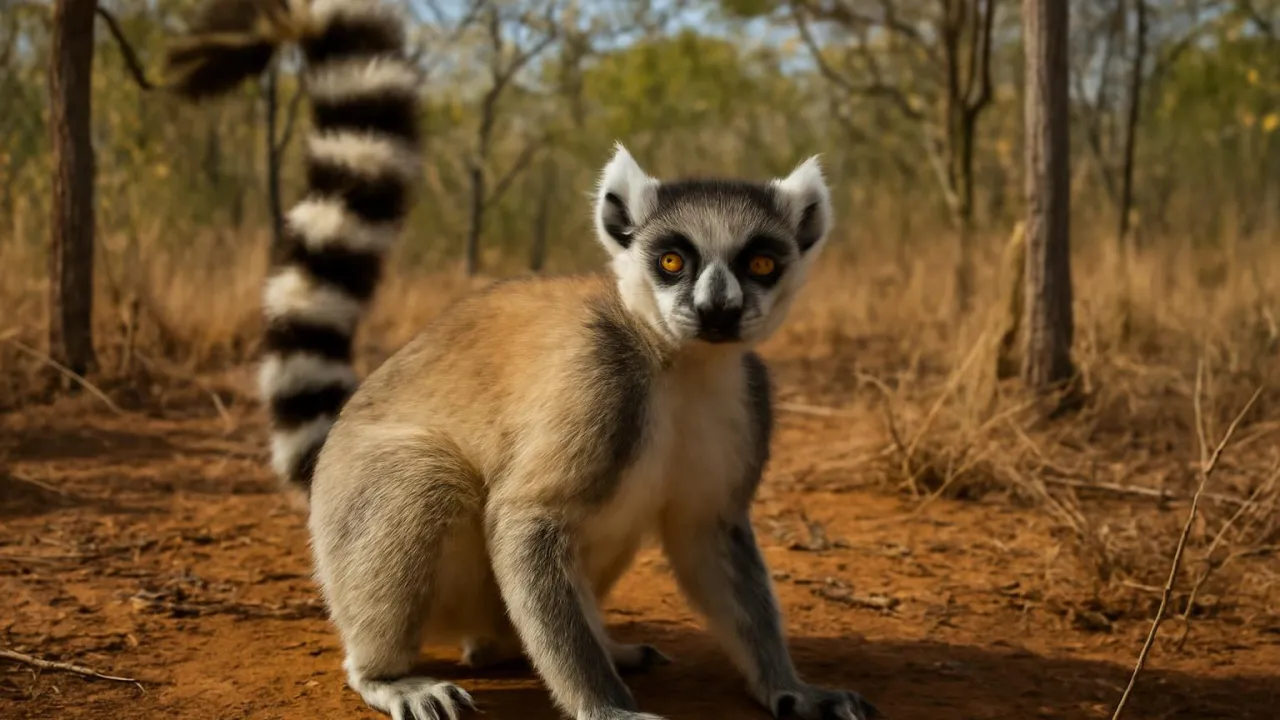
Ring-tailed lemurs have a special scent gland on their tail to mark territory.
✨ Word Sparks (Grade 2 Glossary)
Tap 🔊 to hear
signal
A sign or action that gives a message
scrubland
A dry place with small bushes and trees
territory
An area an animal protects as its home
🪝
How does a ring-tailed lemur’s tail help it talk to friends?
1
Amazing Tail Signals
Ring-tailed lemurs wave their black and white striped tails to send . They use these signals to talk to friends nearby. Their tails help them stay safe and find each other.
2
Home Sweet Home
These lemurs live in dry forests and on Madagascar Island. They climb trees and walk on the ground to find food. The warm climate helps them stay active all year.
3
Food and Fun
Ring-tailed lemurs eat fruits, leaves, flowers, and bark from trees. They spend a lot of time looking for tasty food. Their hands help them grab and hold what they eat.
Ring-tailed lemurs use their tails to send messages and mark territory with scents.
✨ Word Sparks (Grade 3 Glossary)
Tap 🔊 to hear
adaptation
A change that helps animals survive better
pollinator
An animal that helps flowers make seeds
territory
An area animals protect as their home
🪝
Why do ring-tailed lemurs have black and white rings on their long tails?
1
Tail Signals and Communication
Ring-tailed lemurs use their striped tails to communicate with others in their group. The tail’s black and white rings make it easy to see from far away. This helps lemurs stay together and warn about dangers. Their tail waving is a form of social signaling.
2
Habitat and Adaptations
These lemurs live in dry forests and scrublands of Madagascar, where water can be scarce. Their fur helps protect them from the sun and cold nights. They have strong hands and feet to climb trees and walk on rocky ground. These help them survive in a tough environment.
3
Diet and Survival
Ring-tailed lemurs eat fruits, leaves, flowers, and bark to get nutrients. They are important because they help spread pollen while feeding on flowers. Their varied diet helps them survive when some foods are scarce. Eating bark also helps them get water during dry times.
4
Social Life and Defense
Lemurs live in groups called troops that help protect each other from predators. They use scent glands on their tails to mark and warn rivals. Their loud calls and tail waving help keep the group safe. These behaviors are important for survival.
1. What helps ring-tailed lemurs stay together and warn about danger?
2. Why do lemurs eat bark sometimes?
🤯 Mind-Blowing Fact • Grade 4
Male ring-tailed lemurs use scent 'stink fights' to defend territory without fighting.
✨ Word Sparks (Grade 4 Glossary)
Tap 🔊 to hear
ecosystem
A community of plants and animals living together
territory
An area animals protect as their home
pollination
When pollen moves from flower to flower
🪝
How do ring-tailed lemurs use their tails and scents to survive in Madagascar’s forests?
1
Tail Communication and Social Behavior
Ring-tailed lemurs wave their long, black-and-white striped tails to communicate with troop members across distances. This visual signaling helps maintain group cohesion and alerts others to threats. Their tails also play a role in social displays during mating season, strengthening bonds within the group and helping them survive.
2
Habitat and Ecosystem Role
Living in Madagascar’s dry forests and scrublands, ring-tailed lemurs help maintain balance by pollinating flowers and dispersing seeds. Their diet includes fruits, leaves, flowers, and bark, which supports plant reproduction. These lemurs also serve as prey for larger predators, fitting into the food web and supporting biodiversity.
3
Scent Marking and Territorial Defense
Lemurs have scent glands on their wrists and tails that produce strong odors used to mark boundaries. Males engage in 'stink fights' by wafting scents at rivals to defend their area without fighting physically. This chemical communication helps reduce conflict and maintain social order among groups.
4
Geographic Distribution and Conservation
Ring-tailed lemurs are only found naturally on Madagascar, where habitat loss threatens their populations. Conservation efforts focus on protecting forests and educating people about lemurs’ importance. Their limited range makes them vulnerable, so preserving their habitat is critical for their survival and the island’s health.
2. Why is conserving Madagascar’s forests important for lemurs?
🤯 Mind-Blowing Fact • Grade 5
Ring-tailed lemurs combine visual tail signals and scent marking for sophisticated social communication.
✨ Word Sparks (Grade 5 Glossary)
Tap 🔊 to hear
endemic
Animals found only in one special place
pheromone
A smell animals use to send messages
hierarchy
A system where some animals lead others
🪝
What makes the ring-tailed lemur’s tail a key tool for communication and survival in Madagascar?
1
Taxonomy and Scientific Context
The ring-tailed lemur, scientifically named Lemur catta, belongs to the primate family Lemuridae. This species is to Madagascar, meaning it is found nowhere else in the world. It is one of the most recognized lemurs due to its distinctive black and white ringed tail. Their evolutionary history dates back millions of years, adapting uniquely to Madagascar’s environments.
2
Physiological Mechanics of Tail Use
Ring-tailed lemurs use their tails not only for balance but also for complex social communication. The tail’s contrasting black and white rings provide high visibility during group movements and warning signals. Additionally, scent glands located on their wrists and tails produce used in marking territory and social dominance. This combination of visual and chemical signals is vital for troop cohesion.
3
Conservation Status and Human Impact
Currently listed as endangered, ring-tailed lemurs face threats from habitat destruction and hunting. Madagascar’s deforestation reduces available habitat, fragmenting populations and limiting genetic diversity. Conservation programs include habitat protection, captive breeding, and community education to promote coexistence. Understanding their ecological role helps prioritize their protection.
4
Ecological Role and Quantitative Comparisons
Ring-tailed lemurs contribute to seed dispersal and pollination, supporting Madagascar’s unique flora. Adults weigh between 5.5 and 7.7 pounds (2.5 to 3.5 kilograms) and measure about 16 to 18 inches (40 to 46 centimeters) in body length. They can run up to 15 miles per hour (24 kilometers per hour) to escape predators. Their tails can be nearly as long as their bodies, measuring up to 24 inches (60 centimeters).
5
Behavioral Ecology and Social Dynamics
Socially, ring-tailed lemurs live in troops of up to 30 individuals with female dominance hierarchies. Males engage in 'stink fights' by rubbing scent glands and waving tails to assert dominance without physical combat. Group vocalizations include alarm calls and contact calls that maintain social bonds. These complex behaviors demonstrate advanced adaptation to their environment.