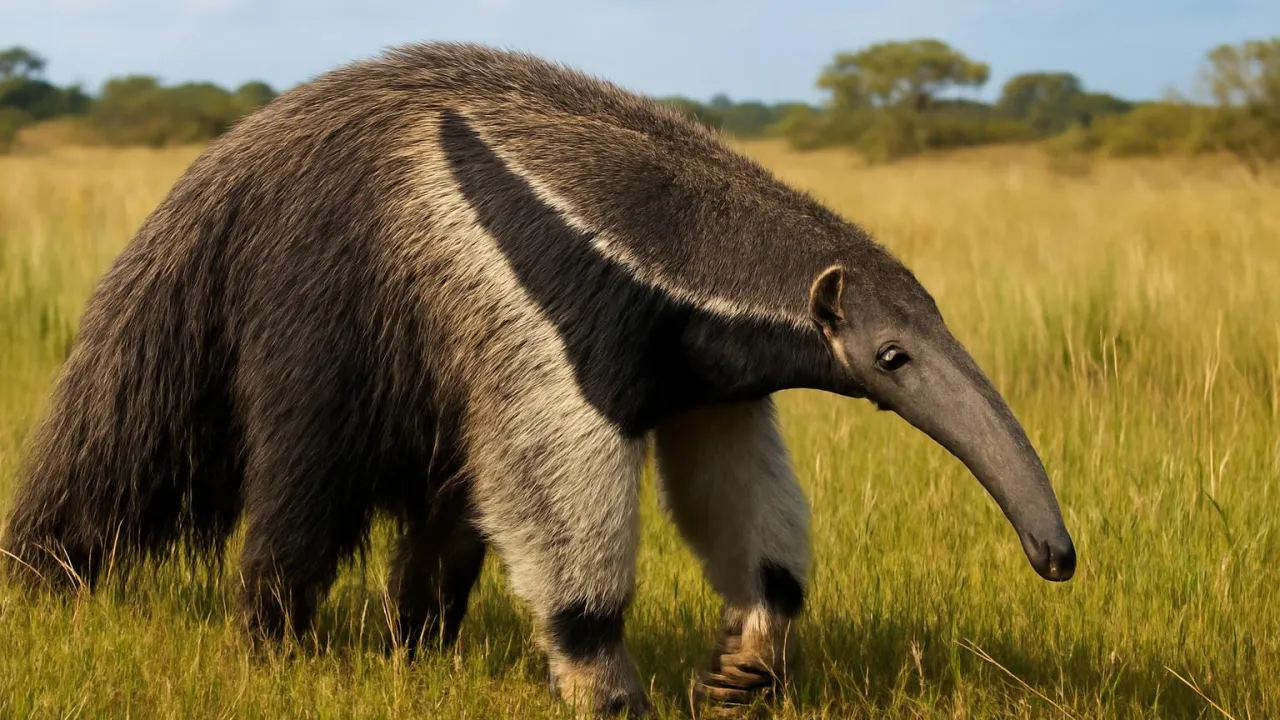
Giant anteaters flick their tongues up to 150 times per minute to catch ants fast!
✨ Word Sparks (Grade 2 Glossary)
Tap 🔊 to hear
claws
Sharp nails on animal feet for digging or fighting
termite
Small insect that lives in wood and soil
fur
Thick hair that covers an animal’s body
🪝
How does a giant anteater catch tiny ants with its long tongue?
1
Long Nose and Tongue
The giant anteater has a very long nose and tongue. It can flick its tongue 150 times per minute. This helps it catch many ants quickly. The tongue is sticky to hold the ants well.
2
Where It Lives
Giant anteaters live in grasslands and forests in Central and South America. They like places with many ants and . They use their strong to dig into ant hills. They walk slowly but can stand tall to look around.
3
Big Body and Fur
They have thick, coarse that protects them from insect bites. Their bodies can grow up to eight feet long. They have big front used for defense and digging. They are mostly active during the day or night.
1. Why does the giant anteater flick its tongue so fast?
2. Where do giant anteaters live?
🤯 Mind-Blowing Fact • Grade 3
A giant anteater’s tongue can be longer than its head and flick 150 times per minute!
✨ Word Sparks (Grade 3 Glossary)
Tap 🔊 to hear
adaptation
A body change that helps animals survive better
camouflage
Colors or shapes that help animals hide
nutrients
Food parts that help animals grow strong
🪝
Did you know the giant anteater uses its long tongue to solve a big survival challenge?
1
Amazing Tongue Adaptation
The giant anteater’s tongue can flick in and out 150 times per minute to catch ants. Its tongue is sticky and very long, sometimes reaching two feet. This helps it gather food quickly without hurting itself. The tongue’s speed and stickiness solve the problem of eating tiny, fast insects.
2
Habitat and Diet
Giant anteaters live in grasslands and tropical forests of Central and South America. They mainly eat ants and termites, which provide important . Their strong claws help them break into insect nests. This specialized diet makes them key players in controlling insect populations.
3
Body and Camouflage
Their thick fur protects them from insect bites and helps with in dry grass. The black and white markings break up their shape, hiding them from predators. Their long snout and bushy tail are also important for survival. These physical features are to their environment.
4
Behavior and Defense
Giant anteaters walk slowly but can stand tall to scan for danger. They use their sharp front claws for defense against predators. When threatened, they can deliver strong swipes that cause serious injury. Their slow movements and help avoid fights whenever possible.
1. How does the giant anteater’s tongue help it survive?
2. Why is camouflage important to the giant anteater?
🤯 Mind-Blowing Fact • Grade 4
Giant anteaters help keep ecosystems healthy by controlling thousands of ants and termites every day!
✨ Word Sparks (Grade 4 Glossary)
Tap 🔊 to hear
symbiosis
A helpful relationship between two living things
ecosystem
All plants and animals living in one place
territory
An area where an animal lives and finds food
🪝
How do giant anteaters play an important role in their ecosystems with their unique features?
1
Tongue Mechanics and Feeding
The giant anteater’s tongue can flick up to 150 times per minute, allowing it to consume thousands of ants and termites daily. This rapid tongue movement is powered by specialized muscles and saliva that makes the tongue sticky. By feeding on insects, anteaters help control pest populations and maintain balance in their habitats. Their long snout and sticky tongue are key adaptations for this feeding strategy.
2
Ecosystem Role and Symbiosis
Giant anteaters play a vital role in food webs by reducing insect numbers, which benefits plants and other animals. They have a symbiotic relationship with their environment because controlling ants and termites prevents damage to trees and crops. However, habitat loss threatens their populations, affecting health. Protecting giant anteaters helps preserve biodiversity and ecosystem stability.
3
Geographic Range and Habitat
These animals inhabit grasslands, savannas, and tropical forests across Central and South America, from Honduras to northern Argentina. They prefer areas with abundant ant and termite nests and require large territories for foraging. Human activities like deforestation and road building fragment their habitats, making survival more difficult. Conservation efforts focus on habitat protection and reducing human-wildlife conflicts.
4
Defense and Behavior
Giant anteaters use their powerful front claws to defend themselves against predators like jaguars and pumas. When threatened, they stand on their hind legs and deliver strong swipes with their claws. Their slow movements and camouflage help avoid detection, reducing the need for fighting. These behaviors are essential for survival in predator-rich environments.
1. Why are giant anteaters important to their ecosystems?
2. How do giant anteaters defend themselves?
🤯 Mind-Blowing Fact • Grade 5
Giant anteaters consume over 30,000 ants and termites every day using their 2-foot-long sticky tongues!
✨ Word Sparks (Grade 5 Glossary)
Tap 🔊 to hear
insectivore
An animal that eats mostly insects
metabolism
How an animal uses energy to live
conservation
Protecting animals and their homes
🪝
What makes the giant anteater a unique insectivore with specialized anatomy and ecological importance?
1
Taxonomy and Scientific Classification
The giant anteater, scientifically named Myrmecophaga tridactyla, belongs to the order Pilosa and family Myrmecophagidae. It is the largest species of anteater and is closely related to sloths. This mammal is classified as a specialized due to its diet exclusively of ants and termites. Its evolutionary adaptations reflect a long history of niche specialization in Neotropical ecosystems.
2
Physiology and Tongue Mechanics
The anteater’s tongue is anchored to its sternum and can extend up to 60 centimeters, flicking approximately 150 times per minute. This rapid movement is enabled by unique muscular and skeletal structures, along with sticky saliva that captures prey efficiently. The tongue’s length and speed allow the anteater to exploit insect nests without damaging its snout. Its powerful forelimbs with curved claws assist in breaking open termite mounds.
3
Conservation Status and History
The giant anteater is currently listed as Vulnerable due to habitat loss, road mortality, and hunting pressures. efforts focus on habitat preservation and creating wildlife corridors to reduce fragmentation. Historically, indigenous peoples recognized the anteater’s role in controlling insect pests. Modern conservation programs also emphasize community education to protect this unique mammal.
4
Ecological Role and Quantitative Impact
Giant anteaters consume an estimated 30,000 to 35,000 ants and termites daily, significantly influencing insect population dynamics. Their foraging behavior helps maintain soil health by aerating the ground during digging. They inhabit territories ranging from 2 to 5 square kilometers, requiring large areas to find sufficient food. Their slow and low body temperature, around 32 degrees Celsius, are adaptations to their specialized diet.
5
Comparative Anatomy and Behavior
Compared to other , giant anteaters have longer tongues and more powerful forelimbs. They can weigh between 40 to 90 kilograms and measure up to 2.4 meters in length. Their solitary and crepuscular behavior helps reduce competition and predation risk. Unlike many mammals, they lack teeth and rely entirely on their tongue and claws for feeding and defense.