Chimpanzee
The Clever Forest Acrobat
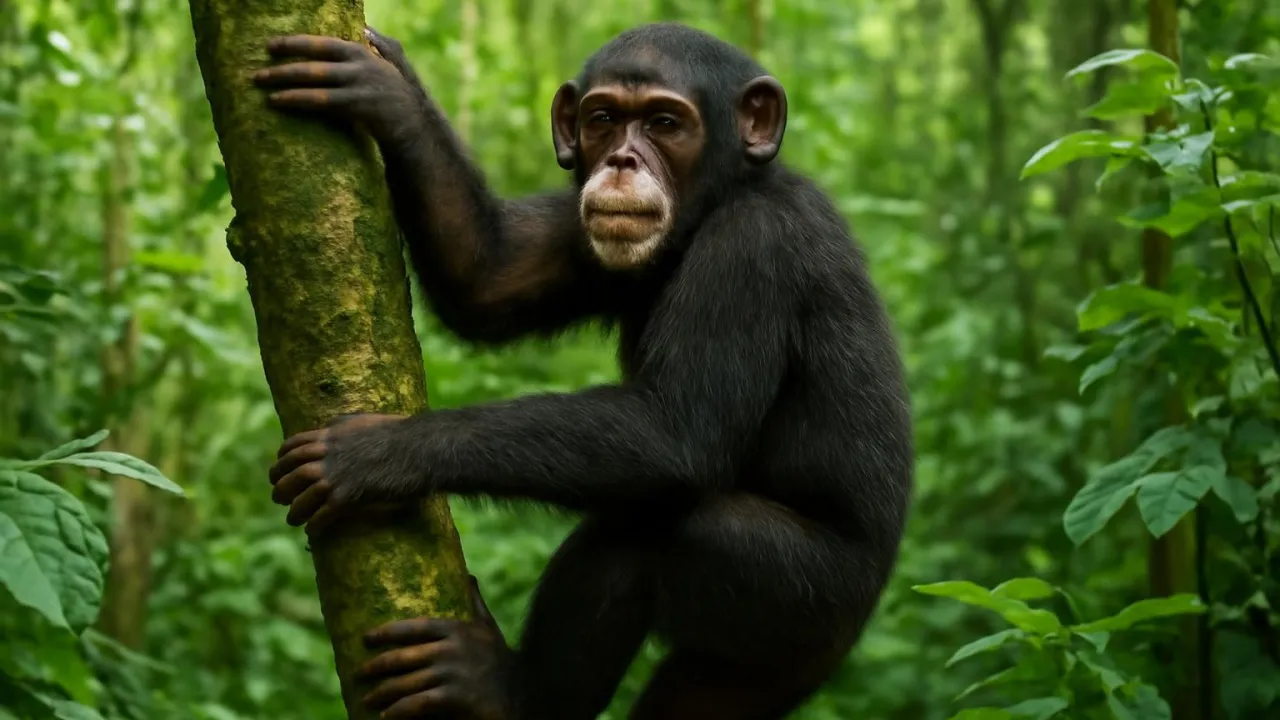
A chimpanzee can remember a sequence of nine numbers faster than most adult humans!
1 Chimpanzee Science: Our Closest Living Relatives
Chimpanzees, classified as Pan troglodytes, are primates and share about 98.7% of their DNA with humans, making them our closest living relatives. They belong to the Hominidae family, which also includes gorillas and orangutans, and are divided into four subspecies across Central and West Africa. Chimpanzees display remarkable intelligence, using memory, reasoning, and even empathy in their daily lives. Scientists study chimps to learn more about human evolution, behavior, and brain development. The similarities between chimpanzee and human social structures are astonishing, including complex family bonds and cultural traditions.
2 Anatomy Built for the Forest Canopy
A chimpanzee’s body is perfectly adapted for life in the trees, with long, powerful arms that are one and a half times longer than their legs. Their opposable thumbs and big toes allow them to grasp branches and objects with great precision, while their strong shoulder muscles support swinging and climbing. Adult males can weigh up to 130 pounds (59 kg) and stand about 4 feet (1.2 meters) tall, but they are much stronger than humans of the same size. Chimpanzees have thick black hair covering most of their bodies, except for their faces, ears, palms, and soles. Their keen eyesight and sense of hearing help them spot danger and communicate with others in dense forests.
3 Tool Use: Intelligence in Action
Chimpanzees are one of the few non-human animals that make and use tools, showing advanced problem-solving skills. They strip leaves from sticks to create termite-fishing rods, use stones as hammers and anvils to crack nuts, and even fashion leaf sponges to soak up drinking water. Tool use is not instinctive but learned, passed from mothers to offspring through careful observation and practice. Some chimpanzee groups have unique tool traditions, a sign of animal culture rarely seen outside humans. Researchers have observed chimps using up to 39 different types of tools in the wild, far more than any other animal except humans.
4 Chimpanzees and the Forest Ecosystem
Chimpanzees play a crucial ecological role by dispersing seeds in their droppings, which helps regenerate forests and maintain plant diversity. They control insect populations by eating termites, ants, and other bugs, balancing the food web. Chimpanzees live in fission-fusion societies, where group size and membership change frequently based on food availability and social needs. Their social lives are rich, with alliances, rivalries, and even political strategies among adults. However, habitat loss from logging, farming, and mining, along with illegal hunting, has caused wild chimpanzee populations to decline by more than 65% in the last 50 years.
5 Conservation and the Future of Chimps
Chimpanzees are now listed as by the International Union for Conservation of Nature (IUCN), with only about 170,000–300,000 left in the wild. Conservation efforts include protecting forests, creating wildlife corridors, and educating local communities about the importance of chimps. Scientists also work with governments to stop illegal hunting and the pet trade, which threaten chimpanzees’ survival. Sanctuaries care for orphaned or rescued chimps, helping them recover and sometimes return to the wild. By studying chimpanzees, we learn not only about their world but also about our own place in nature. Protecting chimpanzees means preserving and the health of entire ecosystems for future generations.
1. Why do scientists compare chimpanzee and human DNA?
2. How do chimpanzees help forests grow?