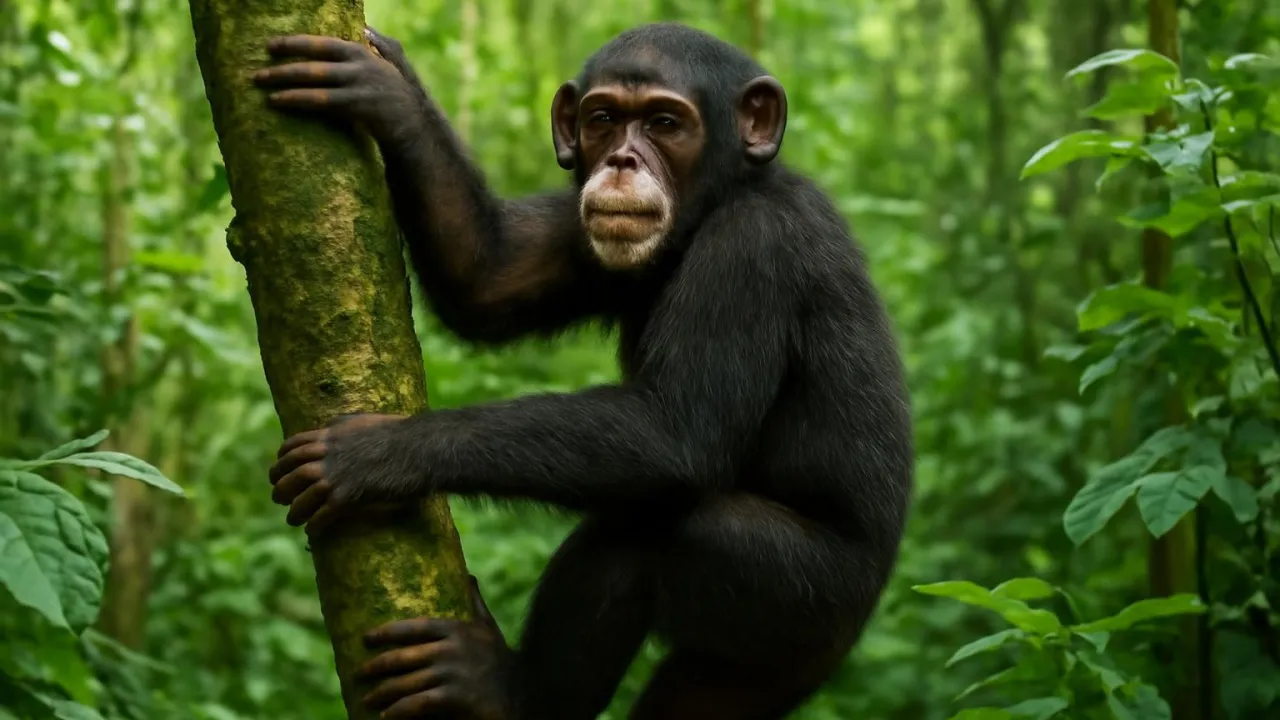
Chimps can learn to use simple sign language to talk!
✨ Word Sparks (Grade 2 Glossary)
Tap 🔊 to hear
community
A group living and working together
protein
A nutrient that helps bodies grow
signal
A way to send a message
🪝
Did you know chimps can use tools like us?
1
Amazing Tree Movers
Chimpanzees have long arms, so they swing easily from branch to branch. Their strong hands help them hold on tightly as they climb. Chimps move quickly through the trees and can even walk on the ground. They use their feet and hands like we use our hands.
2
What’s for Dinner?
Chimps eat many kinds of food, like fruits, leaves, and seeds. Sometimes, they eat insects or eggs for extra . Chimps use sticks to poke into ant hills and catch bugs. They share food with their friends in the group.
3
Chimpanzee Families
Chimps live together in large groups called communities. They spend time playing, grooming, and looking after each other. Chimps talk using loud hoots, grunts, and hand . They care for their babies for many years.
What animal can solve puzzles and make tools in the wild?
1
Super Smart and Strong
Chimpanzees are very intelligent and can solve tricky problems. Their long arms and grasping hands help them swing and climb easily. They use their feet to hold food or branches, just like extra hands. Chimps are much stronger than most humans their size.
2
Life in the Rainforest
Chimps live in warm African forests and woodlands with lots of trees. They build leafy nests high in the branches to sleep safely at night. Each day, chimps travel in groups to find fruits, nuts, and small animals. They use to hide from like leopards.
3
Tool Time
Chimpanzees are famous for using tools, a rare skill in the animal world. They strip leaves from sticks to fish for termites and ants. Sometimes, they use rocks to crack open nuts for food. This helps them get food that other animals cannot reach.
4
Chimpanzee Families and Communication
Chimps live in social groups called troops and care for each other. They groom to keep clean and build friendships within the troop. Chimps communicate with loud calls, hand gestures, and even facial expressions. Mothers teach young chimps important skills for survival.
A chimpanzee can remember numbers in order better than some adult humans!
✨ Word Sparks (Grade 4 Glossary)
Tap 🔊 to hear
opposable thumbs
Thumbs that touch other fingers easily
innovation
A new idea or clever way to solve problems
ecosystem
All living and nonliving things in a place
🪝
How do chimpanzees show off their amazing intelligence in the wild?
1
Brains and Brawn: The Chimpanzee Advantage
Chimpanzees are among the smartest animals on Earth, using problem-solving skills to survive. Their muscular arms and allow them to swing, climb, and grasp objects with ease. This strength helps them travel quickly through the treetops and defend themselves if threatened. Chimps can even remember where fruit trees are located over large distances.
2
Chimpanzees and Their Forest Homes
Chimps live in tropical rainforests and savannas across Central and West Africa, where food is abundant. They build new leafy nests each night high in the trees to avoid predators such as leopards and snakes. The forest provides fruits, seeds, leaves, insects, and small animals for their varied diet. When food is scarce, chimps may travel many miles in search of meals.
3
Masters of Tool Use and Communication
Chimpanzees are famous for their ability to use and even create tools for specific jobs. They carefully select and shape sticks to fish for termites or dig for honey, showing true . Chimps also use rocks as hammers to crack tough nuts, a learned behavior passed down through generations. Their communication system includes vocal calls, hand gestures, and facial expressions, allowing complex social interactions.
4
Chimpanzees in the Web of Life
Chimpanzees play a vital role in their by spreading seeds and controlling insect populations. They live in communities with strong social bonds, where grooming, sharing food, and teamwork are common. Sadly, habitat loss and hunting threaten chimpanzee populations across Africa. Conservation groups work hard to protect their forests and teach people about their importance.
A chimpanzee can remember a sequence of nine numbers faster than most adult humans!
✨ Word Sparks (Grade 5 Glossary)
Tap 🔊 to hear
fission-fusion society
A group that splits and joins often
biodiversity
The variety of living things in nature
endangered
At risk of disappearing forever
🪝
What secrets do chimpanzees share with humans—and why do scientists study them so closely?
1
Chimpanzee Science: Our Closest Living Relatives
Chimpanzees, classified as Pan troglodytes, are primates and share about 98.7% of their DNA with humans, making them our closest living relatives. They belong to the Hominidae family, which also includes gorillas and orangutans, and are divided into four subspecies across Central and West Africa. Chimpanzees display remarkable intelligence, using memory, reasoning, and even empathy in their daily lives. Scientists study chimps to learn more about human evolution, behavior, and brain development. The similarities between chimpanzee and human social structures are astonishing, including complex family bonds and cultural traditions.
2
Anatomy Built for the Forest Canopy
A chimpanzee’s body is perfectly adapted for life in the trees, with long, powerful arms that are one and a half times longer than their legs. Their opposable thumbs and big toes allow them to grasp branches and objects with great precision, while their strong shoulder muscles support swinging and climbing. Adult males can weigh up to 130 pounds (59 kg) and stand about 4 feet (1.2 meters) tall, but they are much stronger than humans of the same size. Chimpanzees have thick black hair covering most of their bodies, except for their faces, ears, palms, and soles. Their keen eyesight and sense of hearing help them spot danger and communicate with others in dense forests.
3
Tool Use: Intelligence in Action
Chimpanzees are one of the few non-human animals that make and use tools, showing advanced problem-solving skills. They strip leaves from sticks to create termite-fishing rods, use stones as hammers and anvils to crack nuts, and even fashion leaf sponges to soak up drinking water. Tool use is not instinctive but learned, passed from mothers to offspring through careful observation and practice. Some chimpanzee groups have unique tool traditions, a sign of animal culture rarely seen outside humans. Researchers have observed chimps using up to 39 different types of tools in the wild, far more than any other animal except humans.
4
Chimpanzees and the Forest Ecosystem
Chimpanzees play a crucial ecological role by dispersing seeds in their droppings, which helps regenerate forests and maintain plant diversity. They control insect populations by eating termites, ants, and other bugs, balancing the food web. Chimpanzees live in fission-fusion societies, where group size and membership change frequently based on food availability and social needs. Their social lives are rich, with alliances, rivalries, and even political strategies among adults. However, habitat loss from logging, farming, and mining, along with illegal hunting, has caused wild chimpanzee populations to decline by more than 65% in the last 50 years.
5
Conservation and the Future of Chimps
Chimpanzees are now listed as by the International Union for Conservation of Nature (IUCN), with only about 170,000–300,000 left in the wild. Conservation efforts include protecting forests, creating wildlife corridors, and educating local communities about the importance of chimps. Scientists also work with governments to stop illegal hunting and the pet trade, which threaten chimpanzees’ survival. Sanctuaries care for orphaned or rescued chimps, helping them recover and sometimes return to the wild. By studying chimpanzees, we learn not only about their world but also about our own place in nature. Protecting chimpanzees means preserving and the health of entire ecosystems for future generations.