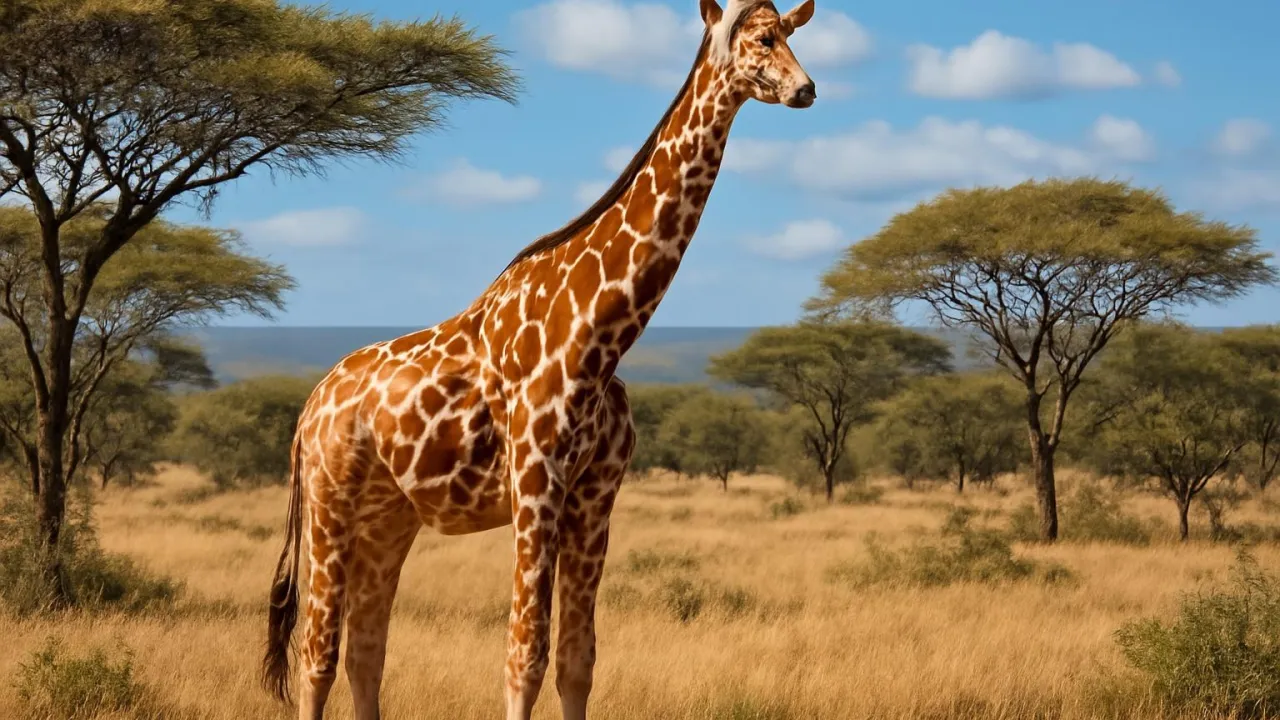
Each reticulated giraffe has a unique pattern just like a human fingerprint!
✨ Word Sparks (Grade 2 Glossary)
Tap 🔊 to hear
pattern
A design made of shapes or colors
savanna
A grassy land with few trees
tongue
The muscle inside your mouth
🪝
Have you ever wondered how giraffes eat leaves from very tall trees?
1
Amazing Patterns
Reticulated giraffes have a net-like on their skin that helps them hide. Their spots are bright brown and outlined by white lines. This pattern is unique to each giraffe and helps them blend into trees and bushes.
2
Tall and Strong
These giraffes grow very tall, up to 18 feet, which helps them reach high leaves. Their long necks have special bones that let them bend and stretch to reach food. They live in dry areas where tall trees grow.
3
Eating with a Long Tongue
Reticulated giraffes use their long, blue to grab leaves from thorny trees. Their tongues can be 18 inches long and are tough to avoid getting hurt. They eat mostly acacia leaves and drink water when they find it.
Reticulated giraffes can run up to 35 miles per hour to escape danger!
✨ Word Sparks (Grade 3 Glossary)
Tap 🔊 to hear
camouflage
Colors that help animals hide
vertebrae
Bones that make up the neck
adaptation
A body change to help survive
🪝
Did you know the reticulated giraffe’s spots help it hide from predators?
1
Camouflage with Patterns
The reticulated giraffe has a unique net-like pattern that acts as . This helps it blend into the savanna trees and bushes. Camouflage is important to hide from predators like lions. Each giraffe’s pattern is different, like a fingerprint.
2
Neck Adaptations
Giraffes have very long necks with seven special bones called . These bones let them reach leaves high in trees that other animals cannot eat. Their necks also help them watch for predators from far away. This is a great for survival.
3
Feeding and Tongue Use
Reticulated giraffes use their long, tough tongues to grab leaves from thorny acacia trees. Their tongues are about 18 inches long and help protect their mouths from sharp thorns. This feeding method is a special to get food safely.
4
Life in the Savanna
Reticulated giraffes live in dry savanna regions with scattered trees and bushes. They drink water when it is available but get most nutrients from leaves. Their height helps them reach food and avoid some predators. They play an important role in their ecosystem.
Reticulated giraffes can clean their ears with their 18-inch long tongues!
✨ Word Sparks (Grade 4 Glossary)
Tap 🔊 to hear
symbiotic
Two living things helping each other
predator
An animal that hunts others
ecosystem
A place where plants and animals live
🪝
How does the reticulated giraffe’s unique pattern affect its survival in the wild?
1
Camouflage and Predator Avoidance
The reticulated giraffe’s net-like pattern provides excellent camouflage that helps it avoid such as lions and hyenas. This pattern breaks up its body outline among trees and bushes, making it harder to see. Because of this, giraffes can stay safer while feeding or resting in the savanna.
2
Role in the Ecosystem
Reticulated giraffes play a key role in their by eating leaves from tall acacia trees, which helps control tree growth. They also spread seeds through their droppings, aiding plant reproduction. This relationship benefits both the giraffes and the plants in their habitat.
3
Geographic Distribution and Habitat
These giraffes live mainly in northeastern Kenya and southern Somalia, where dry savanna and open woodlands are common. Their habitat provides enough tall trees for feeding and open spaces to spot . Human activities like farming sometimes reduce their habitat, affecting their populations.
4
Adaptations for Survival
Their long necks and legs allow giraffes to reach food unavailable to other herbivores, reducing competition. Their tough tongues protect them from thorns while feeding. Additionally, their height helps them spot early, giving them time to run away if needed.
2. How do giraffes help plants in their ecosystem?
🤯 Mind-Blowing Fact • Grade 5
A reticulated giraffe’s heart can weigh as much as 25 pounds to pump blood up its long neck!
✨ Word Sparks (Grade 5 Glossary)
Tap 🔊 to hear
cervical vertebrae
Neck bones that help it move its head
endangered
At risk of disappearing forever
circulatory system
Body parts that move blood around
🪝
What scientific traits make the reticulated giraffe a unique and vital species in African savannas?
1
Taxonomy and Scientific Classification
The reticulated giraffe, scientifically known as Giraffa camelopardalis reticulata, belongs to the family Giraffidae. It is one of several giraffe subspecies distinguished by its distinct net-like coat pattern. Taxonomically, it is classified within the order Artiodactyla, which includes even-toed ungulates such as deer and antelope.
2
Physiological Mechanics of the Neck and Circulation
This giraffe’s neck contains seven elongated , allowing remarkable flexibility and reach. Specialized valves in its prevent blood from rushing to the head when it lowers its neck. Additionally, its heart can weigh up to 25 pounds, pumping blood efficiently against gravity to sustain brain function.
3
Conservation Status and Human Impact
Reticulated giraffes are currently classified as due to habitat loss and poaching. Human agricultural expansion fragments their natural savanna habitat, reducing food availability and increasing human-wildlife conflicts. Conservation efforts include protected reserves and community education to promote coexistence and species preservation.
4
Ecological Role and Quantitative Comparisons
As browsers, reticulated giraffes regulate acacia tree growth, maintaining savanna balance. They can consume up to 75 pounds of leaves daily and reach heights of 18 feet, making them the tallest terrestrial animals. Their speed can reach 35 miles per hour in short bursts, aiding predator evasion.
5
Historical and Botanical Insights
Interestingly, giraffes are often mistaken for having many neck bones, but they share the same seven as humans. Their coat pattern, resembling a botanical net, inspired early naturalists’ studies of camouflage. These unique traits have fascinated scientists for centuries and continue to inform evolutionary biology and conservation efforts today. Their height and unique physiology make them icons of African wildlife.