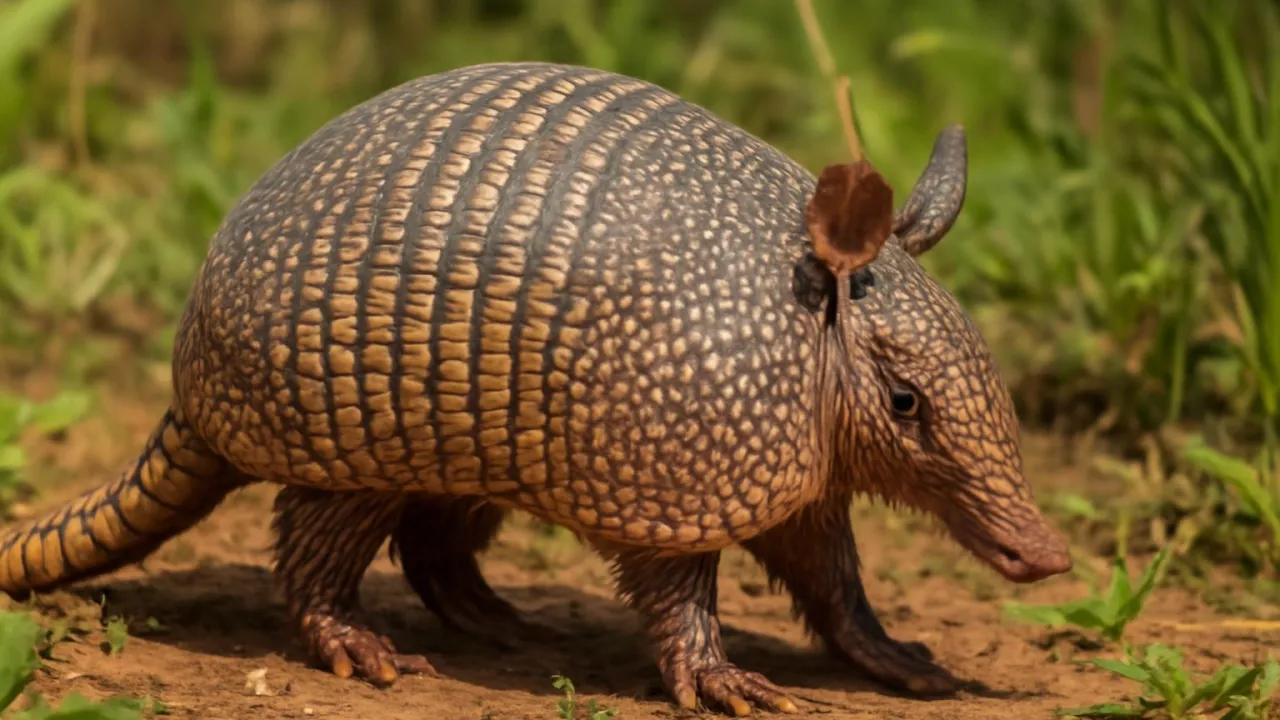
The nine-banded armadillo can hold its breath for up to six minutes underwater!
✨ Word Sparks (Grade 2 Glossary)
Tap 🔊 to hear
predator
An animal that hunts other animals
burrow
A hole an animal digs to live in
armor
Hard shell that protects an animal
🪝
Have you ever seen an animal with a shell like a knight’s armor?
1
Strong Armor Protects
The nine-banded armadillo has a hard shell that covers its back and sides. This helps protect it from . It can curl up a little to hide its soft parts. Its shell looks like bands wrapped around its body.
2
Where It Lives
This armadillo lives in warm places like forests and grasslands. It digs underground to stay cool and safe. It can be found from South America all the way to the southern United States.
3
What It Eats
The armadillo eats insects, worms, and small plants. It uses its strong claws to dig for food in the dirt. Its sharp nose helps it find tasty bugs hiding underground.
The nine-banded armadillo is the only armadillo species that has expanded its range into the United States.
✨ Word Sparks (Grade 3 Glossary)
Tap 🔊 to hear
osteoderms
Bony plates that make up armor
nocturnal
Active mostly at night
camouflage
Colors that help hide an animal
🪝
Did you know the nine-banded armadillo’s armor helps it survive in many ways?
1
Armor and Adaptation
The armadillo’s shell is made of bony plates called that protect it from predators. This armor acts like a shield and helps the armadillo survive attacks. Its bands allow it to move easily while staying protected. This is an amazing adaptation for its environment.
2
Habitat and Behavior
Nine-banded armadillos live in warm forests and grasslands across the Americas. They dig burrows to hide from predators and stay cool. Their digging also helps aerate the soil, which benefits plants. They are mainly , searching for food at night.
3
Diet and Foraging
Armadillos eat insects, grubs, and other small animals, using their strong claws to dig underground. Their long sticky tongue helps catch prey quickly. This diet gives them the nutrients they need to survive. They are important in controlling insect populations.
4
Survival Skills
When threatened, the armadillo can dig quickly or run short distances to escape predators. Its armor provides by blending with the forest floor colors. Sometimes it can even hold its breath underwater to avoid danger. These skills help it live safely in the wild.
1. What helps the armadillo move easily while staying protected?
2. Why do armadillos dig burrows?
🤯 Mind-Blowing Fact • Grade 4
Nine-banded armadillos can dig burrows up to 15 feet long, creating important shelters for other animals.
✨ Word Sparks (Grade 4 Glossary)
Tap 🔊 to hear
nutrient cycling
Process of moving nutrients through nature
suburban
Areas near cities where people live
predator-prey
Animals that hunt and animals hunted
🪝
How does the nine-banded armadillo’s armor affect its role in the ecosystem?
1
Armor and Defense
The nine-banded armadillo’s bony armor protects it from many predators, allowing it to survive in diverse environments. Its flexible bands enable it to curl slightly, which helps shield its vulnerable parts from attacks. This armor-defense relationship helps maintain balance in its ecosystem by keeping interactions stable.
2
Ecosystem Roles and Impact
By digging for insects and grubs, armadillos aerate the soil, which improves and plant growth. Their feeding habits help control insect populations, reducing pests that might damage crops or forests. Humans sometimes impact armadillo habitats by land development, which can reduce their numbers and affect local ecosystems.
3
Geographic Range and Adaptation
Originally from South America, the nine-banded armadillo has expanded its range into the southern United States due to its adaptable nature. It thrives in forests, grasslands, and even areas. This geographic expansion shows how its physical adaptations help it survive in new environments.
4
Behavior and Survival
The armadillo is mainly nocturnal, which helps it avoid daytime predators and heat. Its ability to hold its breath underwater allows it to cross streams safely. These behaviors combined with its armor make it a resilient species in changing habitats.
2. Where has the nine-banded armadillo expanded its range?
🤯 Mind-Blowing Fact • Grade 5
The nine-banded armadillo can hold its breath underwater for six minutes, a rare skill among mammals.
✨ Word Sparks (Grade 5 Glossary)
Tap 🔊 to hear
osteoderms
Bony plates forming armor on the armadillo
carapace
The hard shell covering an animal’s back
insectivore
An animal that mainly eats insects
🪝
What scientific features and behaviors make the nine-banded armadillo a unique mammal in its ecosystem?
1
Taxonomy and Scientific Context
The nine-banded armadillo, Dasypus novemcinctus, belongs to the order Cingulata and family Dasypodidae. It is the most widespread armadillo species, notable for its nine movable bands of armor. This species has adapted to diverse habitats, ranging from tropical forests to suburban areas, showing remarkable evolutionary success. Its unique traits make it an important subject of scientific study.
2
Physiological Mechanics and Defense
Its form a tough, flexible that protects muscles and organs from predators. The bands allow bending for locomotion and partial curling, which helps avoid attacks. The armadillo’s low metabolic rate and strong digging claws enable it to forage efficiently while conserving energy in warm climates. These features support its survival across varied environments.
3
Conservation and Botanical History
While not currently endangered, habitat loss and road mortality pose threats to armadillo populations. The species’ expansion into the United States began in the late 19th century, likely due to climate changes and human land use. Its burrowing behavior influences local plant communities by altering soil structure and nutrient availability. Conservation efforts focus on habitat protection and reducing human-wildlife conflicts.
4
Quantitative Comparisons
Adult nine-banded armadillos weigh between 8 to 17 pounds (3.5 to 7.7 kilograms) and measure about 15 to 17 inches (38 to 43 centimeters) long. They can dig burrows up to 15 feet (4.5 meters) long and hold their breath underwater for six minutes. Their body temperature averages around 33 to 36 degrees Celsius, which is lower than most mammals. These numbers highlight their unique physiological adaptations.
5
Ecological Role and Adaptations
As , armadillos control populations of ants, termites, and beetles, playing a vital role in food webs. Their burrows provide shelter for other species, enhancing biodiversity and ecosystem health. Behavioral adaptations like nocturnality and breath-holding improve survival in variable environments. These complex ecological interactions demonstrate the armadillo’s importance in maintaining balanced ecosystems.