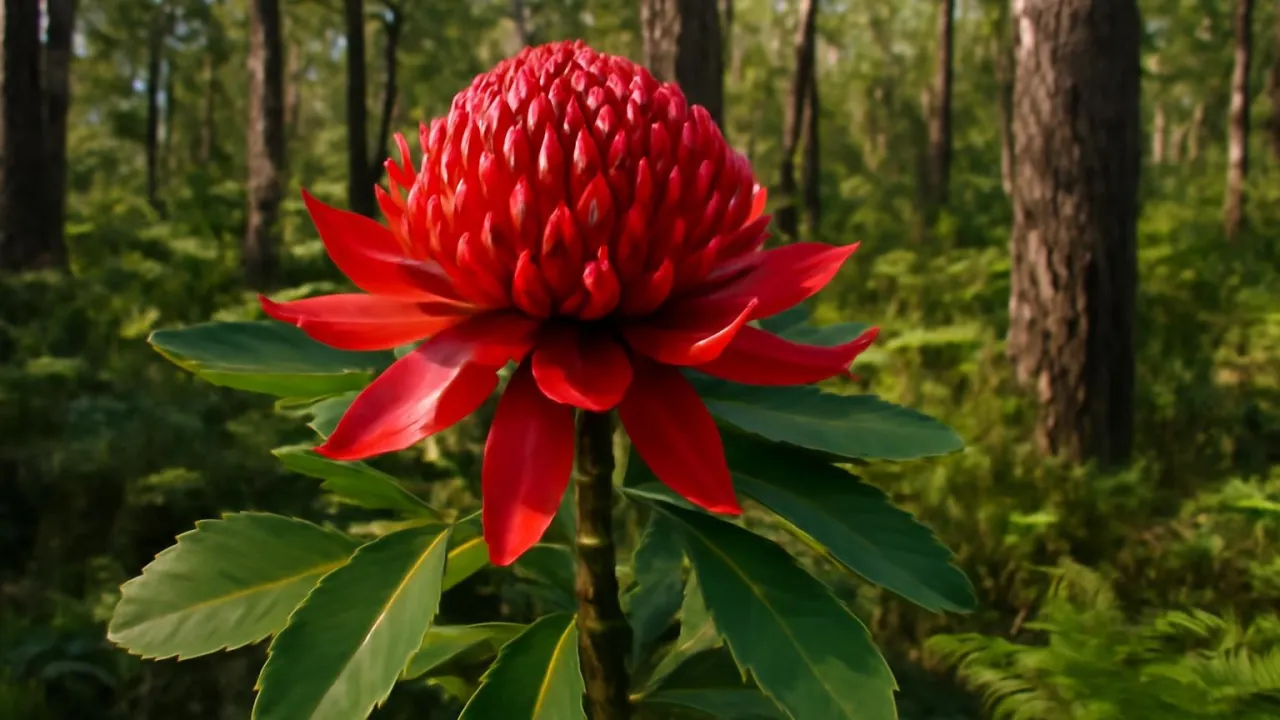
Waratah flowers can be as wide as a small plate, about 5 inches across.
✨ Word Sparks (Grade 2 Glossary)
Tap 🔊 to hear
pollinators
Animals that help flowers make seeds
nectar
Sweet juice inside flowers
soil
Earth where plants grow
🪝
Have you ever seen a flower that looks like a red ball of fire?
1
Waratah’s Bright Flowers
The waratah has bright red flowers that look like balls of fire. They bloom in spring and attract bees and birds. These flowers are big and very easy to see.
2
Where Waratahs Live
Waratahs grow in eastern Australia’s forests where there is plenty of sun. They need well-drained to stay healthy. They can grow up to six feet tall.
3
Special Flower Features
The waratah’s petals are soft and bright red to attract . Bees and birds visit the flower to get . This helps the plant make seeds and grow new flowers.
Waratah flowers can survive bushfires and regrow from underground roots.
✨ Word Sparks (Grade 3 Glossary)
Tap 🔊 to hear
adaptation
A change that helps plants survive
pollination
When pollen helps make new seeds
ecosystem
All living things in one place
🪝
Did you know the waratah’s bright red flowers help it survive in the wild?
1
Waratah’s Bright Red Flowers
The waratah produces bright red flowers that attract many pollinators like birds and bees. This bright color is an that helps the plant survive. allows the plant to produce seeds for new plants. The flower’s shape also helps protect its nectar.
2
Where Waratahs Grow
Waratahs grow mainly in eastern Australia’s coastal forests where sunlight is abundant. They prefer well-drained soils rich in nutrients to grow strong. These plants can reach heights of up to six feet. Their leaves help reduce water loss in hot weather.
3
How Waratahs Survive
Waratahs have tough leaves that protect them from predators and harsh weather. Their bright flowers attract pollinators, which helps with reproduction. The plant’s roots absorb nutrients and water from the soil efficiently. This helps waratahs thrive in their environment.
4
Waratah’s Role in Nature
Waratahs are important in their because they provide food for pollinators. They also help support other plants by improving soil health. The flowers’ bright colors signal pollinators to visit, aiding in . This creates a balanced food web in their habitat.
Waratahs can regrow from underground parts after bushfires, helping forests recover quickly.
✨ Word Sparks (Grade 4 Glossary)
Tap 🔊 to hear
lignotuber
A special root that helps plants regrow
mutualism
A helpful relationship between two living things
pollinators
Animals that move pollen between flowers
🪝
How do waratahs survive wildfires and still brighten Australian forests?
1
Waratah’s Bright Red Flowers
Waratahs produce large, bright red flowers that attract many such as birds and bees, which are essential for the plant’s reproduction. The flower’s shape and color are adaptations that increase pollination success in their natural habitat. These flowers bloom mainly in spring and early summer, providing vital nectar sources. Their striking appearance also helps them stand out in dense forest ecosystems.
2
Survival and Adaptations
Waratahs have evolved to survive frequent wildfires common in Australian forests by regenerating from underground after fires. This adaptation allows them to quickly regrow even when their above-ground parts are damaged. Their tough leaves reduce water loss during dry seasons, helping them endure harsh climates. These survival traits ensure waratahs remain a key part of their ecosystem despite environmental challenges.
3
Role in the Ecosystem
Waratahs play an important role in their ecosystem by providing food and habitat for and other wildlife. Their bright flowers attract nectar-feeding birds and insects, which help in pollination and seed dispersal. This mutualistic relationship supports biodiversity and maintains the health of Australian forests. Additionally, waratahs contribute to soil stabilization and nutrient cycling within their habitats.
4
Geographic Distribution
Waratahs are native to the coastal regions of eastern Australia, particularly in New South Wales and Queensland. They thrive in well-drained soils with ample sunlight and moderate rainfall. Their distribution is limited by climate and soil conditions but they are often found in national parks and protected areas. Human efforts to conserve their habitats help ensure their survival amid environmental changes.
Waratahs’ lignotubers enable regrowth within weeks after intense bushfires, a vital survival strategy.
✨ Word Sparks (Grade 5 Glossary)
Tap 🔊 to hear
lignotuber
Woody root that stores energy for regrowth
inflorescence
A cluster of many small flowers together
mutualism
A helpful relationship between two species
🪝
What makes the waratah a botanical marvel in Australia’s fire-prone landscapes?
1
Taxonomy and Scientific Context
The waratah, scientifically known as Telopea speciosissima, belongs to the Proteaceae family, which includes many Australian native plants. It is the floral emblem of New South Wales and holds cultural significance for Indigenous Australians. Waratahs are closely related to other species in the Telopea genus, sharing similar flower structures and pollination strategies. Their classification helps scientists understand their evolution and ecological role.
2
Physiological Mechanics and Adaptations
Waratahs possess —woody underground swellings—that store energy and nutrients, enabling rapid regrowth after bushfires. Their consist of hundreds of small flowers clustered into a large, bright red head that attracts nectar-feeding birds and insects. The plant’s leaves have thick cuticles and sunken stomata, reducing water loss in dry conditions. These physiological traits optimize survival in nutrient-poor, fire-affected soils.
3
Conservation and Botanical History
Waratahs have been cultivated since the early 19th century, admired for their striking flowers. Habitat loss and frequent fires pose challenges to wild populations, making conservation efforts vital. Protected areas and cultivation programs help preserve genetic diversity. Indigenous knowledge contributes to understanding sustainable management. Botanical gardens worldwide now grow waratahs, promoting awareness of their ecological importance.
4
Quantitative Comparisons and Environmental Impact
Waratah flowers can measure up to 13 centimeters (5 inches) in diameter, making them among the largest Australian native flowers. The plant can grow between 0.9 to 1.8 meters tall, depending on soil and climate. Waratahs thrive in temperatures ranging from 10 to 30 degrees Celsius and require well-drained soils with moderate rainfall. Their ability to regrow after fires helps stabilize ecosystems and supports pollinator populations crucial for biodiversity.
5
Ecological Role and Mutualistic Relationships
Waratahs engage in with nectar-feeding birds such as honeyeaters, which pollinate their flowers while feeding. This relationship ensures reproductive success and genetic diversity. The plant’s bright red serve as visual signals in dense forests. Additionally, waratahs contribute to soil nutrient cycling by shedding leaves and organic matter. Their presence supports complex food webs and maintains ecosystem resilience in fire-prone habitats.