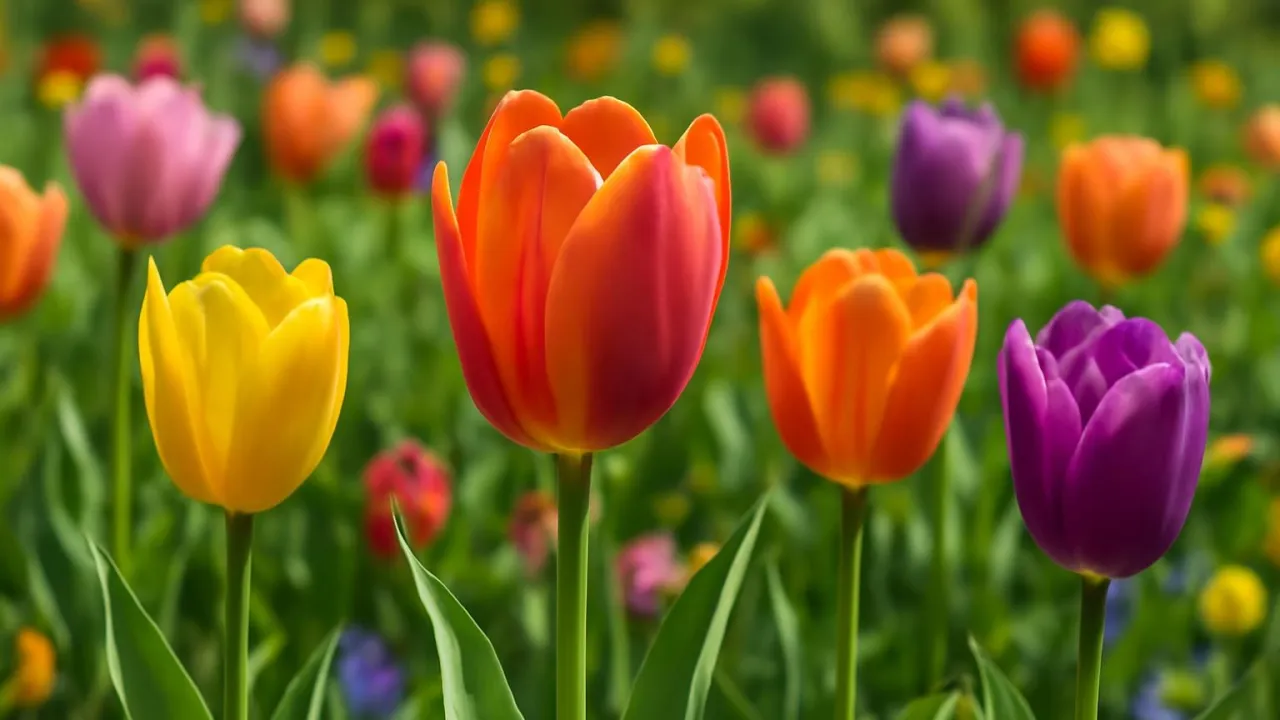
Tulip bulbs can survive cold winters underground before blooming in spring.
✨ Word Sparks (Grade 2 Glossary)
Tap 🔊 to hear
pollinate
Help flowers make seeds by moving pollen
nectar
Sweet juice inside flowers for insects
bulb
Plant part that grows into a flower
🪝
Have you ever seen a tulip bloom in springtime sunshine?
1
Tulip Colors and Shapes
Tulips bloom in many colors like red, yellow, pink, and white. Their petals are smooth and shaped like cups. When the sun shines, tulips open wide to show their bright colors.
2
Where Tulips Grow
Tulips grow best in sunny gardens and fields with good soil. They need moderate water to stay healthy. Bees and butterflies visit tulips to collect and help .
3
Tulip Life Cycle
Tulips start as planted underground in fall. In spring, they sprout green leaves and colorful flowers. After blooming, the petals fall, and the plant rests until next year.
Tulip bulbs can remain dormant underground for months before blooming in spring.
✨ Word Sparks (Grade 3 Glossary)
Tap 🔊 to hear
adaptation
A change that helps a plant survive
photosynthesis
How plants make food from sunlight
dormant
Sleeping or resting state of a plant
🪝
Did you know tulips use bright colors to protect themselves from predators?
1
Tulip Colors and Camouflage
Tulips have bright petals that attract pollinators like bees and butterflies. Their colors also help them stand out to gardeners. This helps tulips survive by attracting helpful insects for pollination.
2
Tulip Growth and Life Cycle
Tulips grow from bulbs planted underground in autumn. The bulbs store nutrients that help the plant sprout in spring. After flowering, tulips produce seeds or new bulbs to grow again next year.
3
Tulip Habitat and Needs
Tulips thrive in temperate climates with well-drained soil and full sunlight. They need moderate water to absorb nutrients from the soil. Their leaves help collect sunlight for , which fuels growth.
4
Tulips in Nature and Gardens
Tulips play a role in food webs by providing nectar for insects. They also add beauty to gardens worldwide. Humans have cultivated tulips for centuries, selecting many colorful varieties through breeding.
Tulips were once so valuable in the 1600s that their bulbs caused a financial craze called 'tulip mania.'
✨ Word Sparks (Grade 4 Glossary)
Tap 🔊 to hear
ecosystem
A community of plants and animals living together
pollinator
An animal that helps flowers make seeds
cultivation
Growing plants for food or beauty
🪝
How do tulips’ bright colors and bulbs help them survive in different environments?
1
Tulip Adaptations and Survival
Tulips have bright, colorful petals that attract such as bees and butterflies, which help with reproduction. Their bulbs store nutrients and energy, allowing them to survive cold winters underground. This cause-and-effect relationship between bulbs and survival enables tulips to bloom annually in temperate climates.
2
Tulips’ Role in Ecosystems
Tulips provide nectar for pollinating insects, supporting local food webs and biodiversity. They also contribute to soil health by cycling nutrients through their growth and decay. Humans cultivate tulips extensively, impacting by creating gardens and farms that support both wild and domestic species.
3
Geographic Distribution and Growth
Originally native to Central Asia and Turkey, tulips now grow worldwide in temperate regions. They prefer well-drained soils and full sun exposure for optimal growth. Tulips require moderate watering, as too much moisture can cause bulb rot, affecting their survival and reproduction.
4
Human Impact and Cultivation
Humans have bred thousands of tulip varieties, selecting for colors, shapes, and sizes that appeal to gardeners. Tulip festivals celebrate their beauty and cultural importance in places like the Netherlands. However, intensive can affect wild tulip populations and local if not managed sustainably.
Tulip petals open and close daily in response to sunlight, a behavior called nyctinasty.
✨ Word Sparks (Grade 5 Glossary)
Tap 🔊 to hear
nyctinasty
Flower movement opening and closing with light
carbohydrates
Plant energy stored in bulbs
genetic diversity
Variety of genes in plants or animals
🪝
How do tulips’ unique biology and history make them special in the plant kingdom?
1
Scientific Classification and Origin
Tulips belong to the genus Tulipa in the Liliaceae family, with Tulipa gesneriana as a common species. They originated in Central Asia and Turkey before spreading to Europe and worldwide cultivation. Their classification helps scientists understand their evolutionary relationships with other flowering plants. This knowledge also aids in conservation and breeding programs.
2
Physiological Mechanics of Growth
Tulips grow from underground bulbs that store and nutrients, enabling rapid spring growth. Their leaves perform photosynthesis, converting sunlight into energy to fuel flower development. The flower’s bright petals attract pollinators, while the reproductive organs enable seed production for . Tulips also exhibit , opening and closing petals in response to sunlight daily.
3
Conservation and Botanical History
Tulips became culturally significant during the 17th-century Dutch 'tulip mania,' one of the first economic bubbles. Today, wild tulip species face habitat loss due to agriculture and urbanization. Conservation efforts focus on protecting natural habitats and preserving in both wild and cultivated tulips. Botanical gardens and seed banks play key roles in these efforts.
4
Quantitative Comparisons and Growth Data
Tulips typically grow between 6 and 24 inches tall, depending on the variety and environment. Their bulbs can survive soil temperatures as low as 14°F (-10°C) during winter dormancy. Tulip flowers can open and close daily in response to sunlight, a movement called . Some tulip petals can reach lengths of up to 4 inches (10 cm), making them easily visible to pollinators.
5
Human Cultivation and Global Impact
Humans have bred over 3,000 tulip varieties with diverse colors and shapes, influencing global horticulture. Tulip festivals attract millions of visitors annually, highlighting their economic and cultural importance. Sustainable cultivation practices aim to balance beauty with environmental conservation worldwide. Advances in genetic research continue to improve tulip breeding and disease resistance.