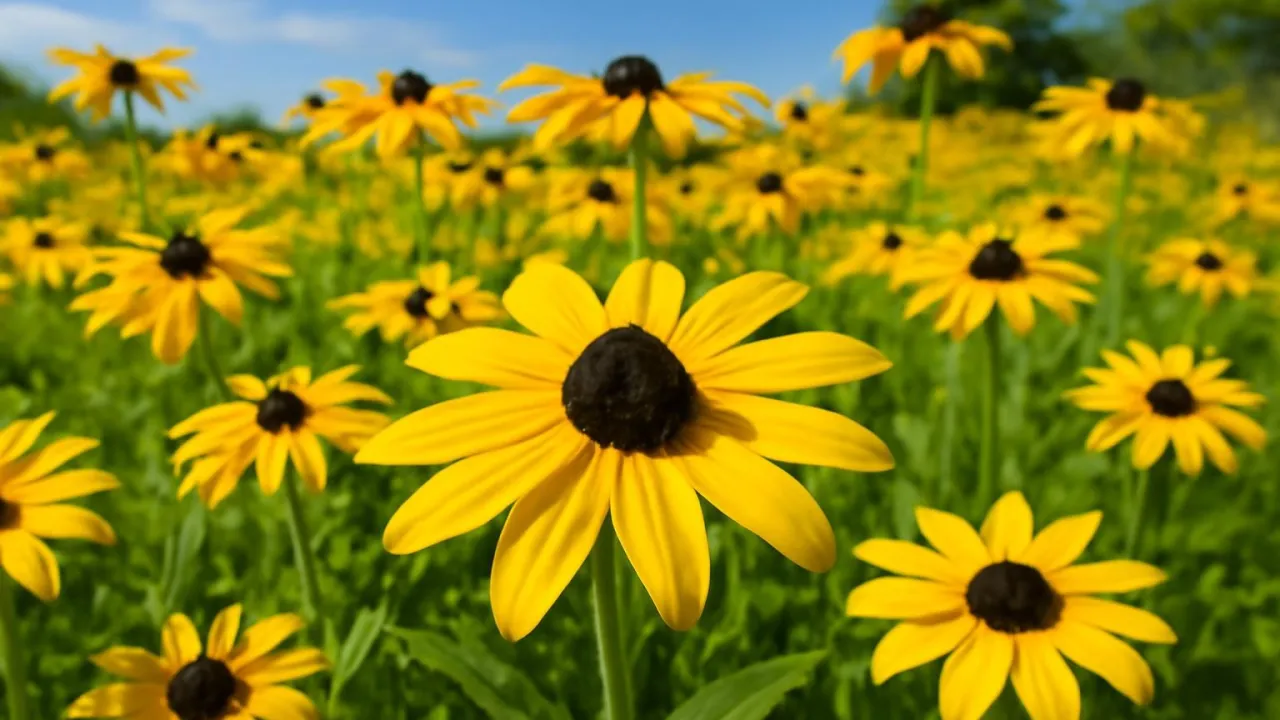
Black-eyed Susans can attract many pollinators with their bright petals and dark centers!
✨ Word Sparks (Grade 2 Glossary)
Tap 🔊 to hear
petals
Bright parts of a flower that attract insects
pollinators
Animals that help flowers make seeds
nectar
Sweet juice inside flowers that insects drink
🪝
Have you seen a flower with a dark eye in the middle of bright petals?
1
Flower Colors and Shape
Black-eyed Susans have bright yellow that shine in the sun. Their dark brown centers look like little eyes. These flowers bloom in warm weather and open wide to attract insects.
2
Where They Live
These flowers grow mostly in North American fields and prairies. They like places with full sun and well-drained soil. Many butterflies and bees visit them to collect and pollen.
3
Special Flower Feature
The dark center of the flower is made of many tiny disk flowers. These disk flowers help the plant make seeds. The help attract like bees and butterflies.
Black-eyed Susans’ hairy stems help them save water in dry places!
✨ Word Sparks (Grade 3 Glossary)
Tap 🔊 to hear
pollination
When insects help flowers make seeds
camouflage
Colors that help hide or blend in
adaptation
A change that helps plants survive
🪝
Did you know the Black-eyed Susan uses bright colors to hide from predators and attract pollinators?
1
Bright Petals and Camouflage
Black-eyed Susans have bright yellow petals that attract pollinators like bees and butterflies. Their dark brown centers are made of many tiny disk flowers that produce seeds. The bright colors also help the flower blend into sunny meadows, which protects it from some predators.
2
Pollination and Seed Growth
Pollinators visit the flower to collect nectar and pollen. When they land on the dark center, they help pollinate the tiny disk flowers. allows the plant to produce seeds for new flowers to grow the next year.
3
Habitat and Adaptations
Black-eyed Susans grow in North American meadows and prairies where there is full sun. They have hairy stems that help protect them from insects and reduce water loss. Their roots grow deep to find nutrients and water in dry soil.
4
Flower Structure and Survival
The flower’s petals attract insects, while the dark center holds the reproductive parts. This structure helps the plant survive by making seeds and spreading them. The plant’s bright colors and shape are important for survival.
Black-eyed Susans support many animals by providing nectar and seeds in their ecosystems!
✨ Word Sparks (Grade 4 Glossary)
Tap 🔊 to hear
ecosystem
A community of living things and their home
pollination
When insects help flowers make seeds
adaptation
A change that helps plants survive
🪝
How do Black-eyed Susans play an important role in their ecosystems and survive in different environments?
1
Ecosystem Role and Pollination
Black-eyed Susans attract many pollinators such as bees and butterflies with their bright yellow petals and dark centers, which helps and seed production. This process supports the food web by providing nectar for insects and seeds for birds. Without these flowers, many pollinators would struggle to find food.
2
Adaptations for Survival
These flowers have hairy stems that reduce water loss and protect against insect damage, allowing them to survive in dry prairies. Their deep roots help them access water and nutrients from the soil even during droughts. These increase their chances of thriving in various habitats.
3
Geographic Distribution
Black-eyed Susans are native to North America and commonly found in meadows, prairies, and open woods. They prefer full sun and well-drained soil but can tolerate different climates. Human activities like farming and gardening have helped spread these flowers to new areas.
4
Human Impact and Uses
People often plant Black-eyed Susans in gardens because they attract pollinators and add bright color. However, habitat loss from urban development can reduce wild populations. Conservation efforts encourage planting native flowers like Black-eyed Susans to support and biodiversity.
1. Why are Black-eyed Susans important to pollinators?
2. What helps Black-eyed Susans survive dry places?
🤯 Mind-Blowing Fact • Grade 5
Black-eyed Susans belong to the same family as sunflowers and daisies, sharing unique composite flower heads!
✨ Word Sparks (Grade 5 Glossary)
Tap 🔊 to hear
Asteraceae
The flower family with daisies and sunflowers
florets
Tiny flowers that make up a big flower head
herbivorous
Animals or insects that eat plants
🪝
What fascinating biological features allow Black-eyed Susans to thrive and support ecosystems across North America?
1
Scientific Classification and Taxonomy
Black-eyed Susan, scientifically named Rudbeckia hirta, belongs to the family, which includes daisies and sunflowers. This family is characterized by composite flower heads made of ray and disk . The genus Rudbeckia honors botanist Olof Rudbeck, and the species name hirta means hairy, referring to the plant’s stem texture.
2
Physiological Mechanics and Adaptations
The plant’s hairy stems reduce water loss by trapping moisture and protecting against insects. Its deep root system allows access to water and nutrients in dry soils, supporting growth during droughts. The bright yellow ray attract pollinators, while the dark disk florets contain reproductive organs essential for seed production.
3
Ecological Role and Conservation
Black-eyed Susans play a vital role in ecosystems by supporting pollinators such as bees, butterflies, and birds through nectar and seed production. Habitat fragmentation and urban development threaten wild populations, but conservation efforts promote planting native species to maintain biodiversity and ecosystem health.
4
Botanical History and Cultural Importance
Historically, Native American tribes used Black-eyed Susans for medicinal purposes, including treating colds and swelling. The flower has become a symbol of encouragement and motivation in American culture, often featured in gardens and wildflower mixes to promote pollinator-friendly environments.
5
Quantitative Comparisons and Growth
Black-eyed Susans typically grow between 2 and 3 feet tall, with flowers measuring 2 to 3 inches in diameter. They bloom from early summer through fall, lasting up to 8 weeks. Their seeds are dispersed by wind and animals, allowing populations to spread across prairies and meadows at elevations up to 6,000 feet. These flowers can tolerate temperatures ranging from 40 to 90 degrees Fahrenheit during their growing season.