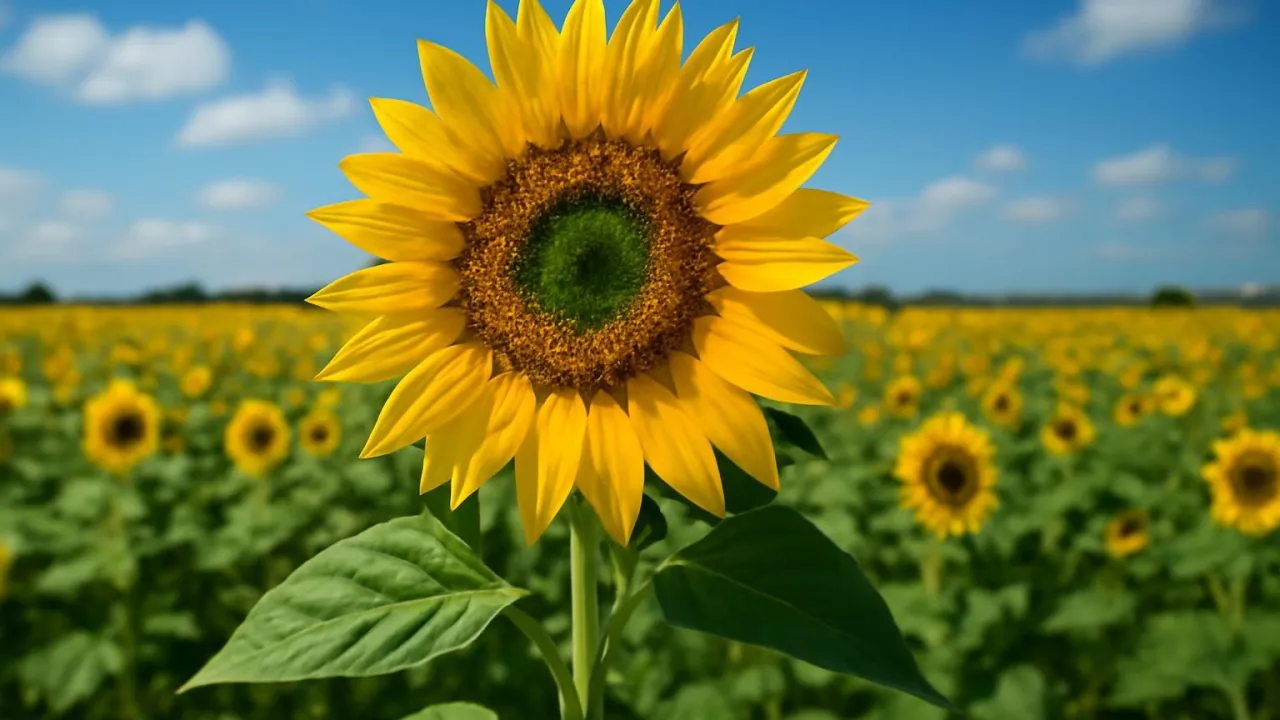
Sunflowers can track the sun’s movement to soak up more sunlight every day.
✨ Word Sparks (Grade 2 Glossary)
Tap 🔊 to hear
petals
Bright parts of a flower that attract bees
stems
Strong parts that hold flowers up tall
seeds
Parts that grow new plants from flowers
🪝
Have you seen a flower that follows the sun all day long?
1
Sunflowers Grow Tall and Bright
Sunflowers grow very tall and have bright yellow that shine in the sun. They live in fields and gardens where they get plenty of sunlight. Their thick help them stand strong against the wind.
2
Following the Sun
Young sunflowers turn their heads to follow the sun from east to west each day. This helps them get more sunlight for growth and energy. At night, they turn back to face east again.
3
Seeds for Food and New Plants
Sunflowers produce many inside their large flower heads. Birds and people eat these seeds as snacks. When seeds fall to the ground, they can grow into new sunflowers.
2. What do sunflower seeds do when they fall to the ground?
🤯 Mind-Blowing Fact • Grade 3
Sunflowers use heliotropism to track the sun, boosting their growth and survival chances.
✨ Word Sparks (Grade 3 Glossary)
Tap 🔊 to hear
heliotropism
When a plant moves to follow the sun
pollination
Bees help flowers make seeds
adaptation
A special trait that helps plants survive
🪝
Did you know sunflowers can move their heads to follow the sun’s path?
1
Sunflower Appearance and Growth
The common sunflower grows tall, often reaching over six feet high. Its large flower head is made of bright yellow petals surrounding many tiny flowers. The thick stem supports the heavy flower and helps it stay upright. This strong stem is an to withstand wind and rain.
2
Sun-Tracking Movement
Young sunflowers show , which means they turn their flower heads to follow the sun’s movement across the sky. This movement helps maximize photosynthesis by capturing more sunlight. At night, the flowers reset to face east, ready for sunrise. This helps the plant grow faster and stronger.
3
Seeds and Pollination
Sunflowers produce seeds in the center of their flower heads after by bees and other insects. These seeds provide nutrients for animals and humans. Pollination is crucial because it allows the plant to reproduce and spread. The seeds can also be harvested for food or oil.
4
Habitat and Survival
Sunflowers grow best in open fields with full sunlight and well-drained soil. They are native to North America but are now grown worldwide. Their bright color attracts pollinators, which helps them survive and reproduce. Sunflowers also provide food and shelter for many animals in their ecosystem.
Sunflowers’ sun-tracking behavior directly boosts photosynthesis and seed production.
✨ Word Sparks (Grade 4 Glossary)
Tap 🔊 to hear
photosynthesis
How plants make food from sunlight
pollinators
Animals like bees that help plants make seeds
ecosystem
A community of plants and animals living together
🪝
How does a sunflower’s sun-tracking help it grow better in its ecosystem?
1
Physical Features and Growth
The common sunflower grows tall, often reaching heights up to ten feet, with a thick stem that supports its large flower head. Its bright yellow petals surround hundreds of tiny flowers, which produce seeds after pollination. This tall structure helps the plant compete for sunlight in open fields. The stem’s strength allows it to withstand strong winds and heavy rain.
2
Sun-Tracking Movement and Photosynthesis
Sunflowers exhibit heliotropism by turning their flower heads to follow the sun’s path across the sky each day, maximizing . This movement increases energy production, which supports faster growth and seed development. At night, the flower heads face east again to prepare for sunrise. This cause-and-effect relationship between sun-tracking and growth is a key adaptation.
3
Role in the Ecosystem
Sunflowers play an important role in their by providing food and shelter for various animals, including birds, bees, and insects. Their seeds are a nutritious food source, and their flowers attract that help many plants reproduce. Sunflowers also contribute to soil health by adding organic matter when they decompose. Humans cultivate sunflowers for food, oil, and ornamental uses.
4
Geographic Distribution and Human Impact
Originally native to North America, sunflowers are now grown worldwide in temperate regions. They thrive in open fields with full sun and well-drained soil. Agricultural practices have increased sunflower cultivation, but habitat loss and pesticide use can threaten wild . Conservation efforts focus on protecting pollinators and promoting sustainable farming to support sunflower growth.
2. Why are sunflowers important to their ecosystem?
🤯 Mind-Blowing Fact • Grade 5
Sunflower seeds grow in spirals that follow math patterns called the Fibonacci sequence.
✨ Word Sparks (Grade 5 Glossary)
Tap 🔊 to hear
heliotropism
Plant movement that follows the sun’s path
photosynthesis
Plants making food using sunlight and air
Fibonacci sequence
A special math pattern in nature’s designs
🪝
What scientific secrets help the common sunflower thrive and support ecosystems worldwide?
1
Scientific Classification and Origins
The common sunflower, scientifically named Helianthus annuus, belongs to the Asteraceae family, which includes daisies and asters. Native to North America, it was first cultivated by indigenous peoples for food and oil. Its widespread cultivation today spans temperate regions worldwide due to its adaptability and economic importance. Understanding its taxonomy helps scientists study its evolutionary relationships.
2
Physiological Mechanics of Sun-Tracking
Sunflowers exhibit through differential growth in stem cells, allowing flower heads to track the sun’s movement daily. This movement maximizes light absorption, enhancing efficiency. At night, growth patterns reverse, orienting the flower eastward for sunrise. This physiological adaptation improves energy capture, accelerating growth rates and seed production compared to stationary flowers.
3
Seed Production and Botanical Importance
Following successful pollination by insects, sunflowers produce hundreds to thousands of seeds arranged in a spiral pattern following the . These seeds contain oils rich in unsaturated fats, making them valuable for human consumption and industrial uses. Botanically, sunflowers are classified as fruits because they develop from fertilized flowers and contain seeds, a fact often surprising to many.
4
Conservation and Agricultural Impact
Sunflowers contribute significantly to agriculture by providing edible seeds and oil, supporting economies globally. However, intensive farming and pesticide use threaten pollinator populations essential for sunflower reproduction. Conservation efforts promote pollinator-friendly practices and habitat restoration to maintain healthy ecosystems. Sustainable sunflower cultivation balances human needs with environmental health.
5
Quantitative Comparisons and Environmental Adaptations
Common sunflowers can grow up to 10 feet (3 meters) tall and produce flower heads measuring up to 12 inches (30 centimeters) wide. Their seeds can weigh about 0.05 grams each, with a mature plant producing thousands annually. They thrive in temperatures between 70 and 78 degrees Fahrenheit (21 to 26 degrees Celsius) and require full sun exposure. These quantitative traits demonstrate remarkable adaptations to temperate environments.