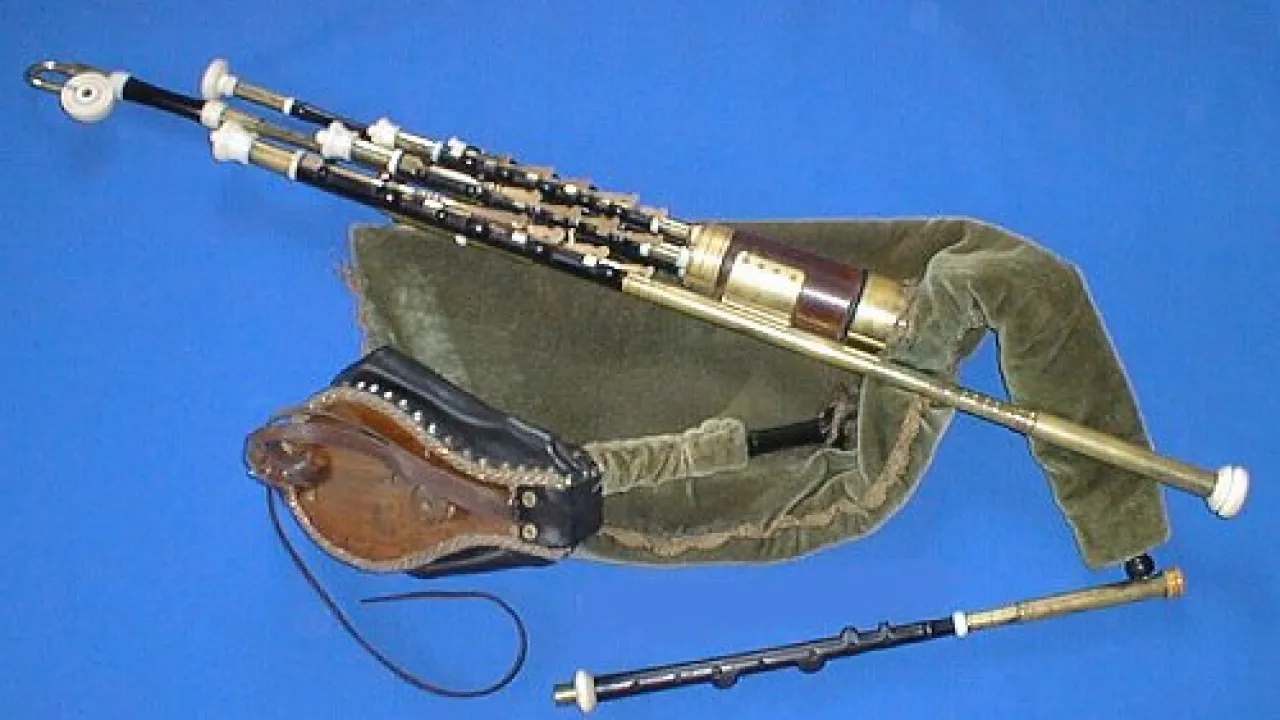
1. How does a musician put air into uilleann pipes?
2. What does the Irish word uilleann mean in English?
🤯 Mind-Blowing Fact • Grade 2
A full set of uilleann pipes holds seven separate reeds—more reeds than almost any other wind instrument on Earth!
✨ Word Sparks (Grade 2 Glossary)
Tap 🔊 to hear
jig
Bouncy, fast traditional Irish dance tune
chord
Three or more notes sounding together nicely
regulators
Keyed lap pipes that play harmony chords
🪝
Why are these Irish bagpipes sweet and gentle enough to play inside a small living room?
1
Made for Fireside Music
Marching bagpipes are built to roar across windy hills, but uilleann pipes have a warm, singing indoor voice. Seated in a chair, a piper dances through lively Irish and tender slow airs.
2
The Knee Trick
To make crisp silent gaps between notes, the piper seals the bottom tip of the melody chanter against a leather pad on their knee. Closing that bottom opening stops the air for a blink—or helps the pipe leap into a higher octave!
3
Wrist-Played Chords
Lying across the piper's lap sit three drones plus special brass-keyed pipes called . Pressing those shiny keys with the edge of the right wrist adds rich harmony while fingers keep dancing!
1. Why does an uilleann piper rest the bottom of the chanter on a leather knee pad?
2. How does a piper press the shiny harmony keys on the regulators?
🤯 Mind-Blowing Fact • Grade 3
The rows of regulator keys are lined up carefully side by side so one press of a piper's wrist can sound a two-note harmony chord!
✨ Word Sparks (Grade 3 Glossary)
Tap 🔊 to hear
moisture
Tiny drops of water carried in air
staccato
Short, crisp notes separated by tiny silences
register
High or low pitch zone of instrument
🪝
Why does dry air from an elbow bellows let uilleann pipes do tricks mouth-blown bagpipes cannot?
1
Dry Air, Delicate Reeds
Warm breath from human lungs carries lots of , which forces mouth-blown bagpipes to use tough, stiff reeds. Because an uilleann piper pumps cool, dry room air with an elbow bellows, makers can shave tiny cane double reeds paper-thin for sweet, expressive tone.
2
Overblowing Two Full Octaves
Most bagpipe chanters only span nine notes, yet the narrow conical uilleann chanter spans two full octaves! Briefly sealing the bottom rim against the knee's popping strap while squeezing the bag firmer jumps the reed cleanly into its crisp upper .
3
Drones and Closed Regulators
Across the piper's thigh rest six horizontal pipes emerging from one central stock: three single-reed drones tuned to D octaves, and three closed-end double-reed regulators lined with brass keys.
4
Growing from Practice Set to Full Set
Students begin with just bellows, bag, and chanter—a practice set—before adding drones into a half set and finally regulators into a grand full set. Alongside fiddles, flutes, and harps, uilleann pipes form the soulful heart of traditional Irish music sessions.
1. How does using an elbow bellows protect and improve the reeds inside uilleann pipes?
2. What do musicians call a beginner uilleann setup that has only the bag, bellows, and chanter?
🤯 Mind-Blowing Fact • Grade 4
Shaking a finger gently in the air above an open chanter hole—or bouncing the chanter slightly on the thigh—creates a shimmering natural vibrato!
✨ Word Sparks (Grade 4 Glossary)
Tap 🔊 to hear
polyphony
Multiple independent musical lines sounding at once
chromatic
Including all twelve half-step pitches per octave
vibrato
Gentle, expressive pulsing wave in a pitch
🪝
How did eighteenth-century Irish and British instrument makers engineer a bagpipe that plays staccato melodies, vibrato, and harmony chords all at once?
1
Baroque Parlor Ingenuity
Emerging in eighteenth-century Ireland and Britain first under the name 'union pipes,' this sophisticated indoor instrument transformed pastoral bagpiping into chamber artistry. Sitting upright requires remarkable four-way limb independence: the right elbow pumps the bellows, the left arm regulates bag pressure, ten fingers dance across the chanter, and the right wrist strikes chordal keys.
2
Acoustic Versatility of the Narrow Chanter
Bored with a much slenderer cone than outdoor Scottish pipes, the chanter usually anchors on D4 and climbs two diatonic octaves to D6, often aided by brass keys for F-natural, C-natural, and G-sharp. Lifting the bell off the knee vents the bottom note and alters timbre; keeping it sealed against the leather popping strap enables crisp staccato cutoffs and vocal sliding glissandi.
3
Mechanical Polyphony of the Regulators
Three drones—tenor, baritone, and coiled or multi-jointed bass—hum steady octave pedals across the lap, governed by an on-off switch on the main stock. Nested right above them lie the tenor, baritone, and bass regulators. Because each regulator's far end is plugged shut, its internal double reed stays completely silent until the player's wrist depresses a spring-loaded brass key, venting a pitched note to build rhythmic harmonic accompaniment.
4
Living Voice of Irish Tradition
Saved from near extinction in the early twentieth century by dedicated pipers' clubs and celebrated masters like Willie Clancy, Leo Rowsome, Seamus Ennis, and Liam O'Flynn, uilleann piping now thrives across global concert halls and was honored by UNESCO in 2017 as Intangible Cultural Heritage of Humanity.
1. Why do the three regulator pipes stay completely silent until a piper presses a key?
2. How do uilleann pipers add sharps and flats outside the natural D scale?
🤯 Mind-Blowing Fact • Grade 5
To reach a deep cello-low D2 at 73.4 hertz without poking three feet past the piper's chair, the bass drone's internal bore doubles back like a trombone loop inside a compact cylinder!
✨ Word Sparks (Grade 5 Glossary)
Tap 🔊 to hear
pneumatic
Operated by pressurized air or gas flow
bimodal
Operating in two distinct pressure or pitch modes
distal
Situated farthest away from the starting point
🪝
What feats of fluid mechanics allow a seated musician to drive seven sensitive reeds across four octaves using only two arms?
1
Closed-System Pneumatic Precision
Listen to a slow Irish caoineadh (lament) rise from total silence into a plaintive cry before blossoming into shimmering chords—a feat impossible on outdoor mouth-blown pipes. Organologically classified as a bellows-blown polyphonic bagpipe (Hornbostel-Sachs 422.112 / 422.211), the uilleann pipes isolate their reeds from respiratory warmth and condensation via a check-valved leather bellows strapped between the right ribcage and forearm, feeding ambient dry air into a swan-necked hide bag.
2
Bimodal Pressure and Stop-Key Acoustics
Crafted from African blackwood, ebony, or boxwood, the narrow-bore conical chanter relies on bag pressure. In the lower octave (D4 at roughly 294 hertz up to C-sharp5), moderate arm pressure excites fundamental modes. Momentarily sealing the chanter's rim against the knee's leather popping strap interrupts airflow, enabling true staccato articulation; simultaneously spiking bag pressure forces the thin Arundo donax double reed to overblow cleanly into its second harmonic register up to D6 (1,175 hertz).
3
Tone Color Contrasts: Tight vs. Open
Keeping the chanter bell sealed on the knee (tight piping) whenever lower holes open creates back-pressure that yields a sweet, muted parlor tone and razor-crisp rolls and cran ornaments. Lifting the bell into free air (open piping) releases robust volume and allows rolling finger slides across tone holes to bend frequencies microtonally.
4
Stock Engineering of Drones and Regulators
A single intricate main stock channels bag air into six horizontal pipes draped across the right thigh. Three cylindrical single-reed drones sound octave Ds down to D2 (roughly 73.4 hertz, achieved via a double-looped bass bore). Above them sit three closed-end conical double-reed regulators—tenor, baritone, and bass—whose aligned brass keys are arranged in vertical harmonic pairs such as G and B or F-sharp and A, so the heel of the right hand can strike rhythmic two-note chords while fingers ornament the chanter.
5
Survival and Global Renaissance
Perfected by late-eighteenth-century Dublin and Drogheda makers like the Coynes—and later redesigned with wider concert-pitch bores by Irish-American builders William and Charles Taylor in Philadelphia—the tradition was safeguarded in 1968 by Na Piobairi Uilleann and now stands among humanity's most mechanically inventive solo wind instruments.