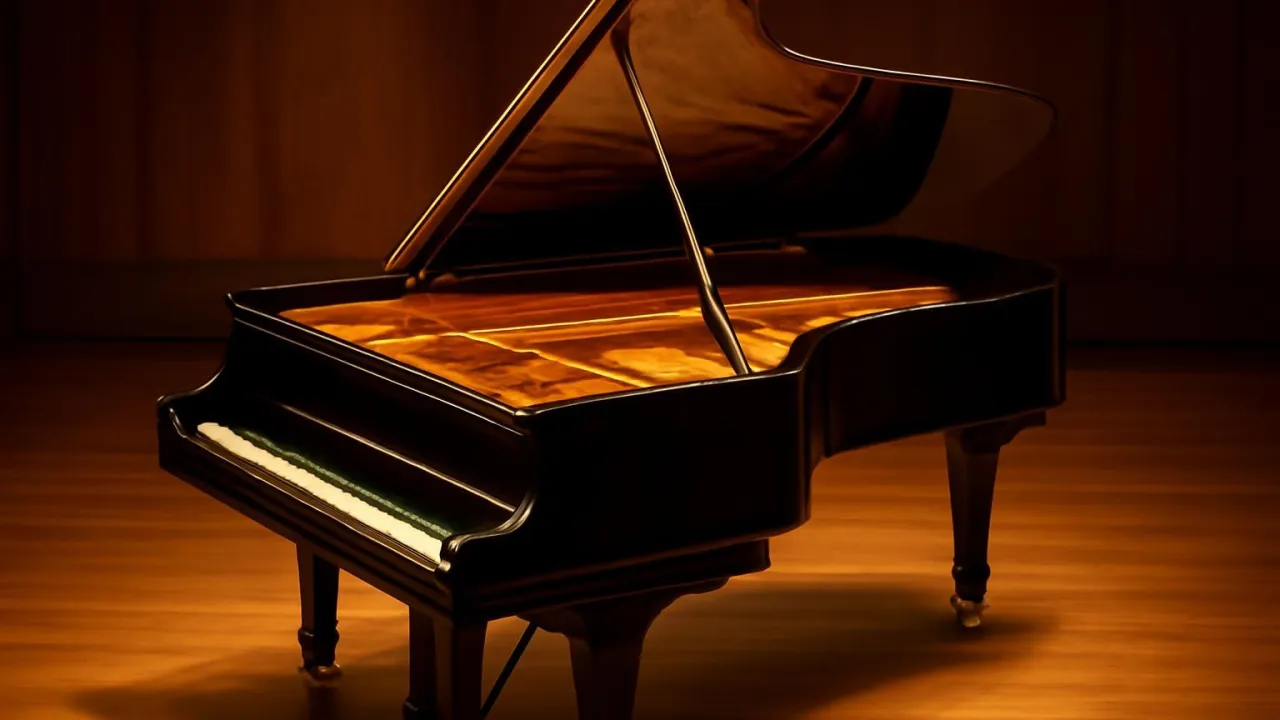
The longest grand pianos can be over nine feet long!
✨ Word Sparks (Grade 2 Glossary)
Tap 🔊 to hear
pedal
A foot lever that changes sound
hammer
A small part that hits strings
concert
A show where people play music
🪝
Have you ever heard a piano thunder like a storm?
1
A Giant with Strings
The grand piano has a huge body and a shiny lid. Inside, strong strings stretch over a wooden board. When you open the lid, the sound gets even louder.
2
How It Plays
You press the keys and little hit the strings. Some notes are deep and low, while others are high and bright. The help the music ring longer.
3
Music for Crowds
People play grand pianos in big halls and . Its music can be soft like a whisper or loud like thunder. Everyone listens and feels the music together.
A single grand piano string can hold over 150 pounds of tension!
✨ Word Sparks (Grade 3 Glossary)
Tap 🔊 to hear
vibration
Fast shaking that makes sound
soundboard
Wood piece that makes notes louder
resonance
A rich, ringing sound that lasts
🪝
What happens inside a grand piano when you press a key?
1
Inside the Piano
A grand piano is filled with tightly stretched steel strings. When you press a key, a felt hammer jumps up and strikes a string. This causes the string to vibrate, making a musical note. The below helps the note become loud and clear.
2
The Power of Pedals
There are usually three pedals at your feet when you play. The right pedal lets notes ring longer by lifting the dampers off the strings. The left pedal makes the sound softer and gentler. The middle pedal can hold certain notes while you play others.
3
A Stage Star
Grand pianos are famous in concert halls all over the world. Their large, curved shape helps project sound across big rooms. Musicians play them for classical, jazz, and even pop music. The piano’s wide range lets it play both melody and harmony.
4
From Workshop to Stage
Building a grand piano takes months of careful work. Craftspeople shape wood, stretch strings, and test each key. The finished instrument can last for many decades. Each piano has its own special sound, or .
Some grand pianos have over 12,000 moving parts working together!
✨ Word Sparks (Grade 4 Glossary)
Tap 🔊 to hear
amplifies
Makes sound bigger and louder
mechanism
A set of moving working parts
craftsmanship
Skill and care in making things
🪝
Can you imagine how many inventions fit inside a grand piano?
1
Engineering a Musical Marvel
The grand piano’s design uses physics and engineering to create powerful sound. When a felt-tipped hammer strikes a string, it vibrates rapidly, producing a musical tone. The curved wooden soundboard those vibrations, allowing the notes to fill a concert hall. Its long, horizontal shape lets the bass strings be extra long, giving the piano its deep, thunderous notes.
2
The Magic of Mechanisms
Every key you press sets off a chain reaction inside the piano. The action moves the hammer, which strikes the string, and then lets it bounce away quickly. This lets the string vibrate freely, creating clear, sustained notes. The pedals add even more control, letting musicians change the piano’s tone and volume in real time.
3
A History of Innovation
The grand piano evolved from earlier keyboard instruments like the harpsichord and clavichord. Inventors in 18th-century Italy and Austria experimented with new ways to make keys strike strings. Over centuries, builders improved the frame, strings, and action, making the modern grand piano a masterpiece of and invention.
4
A Global Stage Presence
Today, grand pianos are played in concert halls, schools, and homes around the world. Their rich resonance and wide range make them essential for classical, jazz, and popular music. Famous composers like Beethoven and Chopin wrote music just for the grand piano. Its expressive power continues to inspire musicians everywhere.
2. What did inventors improve to create the modern grand piano?
🤯 Mind-Blowing Fact • Grade 5
A concert grand piano can project sound over a full orchestra without any electronic amplification!
✨ Word Sparks (Grade 5 Glossary)
Tap 🔊 to hear
frequency
How fast something vibrates to make sound
amplifier
Something that makes sound much louder
customization
Changing something to fit special needs
🪝
What if you could step inside a grand piano and see its secrets in motion?
1
Acoustic Engineering: Turning Force into Music
A grand piano’s sound begins when a pianist’s finger presses a key, triggering a complex action mechanism. This mechanism launches a felt-covered hammer toward a steel string, causing the string to vibrate at a specific . The vibrations transfer through a cast-iron plate and bridge into the soundboard, a precisely crafted spruce panel that amplifies and shapes the tone. The piano’s horizontal layout allows bass strings to reach up to two meters, producing fundamental frequencies as low as 27.5 Hz. The result is a rich spectrum of sound, from the deepest rumble to sparkling high notes.
2
The Science of Resonance and Sustain
The soundboard acts as an acoustic , using resonance to project vibrations across large spaces. Each of the piano’s 230 strings is under high tension—often exceeding 150 pounds per string—creating a total force of over 20 tons. Pedals add expressive control: the right (sustain) pedal lifts all dampers, allowing notes to ring and blend; the left (una corda) pedal shifts the action, softening the sound by striking fewer strings. The middle (sostenuto) pedal sustains selected notes while others are played staccato.
3
Evolution from Harpsichord to Concert Grand
The grand piano evolved from the harpsichord and early fortepiano, which used plucked or lightly struck strings. In the 1700s, Bartolomeo Cristofori invented the hammer mechanism, allowing dynamic changes in volume. Over centuries, innovations included the cast-iron frame (for greater string tension), cross-stringing (for richer tone), and advanced action mechanisms. Today’s concert grands, like the Steinway Model D, can exceed nine feet in length and weigh over 1,000 pounds.
4
A Cultural Icon Across the Globe
Grand pianos are central to Western classical music, jazz, and even film scores, admired for their expressive power and versatility. Composers such as Mozart, Chopin, and Rachmaninoff wrote masterpieces specifically for the grand piano’s unique capabilities. The instrument’s design has inspired countless artists and audiences, making it a symbol of musical achievement in concert halls and homes worldwide.
5
Craftsmanship and Customization
Building a grand piano requires expert craftsmanship, with artisans shaping soundboards, bending rims, and hand-voicing hammers for optimal tone. Each piano is unique, with subtle differences in touch and sound, even among the same model. High-quality grands use premium spruce, maple, and ebony, and can take over a year to construct. Some modern pianos include carbon fiber parts or digital sensors, blending tradition with technology for the next generation of musicians.