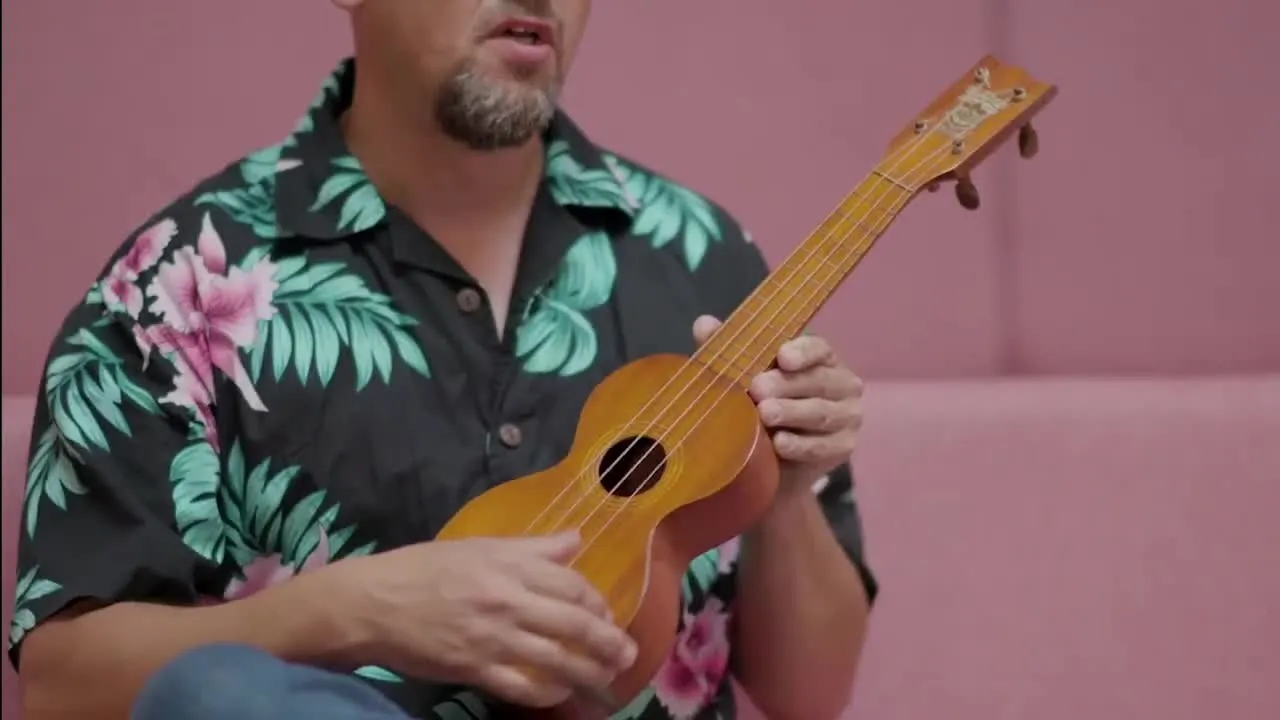
2. What does the Hawaiian name 'ukulele' mean in English?
🤯 Mind-Blowing Fact • Grade 2
Ukuleles come in four main family sizes from smallest to biggest: soprano, concert, tenor, and baritone!
✨ Word Sparks (Grade 2 Glossary)
Tap 🔊 to hear
koa
Golden Hawaiian tree prized for musical wood
soprano
Smallest, brightest standard size in ukulele family
royal
Belonging to a king or a queen
🪝
How did a long ocean voyage from Portugal to Hawaiʻi spark the birth of the ukulele?
1
Music Across the Ocean
Wiggle your wrist in a breezy up-and-down strum, and four bright strings instantly bring warm island breezes into the room! In 1879, woodworkers sailed from Madeira, Portugal, to Honolulu carrying small wooden instruments called machetes.
2
Golden Hawaiian Koa Wood
Hawaiian listeners fell in love with that cheerful sound, and local makers began carving a new cousin from native golden wood. Even King Kalākaua learned to play it and featured its sweet voice at island celebrations!
3
A Funny String Order
Try plucking the four strings from ceiling to floor—G, C, E, A—and listen for a neat trick. Instead of starting low, the top G string jumps higher than the middle C string, giving every chord a sparkly bounce!
1. Which special Hawaiian wood is famous for giving ukuleles warm sound and golden stripes?
2. Which string actually plays the lowest open note on a standard soprano ukulele?
🤯 Mind-Blowing Fact • Grade 3
Remember the playful rhyme 'My Dog Has Fleas'—its four melody notes match the exact G–C–E–A pitches used to tune a ukulele!
✨ Word Sparks (Grade 3 Glossary)
Tap 🔊 to hear
re-entrant
String tuning jumping high instead of climbing straight
mahogany
Reddish hardwood giving warm, balanced musical tone
baritone
Largest standard ukulele size with deeper pitch
🪝
What is 're-entrant tuning,' and why does it make a ukulele sound so much sunnier than a tiny guitar?
1
Small Body, Bright Voice
What would happen if you shrank a guitar to twenty-one inches, gave it four nylon strings, and rearranged how pitches climb? Strum once with the soft pad of your pointer finger and hear crisp acoustic cheer dance across the room!
2
The Secret of Re-Entrant Tuning
On most stringed instruments, pitches step neatly from lowest to highest across the fingerboard. Standard soprano, concert, and tenor ukuleles use tuning—G4, C4, E4, A4—where the top G string sits higher in pitch than the C and E strings beside it!
3
Tightly Clustered Harmony
Because all four open strings cluster inside a single musical sixth near the middle of a piano, chord notes overlap closely like twinkling bells. Low string tension lets the thin koa or soundboard vibrate freely with quick, lively resonance.
4
Four Sizes for Every Player
While twenty-one-inch sopranos deliver classic island sparkle, concert and twenty-six-inch tenor sizes add longer scale lengths, more frets, and fuller volume, and thirty-inch tune deeper like a guitar's top four strings.
1. What makes 're-entrant' G4–C4–E4–A4 tuning different from standard guitar tuning?
2. Which four-word phrase do musicians sing to remember standard ukulele string pitches?
🤯 Mind-Blowing Fact • Grade 4
At the 1915 World's Fair in San Francisco, the Hawaiian Pavilion's ukulele ensembles were such a sensation that mainland factories could barely build instruments fast enough to meet demand!
✨ Word Sparks (Grade 4 Glossary)
Tap 🔊 to hear
fluorocarbon
Dense clear polymer making bright ukulele strings
machete
Small four-string Portuguese lute ancestor of ukulele
voicing
Exact spacing and order of chord notes
🪝
How did three cabinetmakers aboard an 1879 sailing ship blend two Portuguese folk instruments into Hawaiʻi's beloved national treasure?
1
Honolulu Harbor, August 1879
Imagine standing on the Honolulu docks in August 1879 after a four-month sea voyage aboard the clipper ship Ravenscrag: exhausted passenger João Fernandes leaps ashore strumming a pint-sized four-string instrument, captivating everyone within earshot! Aboard that same vessel traveled three Madeiran cabinetmakers—Manuel Nunes, José do Espírito Santo, and Augusto Dias—who soon opened woodworking shops in Oʻahu.
2
Blending the Machete and Rajão
Rather than copying one European instrument, Hawaiian luthiers combined two Portuguese ancestors. From the four-string de braga they borrowed the compact figure-eight silhouette, while from the five-string rajão they adapted the clever re-entrant G–C–E–A interval pattern. Sculpted from luminous Acacia koa native to volcanic Hawaiian slopes and championed by King David Kalākaua, the ʻukulele quickly wove itself into hula and royal court song.
3
Acoustic Physics of a Small Air Cavity
Because a soprano body encloses a tiny air chamber with a short thirteen-inch vibrating string scale, its Helmholtz air resonance sits high in the midrange rather than booming in the bass. Lightweight nylon or dense strings transmit crisp transients across a small rosewood or koa saddle, letting rapid finger-strumming patterns cut cleanly through ocean breezes or ensemble vocals.
4
Global Craze to Modern Virtuosity
After Hawaiian musicians enchanted crowds of millions at San Francisco's 1915 Panama-Pacific International Exposition, sheet-music publishers printed ukulele chord grids on Tin Pan Alley hits, and modern virtuosos like Israel Kamakawiwoʻole and Jake Shimabukuro revealed its breathtaking emotional and technical range.
1. Which three Madeiran cabinetmakers arrived in Honolulu in 1879 and built the first Hawaiian ukuleles?
2. Why doesn't a tiny soprano ukulele produce deep booming bass notes?
🤯 Mind-Blowing Fact • Grade 5
Using campanella ('little bell') fingerings made possible by the high G4 string, a ukulele player can play a smooth scale where four notes ring simultaneously on four different strings without a single finger jumping frets!
✨ Word Sparks (Grade 5 Glossary)
Tap 🔊 to hear
campanella
Scale notes ringing overlapping across adjacent strings
endemic
Growing naturally in only one specific region
linear tuning
Strings ordered steadily from lowest to highest
🪝
How does compressing four strings into a narrow major-sixth span between C4 and A4 unlock harp-like chord inversions and rapid campanella melodies?
1
Campanella Sparkle in Four Strings
Pluck a rapid ascending scale across a soprano ukulele without lifting fingers early, and consecutive notes ring over one another like tiny bronze tower bells—a Baroque lute technique Italians named ('little bell'). Classified as a short-scale, four-course single-strung box chordophone, the ʻukulele turns compact dimensions into an unexpected harmonic advantage.
2
Transoceanic Organology: Madeira to Oʻahu
In August 1879, the British clipper Ravenscrag docked in Honolulu carrying Madeiran artisans Manuel Nunes, José do Espírito Santo, and Augusto Dias. Synthesizing the diminutive body geometry of Madeira's four-string machete de braga (tuned D–G–B–D) with the re-entrant intervals of the five-string rajão, they fashioned a local hybrid from Hawaiian Acacia koa. Under the royal patronage of King David Kalākaua—revered as the 'Merrie Monarch'—the instrument became an emblem of Hawaiian cultural sovereignty.
3
Re-Entrant Harmonics and Cavity Acoustics
Standard C6 tuning on soprano (330-millimeter scale), concert (380-millimeter scale), and tenor (430-millimeter scale) models pitches the fourth string at G4 (392.0 hertz), above C4 (261.6 hertz) and E4 (329.6 hertz) and just one whole step below the first string A4 (440.0 hertz). Spanning barely 120 to 180 newtons of cumulative tension across nylon, Nylgut, or high-density polyvinylidene fluoride (fluorocarbon) strings, thin fan- or ladder-braced koa plates radiate crisp upper partials around a Helmholtz air resonance near 270 to 320 hertz.
4
Linear Low-G and Baritone Extensions
Soloists seeking wider melodic compass often swap the high G4 for a wound linear low G3 (196.0 hertz), expanding open range downward by a perfect fourth, whereas the larger 485-to-510-millimeter baritone ukulele adopts linear D3–G3–B3–E4 tuning (146.8 to 329.6 hertz), mirroring a guitar's top four strings.
5
Enduring Global Cultural Ambassador
From the watershed 1915 Panama-Pacific International Exposition in San Francisco and Jazz Age Tin Pan Alley chord charts to Israel Kamakawiwoʻole's soulful medleys and Jake Shimabukuro's dazzling flamenco-and-rock fingerstyle pyrotechnics, four humble island strings continue uniting beginner circles and concert stages worldwide.