2. Which finger does a harpist leave resting instead of plucking?
🤯 Mind-Blowing Fact • Grade 2
All forty-seven strings pull on a concert harp's frame with nearly two thousand pounds of force—as heavy as a small car!
✨ Word Sparks (Grade 2 Glossary)
Tap 🔊 to hear
vertical
Standing straight up from bottom to top
pillar
Tall front post holding the harp strong
glissando
Smooth sliding sweep across many musical notes
🪝
What happens inside a tall golden harp when the musician steps on its seven brass pedals?
1
Music Like Starlight
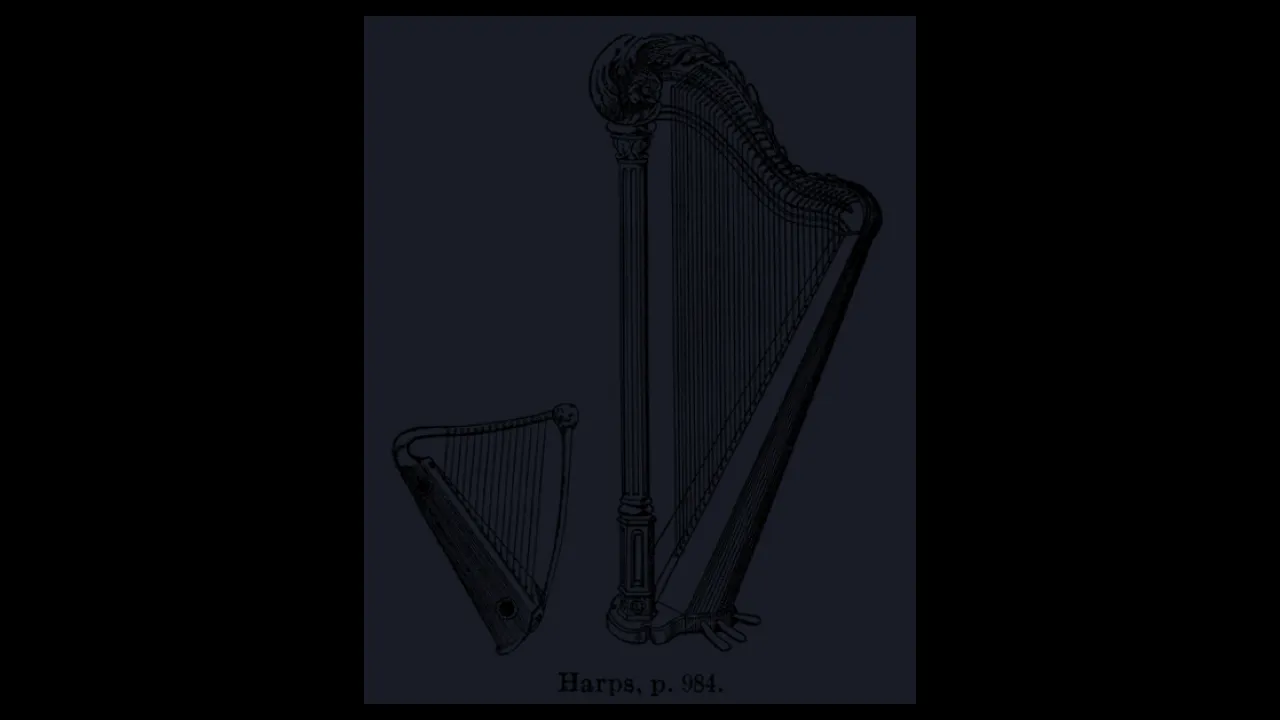
Close your eyes as a musician slides one thumb across a row of strings, filling the hall with a glittering sweep of sound. Standing six feet tall like a wooden triangle, the concert harp holds forty-seven strings of different lengths!
2
Short Highs and Long Lows
Short, thin strings near the player's face sing bright, high notes like chirping birds. Long, wire-wrapped strings near the tall front boom with deep, warm bass notes.
3
Seven Clever Foot Pedals
At the bottom of the harp sit seven brass pedals, and the harpist presses them with both feet while playing. Hidden rods inside the turn tiny metal pins at the top, tightening strings to make notes higher!
1. Where are the lowest, deepest notes located on a concert harp?
2. What is hidden inside the tall front pillar of a concert harp?
🤯 Mind-Blowing Fact • Grade 3
If a harpist sets pairs of strings to sound the exact same note with the pedals, sweeping across them creates a magical waterfall without a single sour note!
✨ Word Sparks (Grade 3 Glossary)
Tap 🔊 to hear
soundboard
Thin wooden surface that amplifies string vibrations
tension
Tight pulling force along a stretched string
pitch
How high or low a note sounds
🪝
Why do strings on a harp attach straight into the wooden soundboard instead of crossing a flat bridge like a guitar?
1
Ripples of Pure Resonance
What would happen if you plucked forty-seven strings spanning nearly the entire range of a grand piano? Lean a concert harp gently back against your right shoulder, sweep your fingertips across the strings, and hear a shimmering glissando ripple through the air!
2
A Triangle Built for Tension
Three sturdy wooden parts form a strong triangle: the hollow soundbox, the gracefully curved neck, and the tall upright pillar. Because forty-seven strings pull under enormous , the pillar braces the neck while strings rise straight out of the tilted spruce .
3
Direct Soundboard Vibration
When plucked, each gut, nylon, or wire-wound string tugs directly upward and downward on the spruce . That direct vibration creates warm acoustic resonance that pours out through soundholes along the back of the hollow body.
4
Pedals That Shift Pitch
Seven foot pedals at the base connect to hidden rods inside the pillar. Stepping a pedal into middle or bottom notches rotates small forked discs along the neck, gripping strings to shorten their length and raise their !
1. How do rotating metal discs on the harp's neck raise a string's pitch?
2. Which three materials are used for the forty-seven strings across a concert harp's range?
🤯 Mind-Blowing Fact • Grade 4
Inside the curved wooden neck and hollow pillar of a single modern concert harp live more than 1,400 precision brass linkages, springs, rods, and rotating discs!
✨ Word Sparks (Grade 4 Glossary)
Tap 🔊 to hear
fourchettes
Tiny two-pronged discs gripping harp strings
semitone
Smallest standard half-step distance between pitches
arpeggio
Notes of a chord played one after another
🪝
How did a nineteenth-century inventor hide over one thousand moving mechanical parts inside an instrument that looks like ancient sculpture?
1
Ancient Roots, Symphonic Power
Picture an instrument born thousands of years ago from a hunter's arched bow, now gleaming beneath orchestra lights as forty-seven vertical strings span six and a half octaves. One thumb glide unleashes an enchanting cascade of overtones, yet inside its carved column hides precision clockwork worthy of a master watchmaker.
2
Color Maps and Direct Acoustics
Unlike pianos with black and white keys, open harp strings look nearly identical in width until color rescues the eye: every C string is dyed crimson red and every F string deep blue or black. Strings emerge at an angle directly from a tapered Sitka spruce soundboard reinforced by a hardwood center strip, driving powerful vibrations straight into the tapered wooden resonator.
3
Érard's Double-Action Breakthrough
Early harps could play in only one scale without stopping to retune by hand. In 1810, French maker Sébastien Érard patented the double-action pedal harp. Seven foot pedals—one for each letter of the musical alphabet—link via rods inside the hollow pillar to brass plates in the curved neck, rotating two rows of forked discs called .
4
Three Notches Per Note
Each pedal clicks into three vertical slots: top notch leaves all strings of that note name flat, middle notch engages the upper disc to raise every octave to natural, and bottom notch engages the lower disc to sharpen them another . Composers such as Tchaikovsky, Debussy, and Ravel celebrated this agility with luminous , muffled harmonics, and shimmering enharmonic glissandos.
1. Who patented the double-action pedal mechanism in 1810 that transformed the modern concert harp?
2. When a harpist pushes the C pedal down from the top slot to the middle slot, which strings change pitch?
🤯 Mind-Blowing Fact • Grade 5
Harpists regularly pluck crisp flute-like harmonics by lightly pressing the outer edge of their palm against the exact midpoint of a string at the instant their thumb plucks it, doubling its frequency one octave higher!
✨ Word Sparks (Grade 5 Glossary)
Tap 🔊 to hear
enharmonic
Different note spellings sounding the exact pitch
harmonic curve
S-shaped harp neck matching string length physics
monofilament
Single solid strand of smooth synthetic fiber
🪝
How does a triangular wooden frame withstand nearly nine thousand newtons of string tension while shifting forty-seven strings across every chromatic key?
1
Cascading Over Six and a Half Octaves
Sweep a thumb from the lowest wire-wound C1 string vibrating at 32.7 hertz up to the highest nylon G7 string oscillating at 3,136 hertz, and a luminous wave of forty-seven pitches fills the symphony hall. Classified by organologists as a triangular frame chordophone, the concert grand pedal harp unites ancient open-string acoustics with intricate nineteenth-century mechanical engineering.
2
Harmonic Curve and Structural Physics
Notice the sweeping S-shaped arch of the upper wooden neck—called the . Its graceful contour is pure physics: string pitch depends jointly on length, linear mass density, and tension. Moving down the compass, strings transition from nylon in the treble to resonant cow gut in the midrange and tarnish-resistant copper- or steel-wound bass wires, collectively exerting roughly 7,000 to 9,000 newtons of pull.
3
Perpendicular Soundboard Coupling
Unlike lutes and violins whose strings pass parallel over a bridge, harp strings pierce a tapered Sitka spruce soundboard at an acute thirty-five-to-forty-degree angle. Plucking with four fingers of each hand—thumbs, index, middle, and ring fingers, omitting the weaker fifth digit—drives transverse impulses directly into the unbraced cross-grained spruce plate, yielding rapid, bell-like attack and lush sympathetic decay.
4
Double-Action Chromatic Kinematics
Perfected by Sébastien Érard in 1810, seven spring-loaded brass pedals sit in two groups around the base: D, C, and B for the left foot; E, F, G, and A for the right. Depressing any pedal pulls a steel rod up the hollow column, pivoting bell cranks housed between brass neck plates to rotate two tiers of two-pronged fourchette discs that pinch strings into natural or sharp positions.
5
Enharmonic Magic in the Repertoire
Because adjacent strings can be pedaled into equivalents—such as B-sharp sounding identical to C-natural, or F-sharp matching G-flat—harpists can configure all forty-seven strings into four-note chords and sweep uninterrupted glissandos without sounding non-harmonic tones. From Tchaikovsky's ballet cadenzas and Debussy's Impressionist tone poems to Ravel's chamber masterworks, this feat of acoustic artistry remains irreplaceable.