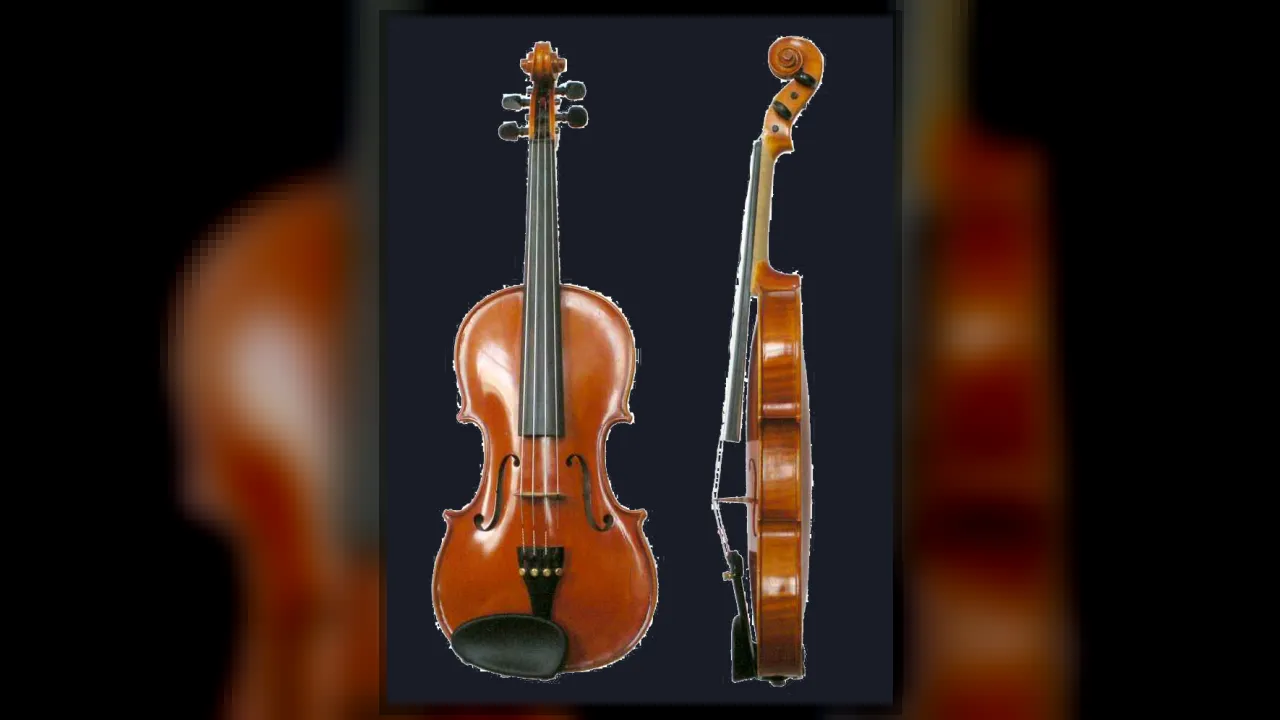
🪵 Materials & RangeCarved Spruce, Maple & Ebony • ~4.5 Octaves (G3 to A7+)
🔊 How Sound Is MadeRosined horsehair bow grips and releases strings to vibrate a hollow wooden soundbox
⚡ Signature Sound SparkSmallest, brightest orchestra string instrument—able to whisper sweet lullabies or dazzle with lightning-fast solos
🤯 Mind-Blowing Fact • Grade 1
A single violin bow is strung with 150 to 200 real hairs from a horse's tail!
✨ Word Sparks (Grade 1 Glossary)
Tap 🔊 to hear
bow
Wooden stick strung tight with horsehair
rosin
Hardened tree sap rubbed onto bow hair
pluck
Pull and let go of a string
🪝
How can hair from a horse's tail make a wooden box sing like a bird?
1
Zing, Sing, Soar!
Hush—the concert hall grows quiet! One musician lifts a shiny wooden box under her chin, glides a across four strings, and bright music fills the room.
2
Strings and Sticky Rosin
Each holds flat hairs rubbed with tree sap called . Rosin helps the bow gently tug the strings. Players can strings with fingers, too!
3
Smallest String Star
This instrument plays the highest notes in the string family. Fiddles at square dances and concert violins are the very same instrument!
1. Why do players rub sticky rosin onto the horsehair of a violin bow?
2. What is the real difference between a concert 'violin' and a country 'fiddle'?
🤯 Mind-Blowing Fact • Grade 2
Although a violin weighs only about 14 ounces, its four tight strings pull on the wooden body with nearly 50 to 60 pounds of tension!
✨ Word Sparks (Grade 2 Glossary)
Tap 🔊 to hear
bridge
Thin carved wood arch supporting the strings
f-holes
Curved openings letting sound leave the body
pitch
How high or low a note sounds
🪝
Why does a hollow wooden box weighing less than a loaf of bread fill a giant concert hall without a microphone?
1
Tiny Weight, Huge Voice
Pick up a full-size violin and surprise—it weighs less than a pound! Yet when a soloist draws a bow across its four tight strings, the clear golden melody reaches the very back balcony over eighty other musicians.
2
Crafted in Sunny Italy
Nearly five hundred years ago in Cremona, Italy, master woodworkers like Andrea Amati and Antonio Stradivari perfected this graceful curve-waisted design. They carved light spruce wood for the top and curly maple for the back.
3
Through the Bridge and f-Holes
Pressing fingers down on the black ebony fingerboard shortens a string to raise its higher. Vibrations race down a thin wooden into the hollow body and pour out through twin S-shaped openings called !
1. What happens to a violin note's pitch when a player presses a finger down to make the vibrating part of the string shorter?
2. Which Italian city became world-famous in the 1500s and 1700s for master violin makers like Amati and Stradivari?
🤯 Mind-Blowing Fact • Grade 3
Only about 650 original violins, violas, and cellos crafted by Antonio Stradivari three centuries ago still survive today—and concert soloists still play them on world stages!
✨ Word Sparks (Grade 3 Glossary)
Tap 🔊 to hear
luthier
Artisan who builds and repairs string instruments
soundpost
Internal wooden dowel linking top and back
pizzicato
Playing bowed strings by plucking with fingers
🪝
Why is a tiny unglued wooden stick hidden inside a violin nicknamed 'the soul' of the instrument?
1
Seventy Carved Pieces Working as One
Tap gently on a spruce tabletop and hear how lively the wood rings! Master instrument makers—called —assemble a violin from about seventy hand-carved pieces of seasoned spruce, maple, and ebony using hide glue without a single metal nail or screw.
2
Four Strings Tuned in Fifths
Tuned from lowest to highest as G, D, A, and E, the four strings stretch from a carved scroll and tuning pegs over an arched bridge. Because the bridge curves like a rainbow, the player can tilt the bow to sing on one string at a time or two together!
3
Inside Secrets: Bass Bar and Soundpost
Peek through the twin f-holes and you will spot a vertical spruce dowel wedged snugly between the top and back plates right under the bridge's foot. Italian makers call this 'l'anima'—the soul—because without it, the violin's booming voice turns thin and quiet.
4
Bowing, Plucking, and Shimmering
From soaring symphony melodies and Indian Carnatic ragas to Irish reels and jazz solos, players shape endless colors by bowing smoothly (legato), plucking with fingertips (), or rocking a left fingertip for warm vibrato.
1. Why is the wooden bridge on a violin carved in a rounded arch instead of completely flat?
2. What does the Italian musical direction 'pizzicato' tell a violinist to do?
🤯 Mind-Blowing Fact • Grade 4
In South Indian Carnatic classical music, violinists sit cross-legged and rest the scroll steadily against their ankle—freeing their left hand to glide effortlessly through intricate microtonal slides called gamakas!
✨ Word Sparks (Grade 4 Glossary)
Tap 🔊 to hear
stick-slip motion
Rhythmic gripping and snapping that vibrates strings
How does a slow-moving horsehair bow trick a string into snapping back and forth hundreds of times per second?
1
Stick-Slip Physics Under the Microscope
Watch a high-speed camera zoomed in on a bowed A4 string vibrating 440 times per second: the string doesn't curve smoothly—it forms a sharp V-shaped kink racing around in a loop! German physicist Hermann von Helmholtz discovered that sticky pine rosin grabs the string and pulls it sideways until tension snaps the string loose, repeating this 'stick-slip' cycle hundreds of times every second.
2
Why Strings Need a Soundboard
Stretch a thin violin string between two bricks and bow it: you will barely hear a mosquito-like buzz because a skinny wire slices through air without pushing many air molecules. Resting the strings on a carved maple bridge transfers rapid vibrations into the broad, lightweight spruce top plate, turning the body into a natural acoustic amplifier.
3
Asymmetry Inside the Soundbox
Inside the body, two hidden spruce components balance high and low frequencies. Glued lengthwise beneath the low G-string foot of the bridge, a long strip called the stiffens the top plate and spreads warm bass vibrations; wedged beneath the high E-string foot, the vertical soundpost anchors one side so the opposite plate rocks like a loudspeaker cone, pumping air efficiently out of the f-holes.
4
A Global Chameleon of Expression
Perfected in 1550s northern Italy by Andrea Amati and Gasparo da Salò and elevated by Cremonese masters Stradivari and Guarneri, the violin anchors orchestra first- and second-violin sections while thriving equally in South Indian Carnatic music (held poised between collarbone and ankle!), mariachi ensembles, bluegrass, and film scores.
1. Why does a stretched violin string make almost no sound by itself without the hollow wooden body underneath?
2. How do the internal soundpost and bass bar work together beneath the bridge's two feet?
🤯 Mind-Blowing Fact • Grade 5
Fluid-dynamics scientists at MIT proved that evolving from Renaissance circular soundholes to slender Italian 'f-holes' doubled the acoustic airflow power of a violin's low register because air moves fastest right along the hole's longer edge!
✨ Word Sparks (Grade 5 Glossary)
Tap 🔊 to hear
Helmholtz resonance
Air-cavity vibration echoing out through soundholes
overtone
Higher multiple frequency enriching a note's tone
sul ponticello
Bowing near bridge for glassy, shimmering harmonics
🪝
How did Renaissance Italian luthiers intuitively solve complex structural acoustics that supercomputers are still decoding centuries later?
1
Cremonese Craft and Structural Elegance
Before the curtain rises on a violin concerto, sixty orchestral strings tune to A4 = 440 Hz—a ritual unchanged in spirit since Andrea Amati standardized the four-string violin in mid-16th-century Cremona. Weighing roughly 400 grams yet resisting nearly 250 newtons of combined string tension and ~90 newtons of downward bridge load, a concert violin represents an extraordinary triumph of thin-shell structural engineering.
2
Helmholtz Motion and Harmonic Overtones
Tuned in perfect fifths (G3 = 196 Hz, D4 = 293.7 Hz, A4 = 440 Hz, E5 = 659.3 Hz) and spanning over four and a half octaves past A7, modern synthetic- or gut-core wound strings alongside steel E strings undergo nonlinear Helmholtz stick-slip oscillation under a concave Pernambuco-wood or carbon-fiber bow. Bowing closer to the bridge () boosts shimmering upper harmonics; bowing over the fingerboard (sul tasto) softens high partials into a flute-like whisper.
3
Modal Resonance, f-Hole Airflow, and the 'Singer's Formant'
Acoustic researchers at MIT and European labs discovered why elongated S-shaped f-holes outperformed earlier Renaissance round rose holes: airflow accelerates fastest around the perimeter edge of an opening, so slender f-holes maximize perimeter length for Helmholtz cavity air resonance (~275 Hz, the A0 mode) without weakening the arched Norway-spruce top plate! Above 2,000–3,500 Hz, intricately graduated plate thicknesses create a 'bridge hill' resonance matching the human ear's peak sensitivity—letting a solo Stradivari or Guarneri soar effortlessly above eighty orchestral players.
4
Wood Anisotropy and Varnish Myths
Rather than a single 'magic varnish,' acoustic excellence stems from quarter-sawn Picea abies spruce—prized for its ultra-high speed of sound along the grain paired with low density—coupled to figured Acer pseudoplatanus maple backs, calibrated by tap-tuning the free plates' Chladni vibration patterns to within fractions of a millimeter.
5
Virtuosity Across Centuries and Continents
From Baroque polyphony by J. S. Bach and Niccolò Paganini's caprices to Arabic maqam ensembles, Carnatic ragas, Stéphane Grappelli's swing jazz, and five-string piezoelectric acoustic-electric stages, the violin remains humanity's quintessential agile singing voice in wood.