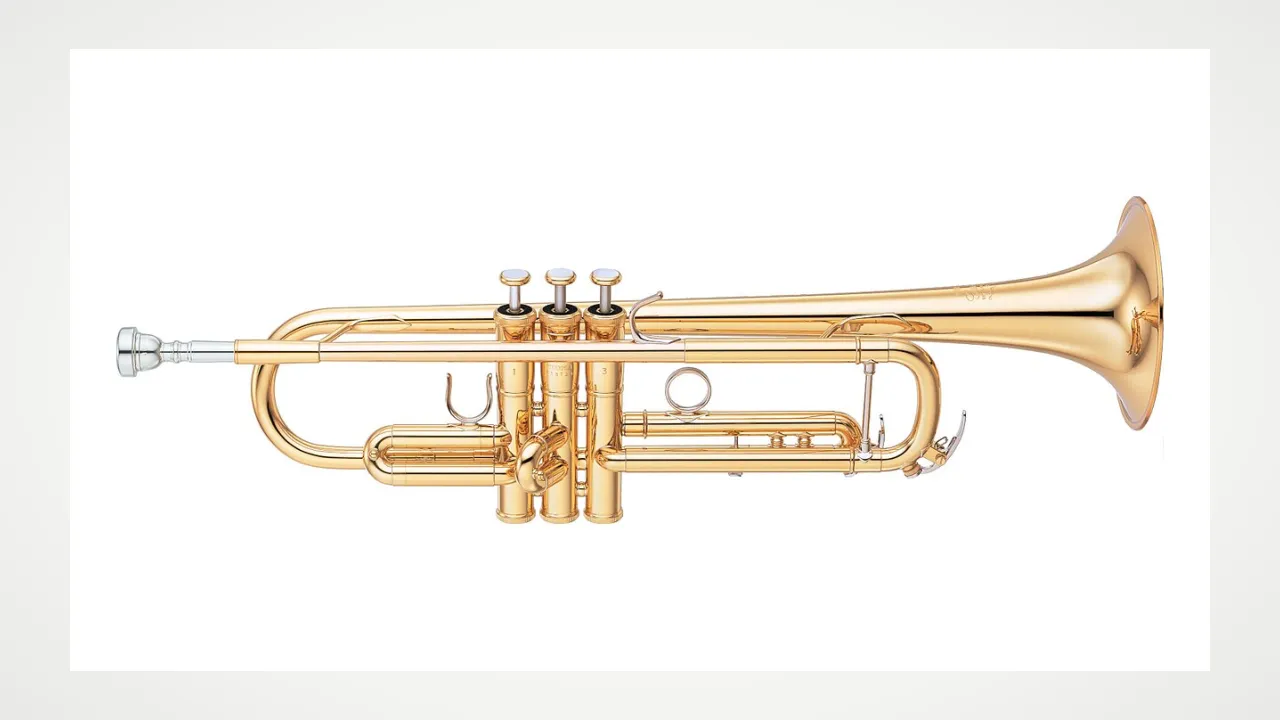
1. How many piston valves sit on top of a standard concert trumpet?
2. What actually vibrates first to start a trumpet's sound?
🤯 Mind-Blowing Fact • Grade 2
Jazz trumpeters slip cone-shaped cups called mutes into the flared bell to turn bold blasts into cool, whispery voices!
✨ Word Sparks (Grade 2 Glossary)
Tap 🔊 to hear
piston
Sliding metal cylinder moving up and down
detour
Longer side path around the main route
mute
Cone placed in bell to soften tone
🪝
How can just three buttons on a trumpet unlock dozens of low, middle, and high musical notes?
1
King Tut's Ancient Horns
More than three thousand years ago, craftspeople placed two straight silver and bronze trumpets inside young King Tutankhamun's tomb in Egypt! Those ancient horns had zero buttons and could only blast a few bold signal calls.
2
Detours Inside the Loops
Modern trumpets bend nearly five feet of brass into a tidy handheld loop. Whenever a finger presses down a valve, holes inside the cylinder redirect your air into an extra side loop—making the path longer and the pitch lower!
3
Lips plus Valves
Tightening your lips for faster buzzes leaps upward from low notes to sparkling high notes without needing dozens of keys, letting one shiny horn play marches, jazz, and classical fanfares.
1. What happens to the air path when you press down a trumpet valve?
2. Where do trumpeters place a mute when they want to change their tone color?
🤯 Mind-Blowing Fact • Grade 3
Trumpet legend Miles Davis removed the center stem from a metal Harmon mute and played right against the microphone, creating one of the most famous sounds in jazz!
✨ Word Sparks (Grade 3 Glossary)
Tap 🔊 to hear
casing
Outer metal tube housing a moving valve
rotary valve
Spinning brass cylinder redirecting air sideways
half-step
Smallest step from one note to neighbor
🪝
Why does the middle valve lower a note just a tiny step while the third valve drops it three times as far?
1
Secret Code of the Three Slides
Look closely at the extra loops poking out from a trumpet's three valve and you will spot three different lengths! The middle second slide is tiny—dropping pitch by one . The first slide drops a whole step, and the long third slide drops three half-steps!
2
Seven Fingerings Times Many Harmonics
Combining three valves up or down gives seven tube lengths, just like seven slide positions on a trombone. By reshaping embouchure tension and air speed, a trumpeter climbs nature's harmonic ladder on every combination.
3
Straight Tube, Brilliant Bite
For most of its journey, a trumpet's brass tubing stays narrow and cylindrical before flaring sharply at the bell. That straight bore preserves bright high overtones so one solo trumpet cuts cleanly over eighty orchestral players!
4
Piston vs. Rotary Styles
While American, French, and jazz players love vertical piston valves pressed from the top, classical orchestras in Vienna and Berlin often play rotary-valve trumpets with smooth sideways paddles that blend warmly with strings and woodwinds.
1. Which trumpet valve has the shortest extra tubing loop and lowers pitch by just one half-step?
2. Why can a single unamplified trumpet be heard clearly over an entire symphony orchestra?
🤯 Mind-Blowing Fact • Grade 4
Tiny piccolo trumpets coiled half as long as standard B-flat horns help modern soloists sparkle through Bach's sky-high Brandenburg Concerto No. 2!
✨ Word Sparks (Grade 4 Glossary)
Tap 🔊 to hear
clarino
High-register Baroque art of playing valveless trumpets
intonation
Accuracy of pitch being perfectly in tune
piccolo trumpet
Miniature trumpet pitched one octave higher
🪝
How did Baroque trumpeters play dazzling high melodies for Johann Sebastian Bach more than a century before valves were invented?
1
Clarino Magic on Eight-Foot Tubes
Before German inventors Heinrich Stolzel and Friedrich Bluhmel patented brass valves around 1818, natural trumpets were twice as long as modern horns and lacked a single button! Because natural harmonics bunch closely together high up in the fourth octave, Baroque masters cultivated ultra-high '' playing using extraordinary lip precision alone.
2
Acoustic Rescue by Mouthpiece and Bell
Pure physics poses a riddle: a straight cylindrical tube closed at one end by buzzing lips should sound only odd harmonics—producing out-of-tune notes! Makers solved this by pairing a resonant cup mouthpiece with an exponentially flaring bell, which shifts the standing waves into a clean, in-tune whole-number harmonic series.
3
Thumb Saddles and Intonation Slides
Even modern three-valve horns face subtle math challenges: when pressing valves 1 and 3 together for low D—or all three valves for low C-sharp—the combined tubing runs slightly too short, making those pitches noticeably sharp! Skilled trumpeters flick out a movable third-valve finger ring mid-note to stretch the tube into pure tune.
4
Reinventing Modern Music
From Louis Armstrong's revolutionary 1920s Hot Five solos in Chicago and Dizzy Gillespie's upturned bebop bell to Maurice Andre and Wynton Marsalis performing both Haydn concertos and swing standards, the B-flat trumpet reshaped twentieth-century music worldwide.
1. How did Baroque musicians play step-by-step melodies on valveless natural trumpets?
2. Why does a concert trumpet have a sliding ring on its third valve slide?
🤯 Mind-Blowing Fact • Grade 5
Inside a trumpet blown at full fortissimo volume, internal sound pressure reaches over 170 decibels—loud enough inside the narrow brass bore that wave peaks literally overtake wave valleys!
✨ Word Sparks (Grade 5 Glossary)
Tap 🔊 to hear
labrosone
Instrument sounded by vibrating the player's lips
Helmholtz resonance
Air resonance inside a hollow cupped cavity
wave steepening
High-pressure peaks catching up to sharpen sound
🪝
What nonlinear shock-wave physics turns gentle lip oscillations into the blazing 'brassy' roar of a fortissimo orchestral trumpet?
1
Impedance Transformation in a Cylindrical-Bell Bore
A lone B-flat trumpet opens Gustav Mahler's Fifth Symphony with crisp triplets that slice effortlessly across three thousand concert seats. Under Hornbostel-Sachs 423.232 (valved tubular with predominantly cylindrical bore), the modern B-flat instrument coils roughly 148 centimeters of ~11.7-millimeter yellow-brass tubing before flaring rapidly into a 125-millimeter terminal bell.
2
Shifting Odd Modes into Harmonic Alignment
Left unaltered, a lip-closed cylinder operates as a quarter-wave resonator producing odd multiples (1f, 3f, 5f) unusable for Western harmony. Two engineered elements recalibrate bore impedance: the flared Bessel-horn bell pulls low-frequency resonances upward by reflecting waves earlier, while the of the hemispherical cup mouthpiece (~850 hertz 'popping frequency') pulls upper modes downward—aligning resonances 2 through 12 into whole-number harmonic ratios spanning concert E3 (164.8 hertz) past C6 (1,046.5 hertz).
3
Nonlinear Wave Steepening ('Cuivre')
Why does blowing louder transform a warm mezzo-piano horn into a blazing laser beam? Inside the long narrow cylindrical bore, high-pressure wave crests travel slightly faster in compressed warm air than wave troughs! Over 1.48 meters, fortissimo pressure waves physically steepen toward tiny acoustic shock fronts, pumping massive spectral energy into upper harmonics between 2,000 and 6,000 hertz.
4
Perinet Pistons, Orchestral Keys, and Heckel Rotors
Perfected by Francois Perinet in Paris in 1838, spring-loaded vertical pistons dominate French, British, and American playing alongside brighter orchestral C trumpets (preferred in American symphonies), D/E-flat solo horns, and four-valve B-flat/A piccolo trumpets, whereas German and Austrian orchestras favor Heckel-style rotary valves coupled to wider bores and broader bells for a darker, weightier symphonic blend.
5
Architect of Jazz and Classical Virtuosity
From Egyptian silver battle horns and Gottfried Reiche's Baroque clarino feats for Bach to Louis Armstrong, Miles Davis, Dizzy Gillespie, Clifford Brown, Maurice Andre, Håkan Hardenberger, and Wynton Marsalis, this gleaming brass cylinder became modern music's ultimate herald.