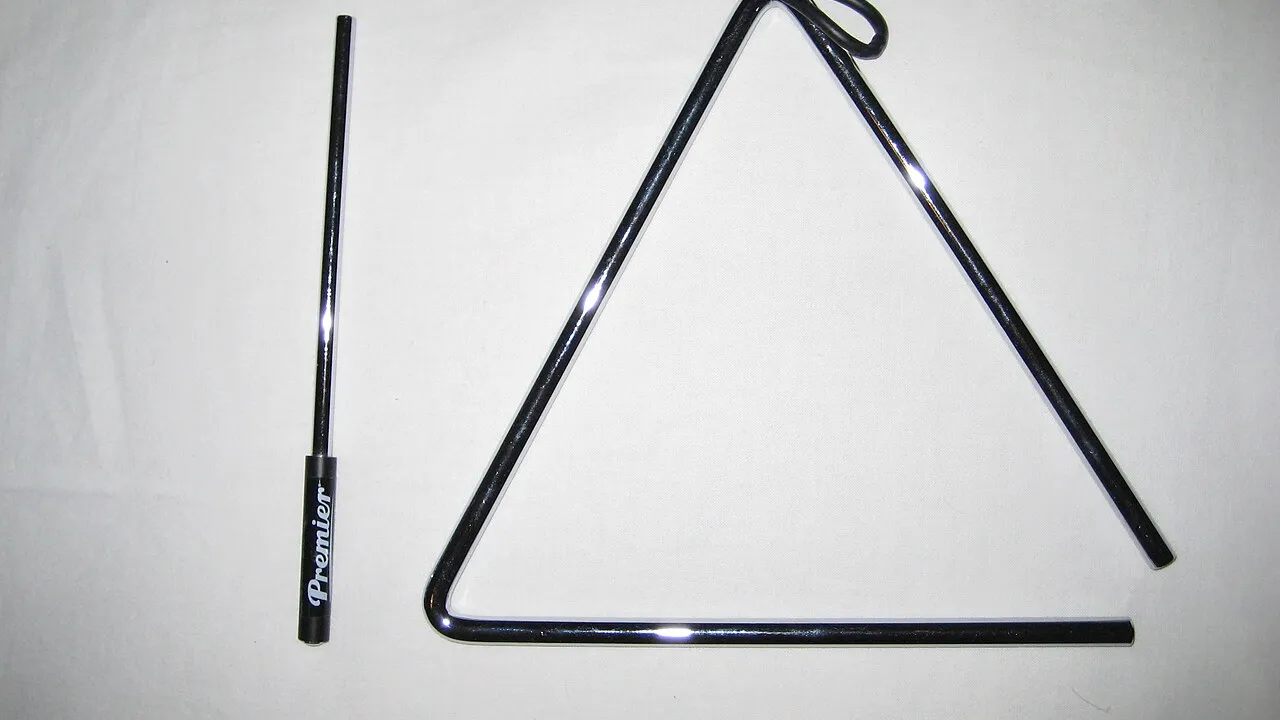
1. Why does a musical triangle have a tiny open gap at one corner?
2. Why must a triangle hang from a thin string loop instead of being gripped in your fist?
🤯 Mind-Blowing Fact • Grade 2
Medieval triangles six hundred years ago had three to five loose metal rings threaded onto the bottom bar that jingled like a tambourine with every tap!
✨ Word Sparks (Grade 2 Glossary)
Tap 🔊 to hear
trill
Rapidly bouncing beater inside a closed corner
frequency
How fast sound waves vibrate each second
hardened
Heated and cooled to stay extra strong
🪝
How can a bent steel bar smaller than a dinner plate outshine giant brass horns and drums?
1
Small Size, Mighty Sparkle!
Ping-shimmer-ring! Right when trumpets blaze and timpani rumble, one bright silvery bell-tone floats effortlessly over the entire orchestra! No microphones help it—just eight inches of steel or bronze bent into three sides.
2
Climbing Above the Crowd
Why isn't the triangle drowned out? Tubas, cellos, and drums fill up the low and middle sound lanes, leaving the super-high sky wide open! Because the triangle rings way up in crisp, twinkling high frequencies, your ears spot it instantly.
3
Fast Corner Trills
For exciting moments, the percussionist wiggles the metal beater rapidly inside a closed top corner, creating a shimmering silver roll!
1. Why can listeners hear a tiny triangle over ninety louder orchestra instruments?
2. How does a percussionist play a fast, continuous roll on a triangle?
🤯 Mind-Blowing Fact • Grade 3
In Brazilian *forró* and Louisiana Cajun music, players open and close their holding fingers rhythmically on a heavy triangle to make funky 'chicka-TING-chicka-TING' grooves!
✨ Word Sparks (Grade 3 Glossary)
Tap 🔊 to hear
inharmonic
Overtones spaced unevenly without one single note
concerto
Piece showcasing a soloist with an orchestra
tit-fer
Cajun French name meaning 'little iron' triangle
🪝
Why did critics laugh when composer Franz Liszt gave the tiny triangle a starring solo in a piano concerto?
1
The Famous 'Triangle Concerto'!
Imagine the surprise inside a grand German concert hall in 1855 when composer Franz Liszt premiered his First Piano —and handed a playful, spotlight solo right to the humble triangle! Grumpy critics nicknamed the piece the 'Triangle Concerto,' yet audiences adored its glittering charm.
2
Why the Open Corner Hides Single Pitch
When a steel beater taps a closed metal ring, waves lock into one fixed note that might clash with the orchestra's chords. Leaving one corner open turns the triangle into a bent free-ended rod whose overtones scatter into a silvery cloud that fits harmoniously in every musical key!
3
Forty Shades of Silver
Symphony percussionists don't own just one beater! They keep slim, medium, and heavy steel or brass wands—and strike different spots along the bottom or side bars—to coax warm chimes or icy, glittering pings.
4
Grooved Cajun Cousins
In Louisiana Cajun bands, a heavy iron triangle called the drives infectious dance rhythms!
1. How does leaving one corner open help a triangle play with an orchestra in any key?
2. Which 1855 Romantic work famously surprised critics with a soloistic dialogue for the triangle?
🤯 Mind-Blowing Fact • Grade 4
To keep an orchestral triangle from spinning away during rapid two-handed rhythms, percussionists suspend it from *two* tiny nodal fishing-line loops spaced half an inch apart on a wooden clip!
✨ Word Sparks (Grade 4 Glossary)
Tap 🔊 to hear
pianissimo
Musical instruction meaning play very softly
equilateral
Having all three sides equal in length
phosphor bronze
Warm-sounding copper alloy prized for concert triangles
🪝
Why is playing a single quiet *pianissimo* note on a triangle considered one of the most nerve-racking jobs in an orchestra?
1
Precision Under the Microscope
Ask orchestral percussionists which instrument demands the steadiest hands and many will point straight to the six-inch steel triangle! Because its crystalline overtones between 2,000 and 14,000 Hz pierce through silence with zero place to hide, even a one-millimeter slip on the braided gut suspension loop can twist the triangle sideways or double-bounce the beater.
2
From Ringed Medieval Trapezoids to Classical Clarity
Fourteenth-century illuminated manuscripts show angel musicians tapping stirrup-shaped and trapezoidal irons strung with jingling rings. Late in the 1700s, European makers dropped the noisy rings and forged pure carbon-steel rods—just in time for Mozart's 1782 opera The Abduction from the Seraglio and the joyous Turkish march inside Beethoven's Ninth Symphony.
3
Bending-Wave Physics at the Two Corners
Where you strike changes which vibration modes wake up! Tapping dead center on the horizontal bottom bar excites simple symmetric bending for a pure, bell-like chime, whereas striking forty-five degrees onto the closed right side bar drives waves sharply around the two solid corners—unleashing a dense, shimmering wash of overtones that blends smoothly into strings and woodwinds.
1. Why do orchestral players often strike the angled side bar instead of the center of the bottom bar?
2. How did medieval European triangles look and sound different from modern concert triangles?
🤯 Mind-Blowing Fact • Grade 5
Inside a steel triangle rod, longitudinal compression sound waves race at over 5,000 meters per second—nearly fifteen times faster than sound travels through the concert hall air!
✨ Word Sparks (Grade 5 Glossary)
Tap 🔊 to hear
dispersive
High-frequency waves traveling faster than low ones
flexural
Side-to-side bending motion along a solid rod
longitudinal
Push-pull compression waves racing down metal
🪝
Why do bending waves in a solid steel rod travel at *different* speeds depending on frequency—and how does that create acoustic stardust?
1
Organology of the Struck Bent-Rod Idiophone
Classified under Hornbostel-Sachs 111.211 as an individual struck idiophone formed from a bent elastic rod, the concert triangle typically measures 15 to 25 centimeters (6 to 10 inches) per side and 8 to 12 millimeters in rod diameter. Forged from hardened high-carbon steel or hand-tapered B8/phosphor bronze with one vertex left open by 8 to 15 millimeters, it suspends from a low-mass gut or monofilament loop positioned at the upper closed vertex.
2
Dispersive Euler–Bernoulli Beam Acoustics
Unlike a stretched violin string—where wave speed stays nearly constant across frequencies to yield neat integer harmonics (f, 2f, 3f)—a stiff metal rod obeys Euler–Bernoulli bending physics: high-frequency waves actually race faster down the steel than low-frequency waves! Consequently, a straight free-free rod's overtones stretch apart quadratically (1.00f, 2.76f, 5.40f, 8.93f), avoiding harmonic alignment.
3
Mode Coupling Across Two 60-Degree Bends
Bending that straight rod into two sharp 60-degree corners adds a remarkable acoustic twist. Whenever a transverse (sideways) bending wave hits a corner, geometric coupling converts part of its energy into ultra-fast (compression) waves and out-of-plane torsional waves! This multi-directional mode conversion packs hundreds of bright, slightly beating resonances between 1,500 Hz and 18,000 Hz, producing sustained, pitchless silver brilliance.
4
Tapered Ends, Beater Mass, and Spectral Masking
Artisan concert triangles taper subtly toward the two open tips, smoothing impedance reflections to eliminate dominant 'clang' tones while concentrating acoustic energy above 3,000 Hz—well above the orchestra's dense 100-to-1,500 Hz masking zone. Selecting a light 4-millimeter steel wand shortens contact duration to microsecond impacts that brighten upper partials, whereas a heavier 9-millimeter bronze beater deepens warm midrange bell partials.
5
Orchestral Gemstones and Global Rhythms
Whether lighting up the third movement of Brahms's Fourth Symphony, sparkling in Dvořák's New World Symphony, or driving syncopated Afro-Brazilian baião and Louisiana Cajun dance grooves, the open-corner triangle proves minimalist physics can effortlessly outshine symphonic giants.