Terracotta Army of Xi'an
China’s Silent Soldiers Guarding an Ancient Secret
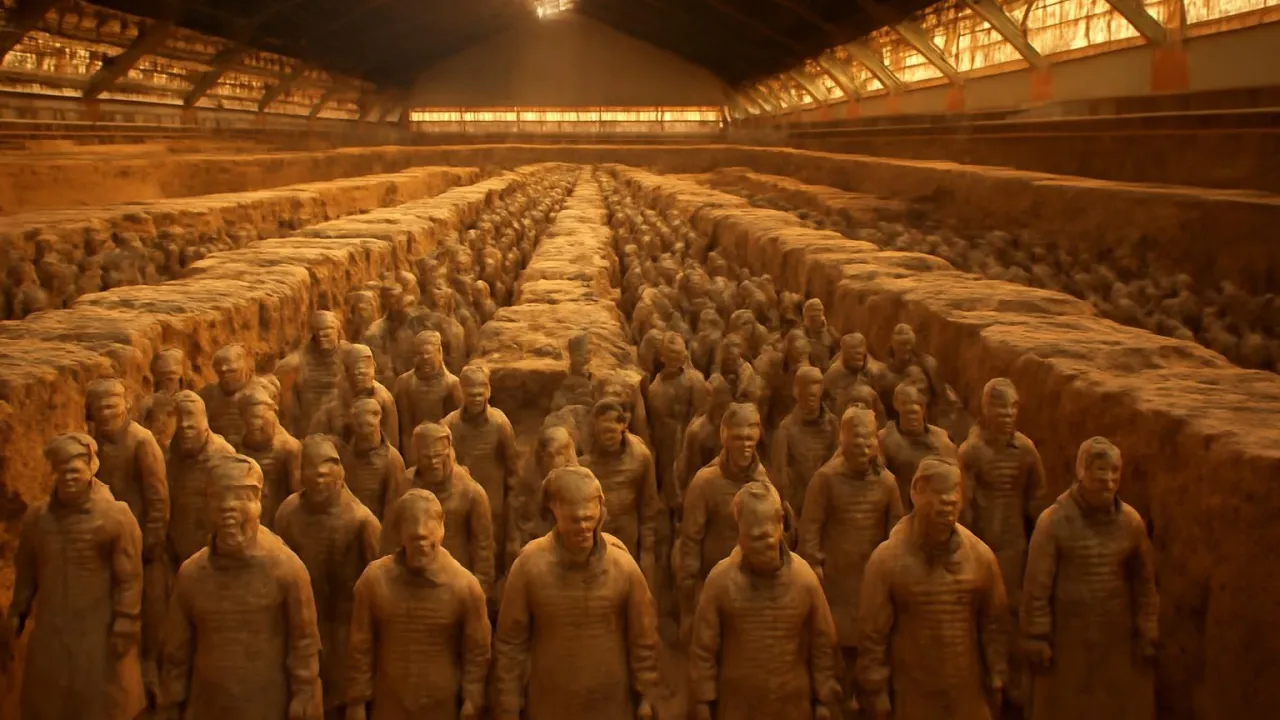
The Terracotta Army’s bronze weapons were coated with chromium, making them surprisingly rust-resistant for over 2,000 years.
1 Discovery Beneath the Fields
In 1974, while digging a well in Xi'an’s Lintong District, local farmers unearthed fragments of pottery that would lead to one of the greatest archaeological discoveries in history. Archaeologists soon uncovered vast underground pits filled with over 8,000 life-sized terracotta soldiers, 520 horses, and 130 chariots, all created to guard the tomb of China’s first emperor, Qin Shi Huang. The burial complex, constructed between 246 and 208 BCE, stretches over 20 square miles, reflecting the immense power and ambition of the Qin Dynasty. The Terracotta Army remained hidden for more than two millennia, perfectly preserved beneath layers of earth.
2 Engineering Marvels of the Qin Dynasty
Crafting the Terracotta Army required extraordinary engineering, artistic skill, and organization. Artisans used local yellow clay, shaping each warrior’s torso, limbs, and head separately before assembling them with a clay slip. After assembly, the figures were fired at temperatures exceeding 1,000°C in massive kilns, a process that gave the clay its durable, stone-like hardness. Artists hand-carved facial expressions, hairstyles, and armor, ensuring that no two soldiers were identical. The original warriors were painted with bright mineral pigments, but exposure to air caused most colors to fade rapidly after excavation.
3 Military Realism and Formation
The Terracotta Army is arranged in precise military formations, mirroring real Qin Dynasty battle tactics. Infantry, archers, cavalry, and charioteers are positioned according to rank and function, with commanding officers distinguishable by their elaborate armor and headgear. Each warrior holds a unique weapon—bronze swords, spears, or crossbows—demonstrating advanced metallurgical techniques for the era. The horses and chariots further illustrate the importance of cavalry and mobility in ancient Chinese warfare. This attention to detail provides historians with invaluable insight into the military organization and technology of the time.
4 Historical and Cultural Significance
The Terracotta Army was constructed as a form of , intended to protect Emperor Qin Shi Huang in the afterlife and demonstrate his absolute authority. The site offers a window into the social hierarchy, craftsmanship, and beliefs of the Qin Dynasty, which unified China under a centralized government. Archaeological studies of the site have revealed not only the scale of the emperor’s ambitions but also the labor and resources required—thousands of workers, complex logistics, and advanced kiln technology. The discovery has revolutionized our understanding of ancient Chinese civilization and its global influence.
5 A Living Legacy
Today, the Terracotta Army is recognized as a UNESCO World Heritage Site and attracts millions of visitors annually. Ongoing excavations continue to yield new warriors, weapons, and artifacts, deepening our knowledge of ancient engineering and artistry. scientists use advanced techniques to preserve the delicate pigments and repair damaged figures, ensuring the army’s survival for future generations. The site stands as a testament to human ingenuity, cultural heritage, and the enduring mysteries of the past. Its discovery has inspired a global appreciation for archaeology and the preservation of world wonders.
1. How did the Terracotta Army’s weapons remain rust-free for so long?
2. What does the arrangement of the army teach us about the Qin Dynasty?