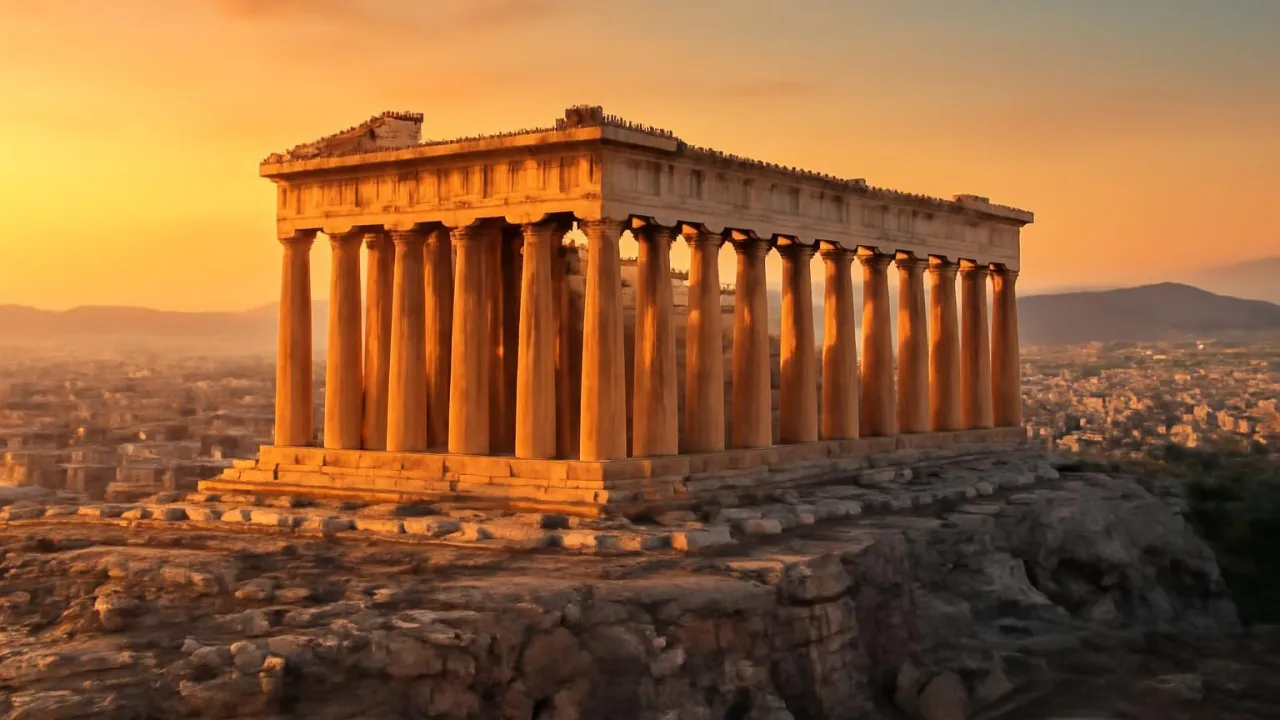
The Parthenon's columns lean slightly so your eyes see them as perfectly straight!
✨ Word Sparks (Grade 2 Glossary)
Tap 🔊 to hear
temple
A place to honor gods
myths
Old stories about heroes or gods
marble
A shiny white rock used for buildings
🪝
Can you imagine standing where ancient Greeks once cheered and prayed?
1
A Hill Above the City
The Acropolis rises high above Athens, shining in the bright sunlight. People climb up stone steps to reach the top. From there, you can see the whole city spread out below.
2
The Parthenon's Marble Magic
The Parthenon is the biggest on the hill. Its tall columns look strong and bright. Builders used special tricks to make the building look straight and perfect.
3
Stories Carved in Stone
The walls are covered with carvings of gods and heroes. These pictures tell stories from ancient Greek . Many visitors come to learn and take photos every year.
1. What special trick did builders use on the Parthenon?
2. What can you see from the top of the Acropolis?
🤯 Mind-Blowing Fact • Grade 3
No two Parthenon columns are exactly the same—they were each carved by hand!
✨ Word Sparks (Grade 3 Glossary)
Tap 🔊 to hear
entasis
A curve that tricks your eyes
frieze
A band of carved pictures on a wall
monument
A famous building or statue
🪝
What secrets do the marble columns of the Parthenon whisper in the breeze?
1
A City’s Crown
The Acropolis sits on a rocky hill, towering above Athens. Its white marble shines in the hot Greek sun. People have climbed its steps for thousands of years. From the top, you can spot the city’s winding streets below.
2
The Parthenon’s Marvelous Design
The Parthenon is the largest temple on the Acropolis. It was built using huge marble blocks and 46 tall columns. Greek builders used optical illusions so the temple would appear perfectly straight. This clever design is called , and it tricks your eyes!
3
Stories in Stone and Sculpture
The Parthenon’s walls are decorated with carved and statues. These show gods, heroes, and scenes from Greek myths. The carvings were made by skilled sculptors using special tools. Today, visitors admire the artwork and learn about ancient stories.
4
Standing Through Time
The Parthenon has survived wars, earthquakes, and weathering. Its strong marble and clever engineering helped it last for centuries. The is a symbol of Greek culture and democracy. People from all over the world come to see its beauty.
The Parthenon’s architects designed the floor to curve slightly so rainwater runs off perfectly!
✨ Word Sparks (Grade 4 Glossary)
Tap 🔊 to hear
symmetry
When both sides match each other
proportions
The right size and shape of parts
UNESCO
A group that protects world treasures
🪝
If you could walk among the Parthenon’s columns, what ancient secrets might you discover?
1
A Hilltop Wonder
The Acropolis rises 490 feet above Athens, crowned by the Parthenon’s dazzling white marble. Sunlight glints off the ancient stones, making the monument visible from miles away. The hill was chosen for its natural strength and sweeping views. For centuries, people have climbed its steep steps to marvel at the city below.
2
Architectural Genius of the Parthenon
The Parthenon was constructed between 447 and 432 BCE by skilled Greek architects and workers. Its 46 outer columns use entasis, a subtle swelling that creates an optical illusion of perfect straightness. Each marble block was carefully carved and fitted without mortar, relying on precise engineering. The Parthenon’s and have inspired architects for generations.
3
Myth and Art in Stone
The Parthenon’s friezes and sculptures depict legendary battles and the gods of Mount Olympus. These artworks were created by master sculptors using bronze and iron tools to carve fine details. The temple honored Athena, the city’s protector, and was filled with statues and painted decorations. Many of these treasures are now displayed in museums around the world.
4
Legacy Across the World
Despite earthquakes, wars, and centuries of weathering, the Parthenon’s ruins remain a symbol of democracy and creativity. Its design principles are echoed in government buildings and museums worldwide. The Acropolis is a World Heritage Site, attracting millions of visitors each year. Its enduring beauty reminds us of the achievements of ancient Greece.
1. Why did the Parthenon's builders use no mortar between stones?
2. What did the Parthenon honor?
🤯 Mind-Blowing Fact • Grade 5
The Parthenon’s marble was transported over 10 miles from Mount Pentelicus using wooden sledges and ramps!
✨ Word Sparks (Grade 5 Glossary)
Tap 🔊 to hear
stylobate
The top step or floor of a temple
metope
A square panel with carved pictures
restoration
Careful repair to keep something strong
🪝
Imagine you’re an ancient architect—how would you design a temple to last thousands of years atop a rocky hill?
1
The Acropolis: Athens’ Enduring Summit
Perched 490 feet above the city, the Acropolis commands sweeping views of Athens and the surrounding plains. Its limestone base provided a naturally defensible foundation, chosen by ancient Greeks for both strategic and spiritual reasons. The Parthenon, its most famous temple, glows in the golden sunlight, its marble reflecting the city’s vibrant history. For centuries, this hilltop complex has symbolized the heart of Greek civilization and identity. Today, the Acropolis remains a powerful reminder of the achievements of ancient architects and artists.
2
Engineering Marvels of the Parthenon
Built between 447 and 432 BCE, the Parthenon is a masterpiece of Classical architecture, designed by Iktinos and Kallikrates under the direction of sculptor Phidias. Its 46 outer Doric columns, each 34 feet tall, employ entasis—a subtle swelling that corrects optical distortion and makes the columns appear perfectly straight. The , or floor, curves upward in the center by nearly 4.3 inches (11 centimeters) to ensure rainwater drains efficiently and to counteract visual sagging. Every marble block was precisely quarried, transported, and fitted without mortar, relying on intricate joinery and metal clamps for stability. These engineering choices have enabled the Parthenon to withstand earthquakes and centuries of weathering.
3
Artistry in Marble and Myth
The Parthenon’s sculptural program was one of the most ambitious in history, featuring a 525-foot-long frieze, 92 , and two grand pediments filled with lifelike statues. These artworks depicted mythological battles, the Panathenaic procession, and the gods of Mount Olympus, celebrating both Athens’ divine protectors and civic pride. Master sculptors used iron chisels and bronze tools to carve intricate details into the marble, achieving remarkable realism and movement. The temple once housed a colossal gold-and-ivory statue of Athena, crafted by Phidias, which stood nearly 40 feet tall. Today, many original sculptures are preserved in the Acropolis Museum and the British Museum.
4
Cultural Influence and Enduring Legacy
The Parthenon’s harmonious proportions and innovative design have profoundly influenced Western architecture, inspiring countless government buildings, museums, and memorials. Its construction reflected the values of democracy, civic responsibility, and artistic excellence that defined ancient Athens. Despite suffering damage from wars, explosions, and looting, the Parthenon remains a UNESCO World Heritage Site and a symbol of resilience. Ongoing efforts use both ancient techniques and modern science to preserve its legacy for future generations. Millions of visitors each year are drawn to its enduring beauty and the stories it tells about human creativity.
5
Scientific Study and Preservation
Archaeologists and engineers continue to study the Parthenon’s construction methods, using digital modeling and laser scanning to understand its original appearance and structural secrets. They have discovered that ancient builders used precise mathematical ratios and advanced knowledge of geometry to achieve the temple’s perfect symmetry and stability. Modern conservation teams work to protect the marble from pollution and erosion, using reversible materials and careful documentation. The Acropolis serves as a living laboratory, where science and history come together to safeguard one of humanity’s greatest architectural achievements. Its preservation ensures that the wisdom and artistry of ancient Greece remain accessible to all.