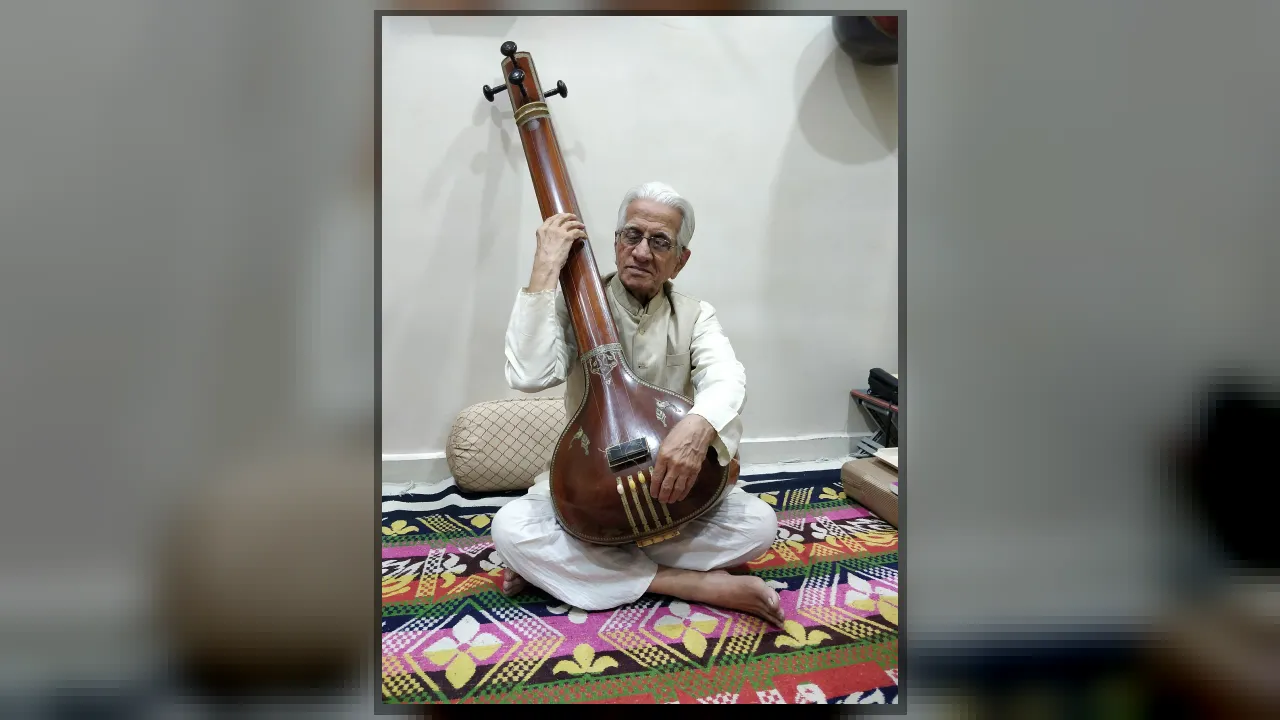
1. How many strings does a classic tanpura usually have?
2. What tiny everyday item tucked on the bridge gives the tanpura its sparkling buzz?
🤯 Mind-Blowing Fact • Grade 2
Small glass or swan-shaped beads threaded near the bottom of each tanpura string let players slide beads slightly to fine-tune pitches without touching the big wooden pegs!
✨ Word Sparks (Grade 2 Glossary)
Tap 🔊 to hear
jiva
Cotton bridge thread meaning 'soul' or 'life'
beads
Small sliding charms used for fine tuning
continuous
Flowing steadily onward without stopping or breaking
🪝
Why does an Indian classical concert feature a musician who never plays a melody at all?
1
The Home Base of Every Song
Before the singer breathes a single word or the sitar plays one fast note, four gentle plucks bloom into a glowing ocean of sound! Held upright on stage, the tall tanpura creates a background hum called a drone.
2
Gourd Bowls and Hollow Necks
Northern Indian tanpuras use a giant dried calabash gourd for their round bottom bowl, while Southern Indian builders carve theirs from warm jackfruit wood. Four thin steel and brass wires stretch down a long, completely fretless hollow neck.
3
Finding the Thread's Sweet Spot
Before playing, the musician slides a tiny cotton thread called a —meaning 'life'—between each string and the wide curved bridge. Move that thread even a hair's width, and suddenly the string bursts alive with sparkling chimes!
How can plucking just two different musical notes fill a room with five or six shimmering pitches at once?
1
A Rainbow Hidden Inside One String
What would happen if a musical beam of sound split into a whole rainbow of hidden pitches the way glass splits sunlight? Close your eyes beside a ringing tanpura and listen as shimmering high bells float out of thin air!
2
Simple Tuning, Rich Resonance
Even though a tanpura stands up to five feet tall, its player never presses strings against the neck. Usually three strings are tuned to the home pitch called —two high and one an octave lower—while the first string sounds the fifth note, Pa.
3
Cotton Threads and Overtones
Every vibrating string naturally contains faint higher pitches called overtones. Wedging a thin cotton jiva thread onto the curved jawari bridge causes the plucked wire to lightly the bridge surface, amplifying those quiet overtones into a dazzling acoustic cloud!
4
Gentle Unhurried Cycles
Soft fingertip pads roll smoothly across the four strings in a calm, unhurried loop, blending each decaying note seamlessly into the next.
1. Why do listeners hear extra high notes floating above a tanpura even when only Sa and Pa strings are plucked?
2. Why doesn't a tanpura have any frets along its long wooden neck?
🤯 Mind-Blowing Fact • Grade 4
Look closely at a well-tuned tanpura string in bright stage light and you can actually see its blur widen and narrow slowly as waves of overtones travel up and down the four-foot wire!
✨ Word Sparks (Grade 4 Glossary)
Tap 🔊 to hear
calabash
Large hard-shelled gourd dried for resonators
manka
Small bead slid on string for micro-tuning
interval
Pitch distance separating any two musical notes
🪝
Why do Miraj gourd farmers in Maharashtra and woodcarvers in Thanjavur build two different styles of India's most essential concert companion?
1
The Canvas Behind Every Raga
Just as a painter needs a luminous canvas before laying down brushstrokes, every Hindustani and Carnatic performance rests upon the shimmering acoustic horizon of the tanpura. Without chord progressions shifting beneath them, Indian soloists measure the emotional tension of every note against this living ocean of resonance.
2
Miraj Gourds and Thanjavur Jackfruit Wood
Two celebrated regional traditions craft concert tanpuras across India. In Miraj, Maharashtra, luthiers join an arched tun-wood soundboard to a giant bitter gourd grown specially in nearby river valleys, yielding airy, enveloping overtones prized in North India. Further south in Thanjavur, Tamil Nadu, artisans hollow the hemispherical bowl from seasoned jackfruit wood with a flatter top for focused, bell-clear projection.
3
Physics of the Jiva Thread
On a normal sharp guitar saddle, string energy stays mostly locked in the fundamental pitch. On a tanpura's wide, gently curved bone or wooden jawari bridge, sliding a cotton thread beneath each thin wire creates a microscopic ramp: each time the vibrating string swings downward, it kisses the bridge face slightly forward of the thread, continuously sparking fresh bursts of third, fourth, fifth, and seventh harmonics!
4
Tuning to Match Each Raga
While Pa–Sa–Sa–Sa suits ragas containing a strong fifth note, musicians retune the first string to Ma (the fourth) or Ni (the seventh) whenever a raga omits the fifth—sliding tinyanka tuning beads below the bridge to lock pure mathematical .
1. How does a Northern Miraj-style tanpura differ in construction from a Southern Thanjavur-style tambura?
2. When a raga skips the fifth scale note (Pa) completely, what does a tanpura player do?
🤯 Mind-Blowing Fact • Grade 5
Because the fifth harmonic ringing inside a tanpura's low Sa string produces a mathematically pure 5:4 major third, singers literally tune their voice inside the glowing overtone pitch floating in midair!
✨ Word Sparks (Grade 5 Glossary)
Tap 🔊 to hear
just intonation
Tuning intervals using pure whole-number frequency ratios
consonance
Smooth, restful blending of musical pitches together
node
Still point along a vibrating string wave
🪝
How does wedging a half-millimeter cotton thread onto a cambered bone bridge violate Young's classical wave law and unleash harmonics at vanished string nodes?
1
Adharaswara: The Acoustic Horizon
Pluck four slender steel and brass wires in tranquil rotation—typically pitched Pa2–Sa3–Sa3–Sa2 (for instance, G2 at 98.0 hertz, C3 at 130.8 hertz, C3 at 130.8 hertz, and C2 at 65.4 hertz)—and an extraordinary psychoacoustic phenomenon fills the hall: distinct major thirds (E4), fifths (G4), and upper octaves bloom vividly despite nobody plucking those notes! Known across India as tanpura or tambura, this unfretted drone lute anchors classical intonation.
2
Raman's Paradox and Grazing-Contact Physics
In classical linear wave physics formulated by Thomas Young, plucking a string at a of any harmonic cannot excite that harmonic. Yet in 1921, physicist C. V. Raman demonstrated that the tanpura's curved staghorn, camel-bone, or hardwood jawari bridge paired with a wedged cotton thread (jiva) introduces nonlinear grazing collisions. As the wire wraps momentarily onto the bridge plateau ahead of the thread, sharp kink waves race back and forth along the meter-long scale, vigorously populating partials well past the fifteenth harmonic!
3
Miraj Gourd Versus Thanjavur All-Wood Organology
Measuring roughly 100 to 150 centimeters with ultra-low-gauge steel upper strings and bronze or brass bass wires, concert instruments follow two regional blueprints. Maharashtra's Miraj school pairs a deep Lagenaria siceraria gourd shell with a convex tun-wood tabli for lush harmonic diffusion, whereas Tamil Nadu's Thanjavur school carves bowl, neck, and flat soundtable entirely from seasoned Artocarpus heterophyllus (jackfruit) wood for crystalline clarity.
4
Just Intonation and Shruti Calibration
Because equal-tempered pianos slightly mistune pure fifths and major thirds, Indian vocalists rely on the tanpura's natural harmonic series—where the third harmonic aligns at an exact 3:2 perfect fifth and the fifth harmonic rings at a pure 5:4 major third! Micro-adjusting carved bone manka beads below the bridge locks each string into beatless acoustic .
5
Timeless Continuity Across Millennia
Cradled upright or angled across the lap and stroked solely by gentle index and middle finger pads without fingernails, the tanpura reminds listeners worldwide that profound musical complexity can emerge from four open wires, seasoned wood, and a humble strand of cotton.