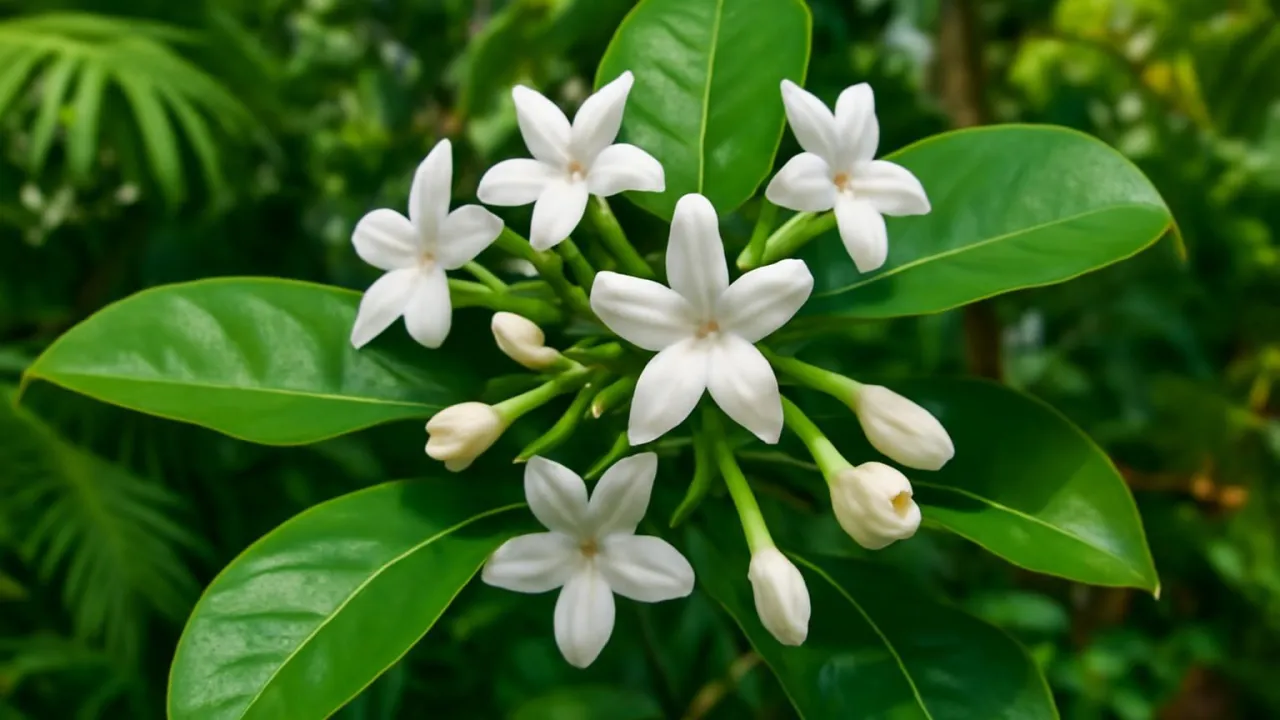
Stephanotis flowers are often called 'Madagascar jasmine' because of their sweet scent!
✨ Word Sparks (Grade 2 Glossary)
Tap 🔊 to hear
cluster
A group of things close together
tendril
A thin part that helps plants climb
wax
A shiny, smooth coating on flowers or leaves
🪝
Have you ever smelled a flower that smells like sweet honey?
1
Lovely White Flowers
Stephanotis produces white, star-shaped flowers that smell very sweet and strong. The flowers bloom in and attract bees and butterflies. Their fragrance is often used in perfumes. These flowers usually bloom in warm seasons.
2
Climbing Vine Habitat
This plant is a climbing vine native to Madagascar and tropical areas. It grows best in bright, indirect sunlight and needs regular watering to stay healthy. The vine can reach up to ten feet tall. It uses to hold onto supports as it climbs.
3
Special Flower Feature
Stephanotis flowers have a waxy texture that helps protect them from drying out. Their strong fragrance attracts pollinators like bees, which help the plant reproduce. The shiny green leaves help the vine collect sunlight for energy. This plant is popular for decorating homes and weddings.
Stephanotis flowers’ waxy petals help them survive dry tropical sun without losing moisture!
✨ Word Sparks (Grade 3 Glossary)
Tap 🔊 to hear
adaptation
A change that helps a plant or animal survive
pollination
When pollen moves to help plants make seeds
photosynthesis
How plants use sunlight to make food
🪝
Did you know some flowers use scent to trick insects into helping them?
1
Star-Shaped Flowers and Scent
Stephanotis floribunda produces star-shaped, waxy white flowers that emit a strong, sweet fragrance. This scent is a special that attracts pollinators such as bees and butterflies. The waxy coating helps protect the flowers from drying out in hot climates. The flowers bloom in clusters, which increases their visibility to pollinators.
2
Climbing Vine Adaptations
This plant is a woody climbing vine that uses tendrils to attach to supports and climb upward. Climbing helps the vine reach sunlight in dense tropical forests where light is limited. The shiny, dark green leaves perform to create nutrients for growth. These allow Stephanotis to survive in competitive environments.
3
Pollination and Reproduction
Pollinators like bees are attracted by the flower's fragrance and shape, helping transfer pollen from flower to flower. This process is called , which is essential for the plant to produce seeds and reproduce. The flowers’ star shape and scent are evolutionary traits that improve pollination success. Without pollinators, Stephanotis would not be able to make seeds.
4
Uses and Popularity
Because of its sweet scent and elegant appearance, Stephanotis is popular in wedding bouquets and home gardens. It is sometimes called Madagascar jasmine, though it is not a true jasmine. The plant prefers warm, humid climates and needs well-drained soil and indirect sunlight to thrive. Gardeners prize it for its beauty and fragrance.
1. Why do Stephanotis flowers have a waxy coating?
2. What helps Stephanotis climb to find sunlight?
🤯 Mind-Blowing Fact • Grade 4
Stephanotis flowers’ scent can travel far, helping pollinators find them in dense forests!
✨ Word Sparks (Grade 4 Glossary)
Tap 🔊 to hear
symbiosis
A helpful relationship between living things
ecosystem
A community of plants and animals living together
pollinator
An animal that helps flowers make seeds
🪝
How does Stephanotis use its scent and shape to survive in tropical forests?
1
Flower Structure and Fragrance
Stephanotis floribunda produces clusters of star-shaped, waxy white flowers that emit a powerful sweet fragrance to attract . This scent acts as a chemical signal that draws bees and butterflies from a distance, increasing pollination chances. The waxy petals reduce water loss, which is vital in the hot, tropical environment. Together, these features help the plant reproduce successfully.
2
Climbing Growth and Habitat
As a woody climbing vine, Stephanotis uses slender tendrils to grasp onto nearby trees or supports, allowing it to reach sunlight in dense tropical forests. This climbing habit is an adaptation to compete for light in crowded . The plant thrives in Madagascar and other tropical regions where humidity and temperature remain consistently warm. It prefers well-drained soil and indirect sunlight for optimal growth.
3
Role in Ecosystems and Human Use
Stephanotis plays a role in tropical food webs by providing nectar to , which in turn help the plant reproduce. Its fragrant flowers are also harvested for ornamental use, especially in wedding bouquets and perfumes, showing a symbiotic relationship with humans. However, overharvesting or habitat loss could threaten wild populations. Cultivation in gardens helps conserve this beautiful species.
4
Geographic Distribution and Cultivation
Native to Madagascar, Stephanotis has been introduced to tropical and subtropical gardens worldwide due to its appealing fragrance and appearance. Gardeners must provide warm temperatures and high humidity to mimic its natural habitat. It is sensitive to cold and frost, which limits its outdoor cultivation in temperate zones. Proper care ensures the vine can flower abundantly and maintain its health.
1. Why does Stephanotis climb trees in tropical forests?
2. What role do pollinators play for Stephanotis?
🤯 Mind-Blowing Fact • Grade 5
Stephanotis floribunda’s fragrance molecules can travel meters, guiding pollinators through dense tropical forests!
✨ Word Sparks (Grade 5 Glossary)
Tap 🔊 to hear
Apocynaceae
The plant family of woody vines and fragrant flowers
cuticle
A waxy layer that protects plant leaves and flowers
volatile
Easily evaporates and spreads into the air
🪝
How does Stephanotis floribunda’s structure and scent enable survival and reproduction in tropical ecosystems?
1
Taxonomy and Botanical Classification
Stephanotis floribunda belongs to the family, known for its woody vines and fragrant flowers. It is native to Madagascar’s tropical forests, where it evolved traits suited for climbing and attracting pollinators. Unlike true jasmines in the Oleaceae family, Stephanotis is often called Madagascar jasmine due to similar fragrance. Its botanical classification helps scientists understand its ecological role and evolutionary history.
2
Physiological Adaptations and Mechanics
The plant’s woody climbing vine uses specialized tendrils to anchor and ascend towards sunlight, maximizing photosynthesis. Its star-shaped flowers have a waxy that minimizes water loss while emitting organic compounds as a strong fragrance to attract specific pollinators. These physiological traits enhance survival in hot, humid tropical environments by balancing moisture retention and reproductive success.
3
Ecological Role and Conservation Status
Stephanotis contributes nectar to pollinators such as bees and butterflies, playing a vital role in tropical forest ecosystems’ food webs. Its fragrant flowers facilitate cross-pollination, promoting genetic diversity. However, habitat destruction and overharvesting for ornamental use threaten wild populations. Conservation efforts focus on habitat preservation and sustainable cultivation to protect this species from decline.
4
Botanical History and Human Uses
Introduced globally as an ornamental plant, Stephanotis has a long history in horticulture, prized for its fragrant flowers in wedding bouquets and perfumes. The plant’s cultural significance spans continents, symbolizing marital happiness and purity. Botanical studies have documented its growth requirements, influencing cultivation practices that mimic its native tropical environment for optimal flowering.
5
Quantitative Comparisons and Growth Data
Stephanotis vines can grow up to 10 feet (3 meters) in length under ideal conditions, with flowers measuring about 1 inch (2.5 cm) across. The plant thrives at temperatures between 65°F and 85°F (18°C to 29°C) and requires consistent humidity above 60 percent. Its fragrance molecules can disperse several meters, effectively attracting pollinators over long distances in dense forests.