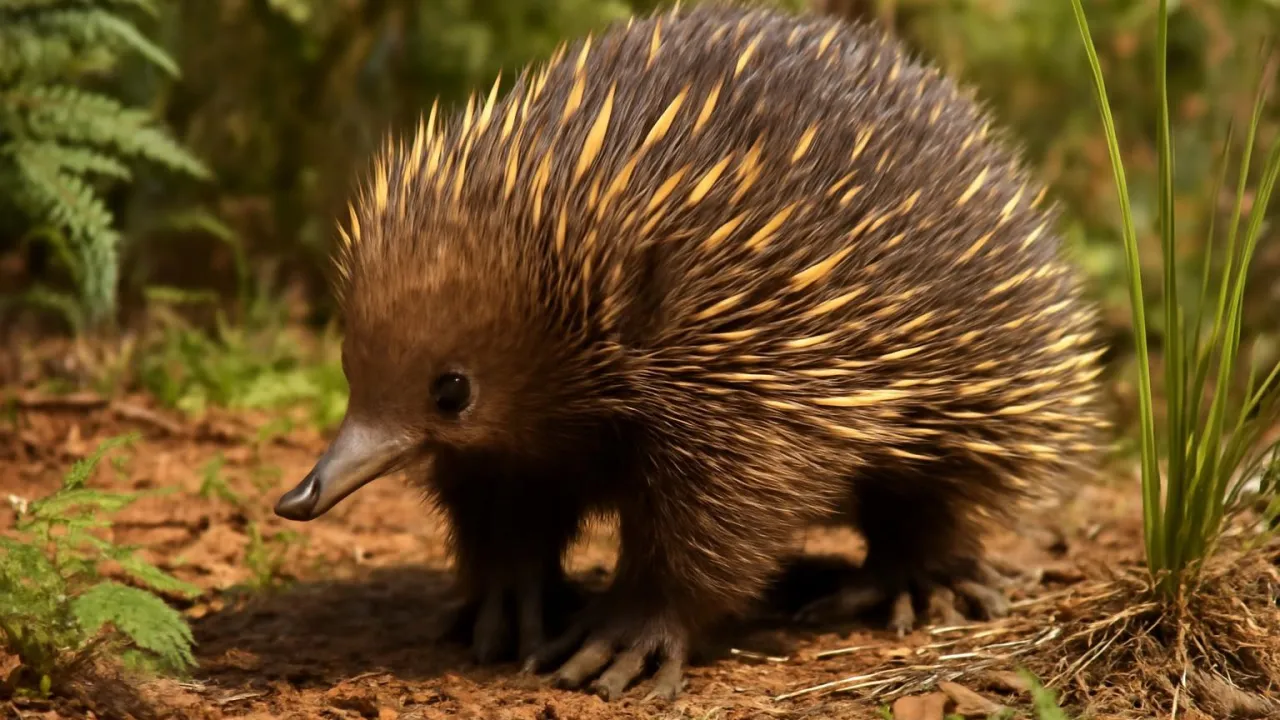
Echidnas are one of the few mammals that lay eggs instead of giving birth to live babies.
✨ Word Sparks (Grade 2 Glossary)
Tap 🔊 to hear
predator
An animal that hunts other animals
burrow
A hole or tunnel animals live in
termite
A small insect that lives in wood
🪝
Have you ever seen a spiky animal that digs for ants with a long nose?
1
Spiky Body and Nose
The short-beaked echidna has sharp spikes all over its body, and it uses its long nose to find food. It cannot see well but smells ants and underground. Its spikes help protect it from like dingoes and birds.
2
Where It Lives
Echidnas live in Australia and New Guinea, mostly in forests and grasslands where they can find insects easily. They dig to sleep in and hide from danger. Echidnas are active mostly at night and early morning.
3
Eating and Digging
This animal uses strong claws to dig quickly into ant hills or mounds. It catches insects with a sticky tongue that can flick out fast. Echidnas eat mostly ants, termites, and other small bugs.
Echidnas and platypuses are the only mammals that lay eggs instead of live babies.
✨ Word Sparks (Grade 3 Glossary)
Tap 🔊 to hear
camouflage
Colors or shapes that help hide animals
nocturnal
Active at night, sleeping in the day
nutrients
Food parts that help animals grow
🪝
Did you know the short-beaked echidna is a spiny mammal that lays eggs?
1
Spines and Camouflage
The short-beaked echidna has sharp spines that act as and protect it from predators. Its spines blend well with dry leaves and grass, helping it hide from dingoes and birds. This adaptation helps the echidna survive in the wild.
2
Habitat and Behavior
Echidnas live in forests, woodlands, and grasslands across Australia and New Guinea. They dig burrows to sleep and escape danger. Echidnas are mostly , searching for food at night when fewer predators are active.
3
Feeding and Digging
Echidnas use strong claws to dig into termite mounds and ant hills. They catch insects using a long, sticky tongue that flicks out quickly. This method of feeding is an important adaptation for finding underground.
4
Unique Reproduction
Unlike most mammals, echidnas lay eggs instead of giving birth to live young. The female lays one leathery egg and keeps it in a pouch until it hatches. This unusual reproductive method is shared only with platypuses among mammals.
Echidnas are one of only five egg-laying mammals called monotremes in the world.
✨ Word Sparks (Grade 4 Glossary)
Tap 🔊 to hear
monotreme
A mammal that lays eggs instead of live babies
foraging
Searching for food in nature
aeration
Mixing air into soil to help plants grow
🪝
Have you heard about a spiky mammal that digs fast and lays eggs in a pouch?
1
Spines Protect and Hide
The short-beaked echidna’s sharp spines serve as an effective defense mechanism that deters predators like dingoes and birds of prey. These spines also provide camouflage by blending with the dry leaves and twigs found in their forest and grassland habitats. This dual function helps the echidna survive in a world full of threats.
2
Habitat and Nocturnal Life
Echidnas inhabit diverse environments such as forests, woodlands, and grasslands throughout Australia and New Guinea. They are mostly nocturnal, at night when fewer predators hunt. By digging burrows, echidnas create safe shelters to rest during the day and avoid extreme temperatures.
3
Feeding Strategies and Adaptations
Equipped with strong claws, echidnas can rapidly dig into termite mounds and ant hills to access their prey. Their long, sticky tongue flicks out quickly to capture insects, providing essential nutrients for survival. This specialized feeding adaptation allows echidnas to thrive in areas where food can be hidden underground.
4
Unique Reproduction and Ecosystem Role
Echidnas are , meaning they lay leathery eggs instead of giving birth to live young, a rare trait among mammals. The female incubates the egg in a pouch until hatching. Echidnas help control insect populations and contribute to soil through their digging, playing an important role in their ecosystems.
Echidnas use electroreceptors in their snouts to detect electrical signals from their insect prey underground.
✨ Word Sparks (Grade 5 Glossary)
Tap 🔊 to hear
monotreme
A mammal that lays eggs instead of live babies
electroreceptor
A sensor that detects electrical signals in animals
puggle
A baby echidna that hatches from an egg
🪝
Did you know the short-beaked echidna is a spiny monotreme that lays eggs and digs with powerful claws?
1
Taxonomy and Scientific Classification
The short-beaked echidna, scientifically named Tachyglossus aculeatus, belongs to the order, which includes only five egg-laying mammals. Monotremes are unique because they combine reptilian traits like egg-laying with mammalian features such as fur and milk production. Echidnas are further classified within the family Tachyglossidae, distinct for their spiny bodies and specialized feeding habits.
2
Physiological Mechanics and Adaptations
Echidnas have a low body temperature averaging 32 degrees Celsius, which is lower than most mammals, helping them conserve energy. Their spines are modified hairs that provide defense, while their in the snout detect electrical signals from prey underground. The echidna’s strong forelimbs and curved claws allow it to dig through tough soil and termite mounds rapidly.
3
Reproduction and Development
Unlike placental mammals, female echidnas lay a single leathery egg and incubate it in a pouch for about ten days. After hatching, the young, called , remain in the pouch for several weeks while feeding on milk secreted from mammary glands without nipples. This reproductive strategy is ancient and links echidnas closely to early mammalian evolution.
4
Ecological Role and Conservation Status
Echidnas play a vital role in controlling insect populations, particularly ants and termites, which helps maintain ecological balance. Their digging behavior aerates the soil, promoting plant growth and nutrient cycling in their habitats. Currently, short-beaked echidnas are listed as Least Concern, but habitat loss and climate change pose future risks to their populations.
5
Quantitative Comparisons and Interesting Facts
Short-beaked echidnas measure about 12 to 18 inches long and weigh between 4 and 10 pounds, making them one of the largest . They can dig at speeds up to 2 feet per minute when foraging for insects. Their body temperature is about 10 degrees Celsius lower than most mammals, which helps them survive in cooler environments.