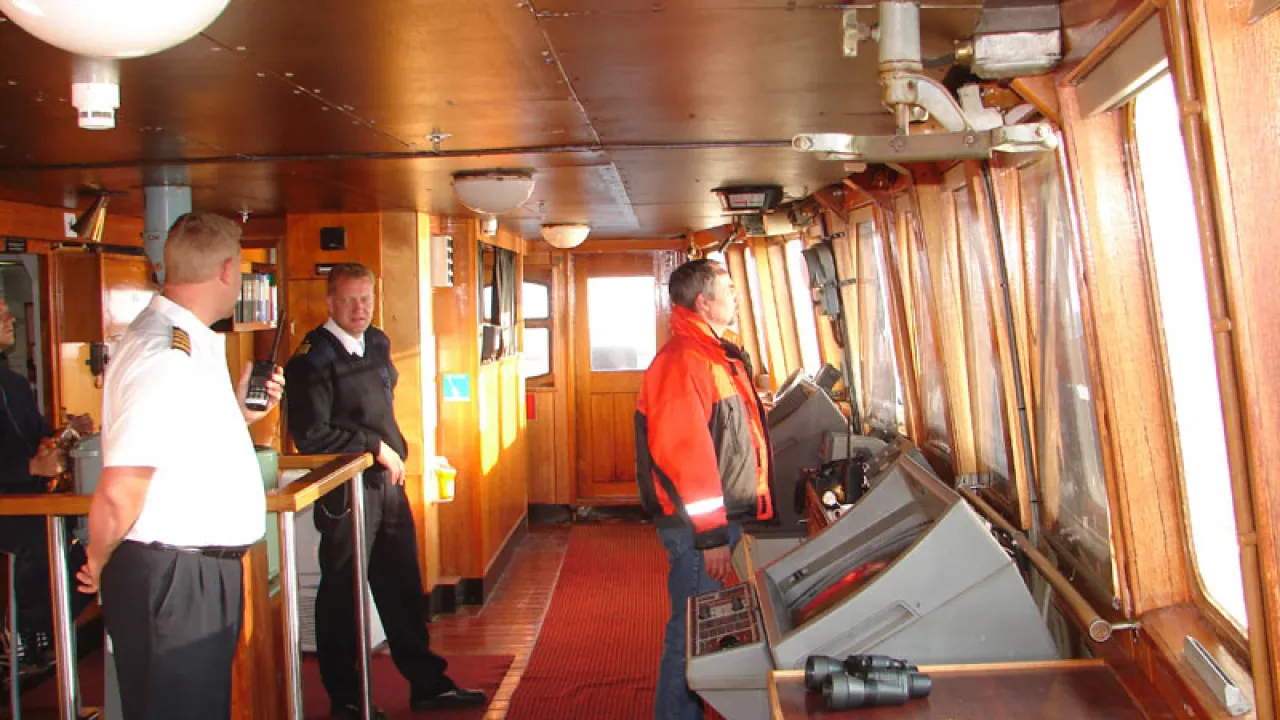
⚡ Everyday Impact SparkLeads crews and steers 1,200-foot vessels carrying food, toys, and travelers safely across stormy seas
🤯 Mind-Blowing Fact • Grade 1
About 9 out of every 10 things in your home—from bananas to sneakers—traveled across the ocean on a ship led by a captain!
✨ Word Sparks (Grade 1 Glossary)
Tap 🔊 to hear
Bridge
High glass room where a ship is steered
Cargo
Goods and boxes carried on ships or planes
Crew
Team of sailors working together aboard a vessel
🪝
Who commands a giant ship sailing across the wide blue ocean?
1
Up on the Bridge!
Boooooom goes a deep ship horn across sparkling waves! High up in a glass room called the stands the ship captain. From there, she can see miles of open water.
2
Carrying the World's Goods
Big ships stack colorful metal boxes filled with bananas, sneakers, bicycles, and books. Ferries and cruise ships carry people safely across bays and seas.
3
Leading the Crew
The captain checks sea maps, watches the weather, and keeps every sailor and passenger safe!
1. What do sailors call the high glass control room where the ship captain stands?
2. Roughly how much of the world's everyday goods travel across oceans by ship?
🤯 Mind-Blowing Fact • Grade 2
Easy sailor trick: 'Port' and 'Left' both have exactly four letters—and at night, ships shine a red light on the port side and a green light on starboard!
✨ Word Sparks (Grade 2 Glossary)
Tap 🔊 to hear
Port
Left side of a boat when facing forward
Starboard
Right side of a boat when facing forward
Buoy
Floating anchored marker guiding ships along safe channels
🪝
Why do sailors say 'port' and 'starboard' instead of 'left' and 'right'?
1
Words That Never Get Confused
Imagine standing on the rolling deck of an ocean ship in windy rain! If two sailors face opposite directions, 'my left' and 'your left' point to totally different sides. That is why ship captains use clear ship words: 'bow' is the front, 'stern' is the back, '' is the left side, and '' is the right!
2
Reading Nautical Charts
Land maps show highways, while a captain's 'nautical chart' shows exact water depths, tall lighthouses, hidden sandbars, and floating channel . Glowing radar screens spot other boats miles away even through thick gray sea fog.
1. When facing the front (bow) of a ship, what is the left side called?
2. What special information does a captain's nautical chart show that a regular road map does not?
🤯 Mind-Blowing Fact • Grade 3
The largest modern container ships stretch 1,312 feet long—if you stood one upright on its stern, it would tower taller than the Empire State Building!
✨ Word Sparks (Grade 3 Glossary)
Tap 🔊 to hear
Buoyancy
Upward force of water keeping hollow ships afloat
Master Mariner
Highest professional license held by an ocean captain
Draft
How many feet deep a hull sits underwater
🪝
How can a massive cargo ship longer than three football fields float on water instead of sinking?
1
The Secret of Buoyancy
Drop a tiny steel bolt into a bucket of water, and it sinks right to the bottom—yet a steel container ship carrying 20,000 giant boxes floats high and proud! Because the ship's wide, hollow hull pushes aside a massive weight of ocean water, upward '' holds the entire vessel afloat.
2
Working Up the Ranks to Master
On an official Coast Guard license, a ship captain holds the proud title '.' Mariners climb the bridge ranks step by step—starting out as Third Mate, advancing to Second Mate, then Chief Mate, logging years of ocean voyages before earning command.
3
Rules of the Road at Sea
Open oceans have strict international traffic laws! Using red and green side lights, horn whistle blasts, and collision-avoidance radar, captains know exactly which vessel must turn to give way.
4
Round-the-Clock Bridge Watches
Because ocean crossings continue day and night for weeks, deck officers stand four-hour bridge watches while the captain oversees storm routing, harbor docking, and crew safety.
1. Why does a massive steel cargo ship float while a solid steel bolt sinks?
2. What does a ship's 'draft' measure?
🤯 Mind-Blowing Fact • Grade 4
On the side of every cargo ship's hull sits a painted circle-and-lines symbol called the 'Plimsoll mark'—invented in the 1870s so anyone on the dock can instantly see if a ship is safely loaded for tropical or winter seas!
✨ Word Sparks (Grade 4 Glossary)
Tap 🔊 to hear
Center of Gravity
Balance point where an object's weight concentrates
Ballast
Seawater pumped into lower tanks to steady ships
Plimsoll Mark
Hull waterline symbol showing safe maximum cargo weight
🪝
Why can stacking heavy cargo boxes too high on deck make a giant ocean ship tippy in waves?
1
Keeping the Center of Gravity Low
Watch towering blue dock cranes at the Port of Virginia in Norfolk load thousands of steel shipping containers onto a trans-Atlantic vessel. Before a single box lifts off the pier, the ship captain and Chief Mate run computer stability checks! Heavy machinery containers belong deep down inside the cargo hold while lighter or empty boxes stack high on deck, keeping the vessel's '' low and steady when 30-foot Atlantic swells roll past.
2
Weather Routing Around Ocean Storms
Even a 1,200-foot steel ship respects ocean storms. Captains study live satellite weather maps, warm Gulf Stream currents, and wave forecasts—adjusting course hundreds of miles north or south to steer safely clear of tropical hurricanes while saving fuel.
3
Ballast Water and Environmental Care
When cranes unload heavy cargo, captains pump seawater into lower hull ' tanks' to keep the propeller deep and balanced. Modern captains operate onboard ultraviolet and filtration systems so tiny crabs, mussels, or algae from foreign ports are never accidentally released into local bays.
4
Coast Guard Licensing and Academies
In the United States, ship captains earn U.S. Coast Guard credentials through four-year maritime academies or sea-service apprenticeships—mastering radar plotting, shipboard firefighting, ocean medicine, and star navigation.
1. Why do ship captains and mates place the heaviest cargo containers deep in the bottom of the ship?
2. Why do modern cargo ships treat and filter their 'ballast water' before releasing it in a new port?
🤯 Mind-Blowing Fact • Grade 5
Even on sleek 21st-century satellite-guided ships, candidates for an Unlimited Ocean Master's license still learn classic celestial navigation—calculating latitude and longitude from the Sun, Moon, and 57 navigation stars using a handheld sextant and chronometer!
✨ Word Sparks (Grade 5 Glossary)
Tap 🔊 to hear
Sextant
Mirrored angle tool measuring stars above the horizon
Gyrocompass
Spinning-rotor compass pointing to Earth's true north
ECDIS
Computerized bridge map combining GPS, depth, and radar
🪝
How do Unlimited Master Mariners combine Archimedes' hydrostatics, gyrocompass navigation, and international maritime law to command 200,000-ton vessels?
1
Supreme Responsibility Under Maritime Law
Aboard an ocean-going container ship, polar icebreaker, or oceanographic research vessel, an Unlimited Master Mariner exercises comprehensive legal and operational command over navigation, hull stability, cargo security, environmental protection, and every human life embarked. Across multi-week Pacific or Atlantic crossings—thousands of nautical miles beyond coastal rescue helicopters—the captain leads a self-reliant floating town with its own power plant, water desalinator, fire brigade, and medical ward.
2
Metacentric Height and Hydrostatic Stability
Safe ocean seamanship rests directly upon Archimedes' principle and naval hydrostatics—specifically the interplay between a ship's Center of Buoyancy (B) and Center of Gravity (G). Whenever heavy beam waves roll a hull sideways, the underwater hull shape shifts, creating an upward 'righting lever' that restores the ship upright—provided its Metacentric Height (GM) stays safely positive. Captains also calculate hull shear and bending moments so uneven cargo weight never strains steel keel plates.
3
ECDIS, Gyrocompasses, and Celestial Backup
Modern navigation bridges fuse Electronic Chart Display and Information Systems (), satellite Automatic Identification System (AIS) transponders, ARPA collision-avoidance radar, and spinning that seek geographic True North without magnetic distortion from steel cargo. Even so, to guard against solar storms or electronic interference, maritime academies still require future captains to measure sun and star altitudes above the sea horizon using a mirrored and marine chronometer!
4
Dynamic Positioning and Clean Ocean Propulsion
Specialized captains command offshore wind-turbine installation ships equipped with computer-linked 360-degree azimuth thrusters holding station within centimeters in open swells, alongside next-generation merchant vessels powered by green methanol, liquefied natural gas, and towering spinning rotor sails.
5
Pathway to Unlimited Tonnage Command
Graduating from the U.S. Merchant Marine Academy, state maritime colleges, or hawsepipe sea-time tracks, mariners pass multi-day U.S. Coast Guard examinations under international STCW treaties—advancing from Third Mate to Master of Vessels of Any Gross Tons Upon Oceans.