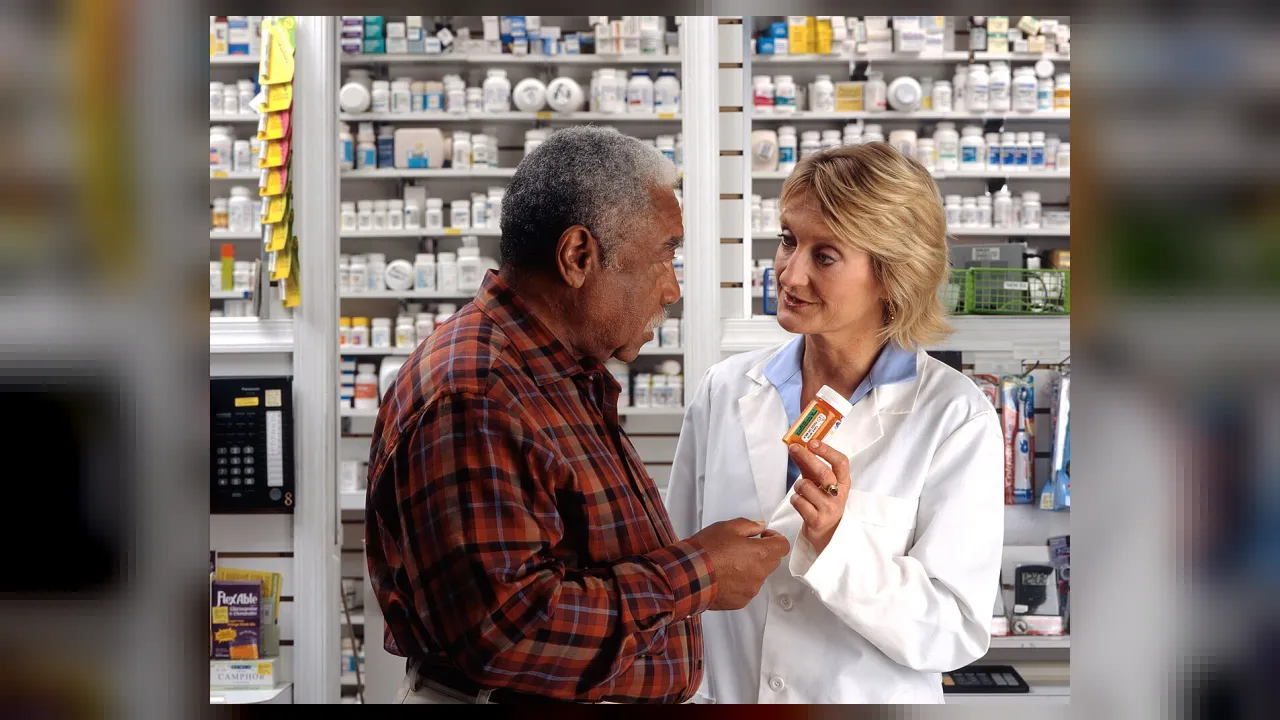
1. Why are so many medicine bottles tinted orange-brown (amber)?
2. What important safety rule do pharmacists teach every kid about medicine?
🤯 Mind-Blowing Fact • Grade 2
One of the world's most famous medicines—aspirin—was originally inspired by a natural pain-soothing chemical found in willow tree bark!
✨ Word Sparks (Grade 2 Glossary)
Tap 🔊 to hear
allergy
When bodies react badly to something
interaction
How two medicines affect each other
antibiotic
Medicine that defeats harmful bacteria infections
🪝
Why does a pharmacist double-check a doctor's prescription before handing medicine to your family?
1
Chemistry Champions in White Coats
Beep goes the barcode scanner at your neighborhood pharmacy! Pharmacists are doctors of medicine chemistry who work as teammates with pediatricians and nurses. Before filling a prescription, they check your age, weight, and allergies to make sure the medicine is 100 percent safe.
2
Checking How Medicines Mix
Sometimes a person takes two different medicines at once. Pharmacists know which medicines work great together and which ones might clash inside the tummy or bloodstream!
3
Custom Flavors and Flu Shots
Pharmacists also mix custom liquids for kids who cannot swallow pills, give protective flu shots, and explain whether medicine needs food or the refrigerator.
1. What do pharmacists check when someone takes more than one medicine at the same time?
2. Which tree's bark inspired scientists to create aspirin?
🤯 Mind-Blowing Fact • Grade 3
High-tech pharmacies now use robotic pill-counting machines that use laser beams to count hundreds of tablets in just a few seconds while human pharmacists focus on patient care!
✨ Word Sparks (Grade 3 Glossary)
Tap 🔊 to hear
compounding
Custom-mixing medicine to fit one patient
cleanroom
Filtered germ-free room for making IVs
mortar and pestle
Bowl and club for grinding powders
🪝
What is 'compounding,' and what do hospital pharmacists do inside ultra-clean rooms?
1
Custom Mixing Through Compounding
Grind, measure, and swirl with a porcelain ! What happens if a toddler needs heart medicine that only comes in giant adult tablets, or a child is allergic to red dye? pharmacists measure pure medicine powders to the milligram and blend custom dye-free liquids!
2
Inside Hospital Cleanrooms
Not all pharmacists work in neighborhood drugstores. Hospital pharmacists gown up from head to toe inside sterile to prepare intravenous (IV) bags, nutrition drips for premature babies, and exact chemotherapy doses.
3
Why Finishing Antibiotics Matters
When you have strep throat, pharmacists explain why you must finish every single dose of your antibiotic—even if you feel better on day three—so tough leftover bacteria cannot bounce back!
4
Earning a Pharm.D.
Pharmacists study chemistry and biology in college and complete four years of pharmacy school to earn a Doctor of Pharmacy (Pharm.D.) degree.
2. Why do pharmacists tell patients to finish all prescribed days of an antibiotic?
🤯 Mind-Blowing Fact • Grade 4
Inside one 'extended-release' capsule are hundreds of tiny sugar spheres coated in polymer layers of different thicknesses so medicine releases steadily hour after hour!
✨ Word Sparks (Grade 4 Glossary)
Tap 🔊 to hear
receptor
Tiny cell dock where medicine attaches
extended-release
Designed to dissolve slowly over hours
penicillin
First major antibiotic discovered from mold
🪝
How does a tiny pill know where to work inside your body—and how do pharmacists use chemistry to time its release?
1
Following a Medicine's Journey
Have you ever wondered how swallowing a tiny tablet helps a sprained ankle or an ear infection far from your stomach? Pharmacists study pharmacokinetics—the four-step journey of Absorption, Distribution, Metabolism, and Elimination! Once absorbed into the bloodstream, medicine molecules circulate everywhere and lock onto matching microscopic cell like keys fitting only specific locks.
2
Clever Pill Engineering
Not every tablet is built the same! Pharmacists know why you should never crush an '' capsule: tiny layered beads inside are engineered to dissolve slowly over twelve hours instead of all at once. Other tablets wear 'enteric coatings' that survive harsh stomach acid so the medicine opens safely inside the small intestine.
3
Hospital Rounds and Poison Control
Clinical pharmacists walk hospital floors alongside doctors and nurses every morning, reviewing kidney and liver lab tests so antibiotic, heart, and seizure medications match each patient's exact body chemistry. Specialized pharmacists also staff twenty-four-hour regional Poison Control hotlines, guiding families and emergency doctors through urgent chemical or medication questions within seconds.
4
From Penicillin Mold to Modern Labs
Modern pharmacy blossomed after Scottish scientist Alexander Fleming spotted bacteria-stopping Penicillium mold on a laboratory dish in 1928. During the 1940s, American pharmaceutical researchers and engineers figured out how to brew and purify millions of lifesaving doses in deep fermentation tanks—launching the antibiotic era and inspiring thousands of targeted medicines used in clinics today!
1. Why do pharmacists warn patients never to chew or crush an 'extended-release' tablet?
2. How do medicine molecules in the bloodstream affect the right cells in your body?
🤯 Mind-Blowing Fact • Grade 5
Nearly nine out of every ten Americans live within just five miles of a community pharmacy, making pharmacists the most easily reachable doctoral-level healthcare professionals in the nation!
✨ Word Sparks (Grade 5 Glossary)
Tap 🔊 to hear
pharmacokinetics
How bodies absorb, process, and clear medicines
pharmacogenomics
Matching safest medicines to your DNA
enzyme
Protein helper speeding up body chemistry
🪝
How do organic chemistry, pharmacogenomics, and clinical therapeutics make Doctors of Pharmacy indispensable guardians of modern healthcare?
1
Mastering ADME and Receptor Chemistry
Behind every safe prescription stands deep biochemical precision. Doctors of Pharmacy (Pharm.D.) master both pharmacodynamics—what a drug molecule does to cellular and receptors—and , abbreviated ADME: how a compound is Absorbed across membranes, Distributed through plasma proteins, Metabolized by liver cytochrome P450 enzymes, and Eliminated by the kidneys! Slight shifts in renal filtration or enzyme activity can double a medication's concentration in the blood, requiring a pharmacist's exact mathematical adjustment.
2
Pharmacogenomics: Tailoring Medicine to DNA
Why does the exact same dose of a medication work wonders for one patient while causing side effects in another? Cutting-edge pharmacists increasingly use —analyzing inherited variations in a patient's DNA that govern how rapidly or slowly their liver process specific medications—to select personalized therapies for pediatric oncology, cardiology, and transplant patients.
3
Antimicrobial Stewardship and Sterile Prep
Inside tertiary medical centers, clinical pharmacists round daily with intensive-care and infectious-disease physicians. Leading 'antimicrobial stewardship' teams, they match narrow-spectrum antibiotics to laboratory bacterial cultures so hospitals cure tough infections while preventing antibiotic-resistant 'superbugs.' Meanwhile, oncology and neonatal pharmacists work inside ISO-classified positive- and negative-pressure cleanrooms compounding sterile biologics and total parenteral nutrition.
4
Six to Eight Years of Rigorous Training
Becoming a licensed pharmacist requires undergraduate prerequisites in organic chemistry, biochemistry, calculus, and microbiology, followed by a four-year accredited Doctor of Pharmacy (Pharm.D.) program including Advanced Pharmacy Practice Experiences (APPEs), passing the North American Pharmacist Licensure Examination (NAPLEX) and pharmacy law exam, and often completing one- to two-year clinical residencies.
5
America's Most Accessible Healthcare Experts
Nearly ninety percent of Americans live within five miles of a community pharmacy—making neighborhood pharmacists trusted frontline educators for immunizations, chronic-care coaching, and medication safety.