🏢 WorkplaceAmbulances, Fire Stations, Rescue Helicopters & Community Scenes
⚡ Everyday Impact SparkBrings emergency-room care straight to homes, roads, and playgrounds when every second counts
🤯 Mind-Blowing Fact • Grade 1
Look at the front hood of many ambulances—the word 'AMBULANCE' is often printed backward so drivers ahead can read it right-side-up in their rearview mirrors!
✨ Word Sparks (Grade 1 Glossary)
Tap 🔊 to hear
ambulance
Special rescue vehicle carrying medical gear
splint
Support keeping an injured bone super still
emergency
Sudden problem needing fast, careful help
🪝
Who rides in the flashing ambulance to help hurt or sick people fast?
1
Wee-Ooo, Help Is Coming!
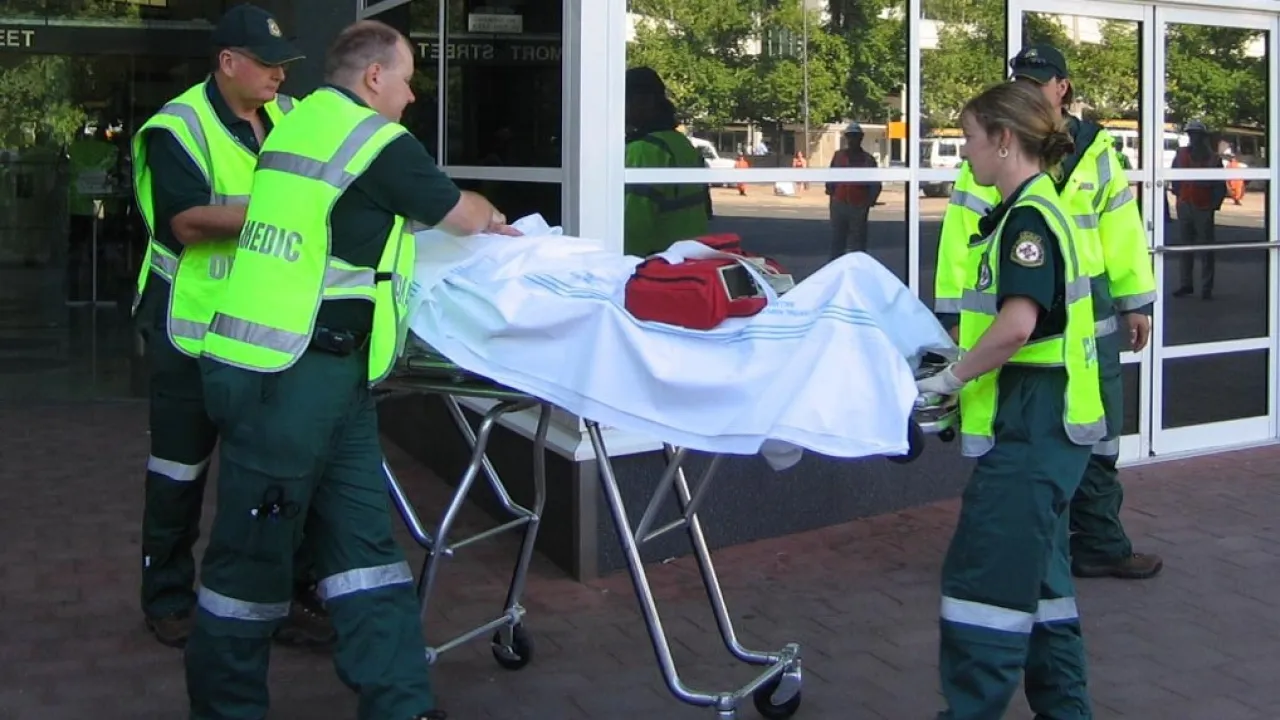
Flash go the bright lights on the ! Paramedics and EMTs rush to help when someone dials 9-1-1.
2
A Hospital on Wheels
Inside the are bandages, , oxygen masks, and stretchers. Helpers wrap hurt arms and check hearts right away!
3
Calm and Brave
EMTs and paramedics speak in calm, kind voices so patients feel safe all the way to the hospital.
1. What three-digit phone number connects people in the United States to paramedics and EMTs in an emergency?
2. Why is the word AMBULANCE often printed backward on the front of the vehicle?
🤯 Mind-Blowing Fact • Grade 2
The six points on the blue 'Star of Life' symbol painted on ambulances stand for the six steps of emergency care—from spotting the emergency all the way to reaching the hospital!
✨ Word Sparks (Grade 2 Glossary)
Tap 🔊 to hear
dispatcher
9-1-1 helper who sends rescue crews
stretcher
Wheeled bed for carrying injured patients
CPR
Chest pushes keeping blood moving in emergencies
🪝
What do the letters EMT stand for, and how do EMTs and paramedics work together as partners?
1
Two Lifesaving Partners
Beep-beep crackles the dispatch radio at the station! EMT stands for Emergency Medical Technician. When a 9-1-1 call arrives, EMTs and paramedics jump into a stocked ambulance—a rolling mini-emergency room—and head straight to the scene.
2
How Their Training Connects
EMTs provide essential lifesaving care like , oxygen, bleeding control, and splinting broken bones. Paramedics complete extra months of advanced medical schoolwork so they can also read heart-rhythm screens and give emergency medicines.
3
Teamwork in Transit
While one partner drives safely through traffic, the other stays in back caring for the patient and radioing the hospital ahead!
2. What extra advanced skills can a paramedic perform compared to a basic EMT?
🤯 Mind-Blowing Fact • Grade 3
America's very first trained paramedic unit—the Freedom House Ambulance Service founded in Pittsburgh in 1967—helped set the national blueprint for every modern 9-1-1 ambulance crew!
✨ Word Sparks (Grade 3 Glossary)
Tap 🔊 to hear
defibrillator
Device using gentle electrical pulse for hearts
triage
Sorting patients so urgent needs go first
medevac
Helicopter or plane used for medical rescue
🪝
How did a groundbreaking neighborhood team in Pittsburgh invent America's modern ambulance and paramedic service?
1
Before Modern Ambulances
Believe it or not, before the late 1960s, most injured Americans were driven to hospitals in fast station wagons with almost no medical equipment or trained medics in back! Doctors realized patients needed emergency-room care right on the spot during the critical 'Golden Hour.'
2
Freedom House Leads the Way
In 1967 in Pittsburgh, Pennsylvania, Dr. Peter Safar and Dr. Nancy Caroline teamed up with community leaders to launch the Freedom House Ambulance Service. Staffed by Black men and women from the Hill District who completed intensive hospital training, Freedom House became America's very first advanced paramedic crew—designing the spacious high-roof ambulance layout still used around the world today!
3
Tools Inside the Rig
Modern EMTs and paramedics carry that restore steady heartbeats, nebulizers for severe asthma attacks, glucose meters, Epipens for allergic reactions, and vacuum splints that mold gently around fractured limbs.
4
Calm Minds in Every Weather
Whether climbing icy stairs, landing in a helicopter, or standing by at youth soccer games, EMS crews bring calm focus to stressful moments.
1. Which 1967 Pittsburgh team became America's first advanced paramedic ambulance service?
2. What does a defibrillator help restore during a sudden cardiac emergency?
🤯 Mind-Blowing Fact • Grade 4
Paramedics can wirelessly beam a patient's heart-rhythm graph from a moving ambulance miles down the highway so hospital heart specialists are scrubbed in and ready before the patient even arrives!
✨ Word Sparks (Grade 4 Glossary)
Tap 🔊 to hear
circulation
Movement of blood pumping through the body
epinephrine
Fast-acting medicine stopping severe allergic reactions
immobilize
To keep an injured area completely still
🪝
What happens minute by minute from the moment a 9-1-1 call comes in until a paramedic hands off care at a hospital trauma bay?
1
Minute Zero: Scene Safety and Rapid Check
Tones drop over the firehouse loudspeaker, and within sixty seconds a two-person EMS crew rolls out the bay doors! Upon arriving, paramedics and EMTs always check scene safety first—watching for traffic hazards, downed power lines, or smoke—so rescuers stay safe while helping others. Next comes the ABC check: verifying an open Airway, effective Breathing, and strong .
2
EMT vs. Paramedic Scope of Practice
Emergency Medical Services operate in coordinated tiers. EMTs complete roughly 150 to 200 hours of coursework and exams in Basic Life Support (BLS): performing high-quality CPR, administering oxygen, using Automated External Defibrillators (AEDs), giving auto-injectors, and immobilizing spinal or bone injuries. Paramedics complete 1,200 to 1,800 hours—often earning an associate degree—in Advanced Life Support (ALS), enabling them to interpret 12-lead electrocardiograms (ECGs), start intravenous lines, and administer dozens of lifesaving cardiac and respiratory medications.
3
Wireless Links to the Hospital
From the back of a moving ambulance, a paramedic can transmit a patient's 12-lead heart tracing wirelessly to the hospital cardiology team miles ahead—allowing doctors to prepare the heart lab before the ambulance wheels even touch the hospital driveway!
4
Community Paramedicine
Beyond 9-1-1 calls, many EMS agencies also teach hands-only CPR and AED skills in schools and libraries, turning everyday citizens into lifesaving helpers.
1. What do the letters A-B-C remind EMTs and paramedics to check right away?
2. Approximately how many hours of advanced clinical and classroom training do paramedics complete?
🤯 Mind-Blowing Fact • Grade 5
Paramedics use a sensor called 'waveform capnography' that measures tiny amounts of carbon dioxide in every single breath you exhale, giving an instant real-time picture of both lung ventilation and blood circulation!
✨ Word Sparks (Grade 5 Glossary)
Tap 🔊 to hear
anaphylaxis
Sudden, severe whole-body allergic reaction
capnography
Measuring carbon dioxide breathed out from lungs
protocol
Step-by-step medical plan approved by doctors
🪝
How do prehospital physiology, telemetry engineering, and split-second triage protocols allow paramedics and EMTs to bring intensive care into the field?
1
Medicine Without Walls
Inside a brightly lit hospital, clinicians work with level floors, climate control, and entire laboratories down the hall. Paramedics and Emergency Medical Technicians (EMTs) deliver that same physiological precision on rain-slicked interstate shoulders, fourth-floor walk-up apartments, wilderness trails, and medevac rotorcraft! Operating under physician medical direction and evidence-based standing , EMS clinicians stabilize respiratory distress, , trauma, stroke, and cardiac arrest during the crucial minutes before hospital arrival.
2
Origins: 1966 White Paper and Freedom House
Modern American EMS crystallized after a landmark 1966 National Academy of Sciences report revealed that civilian trauma care lagged behind battlefield medicine, because mortuary hearses often doubled as ambulances with minimal equipment. In 1967, anesthesiologist Dr. Peter Safar—pioneer of modern cardiopulmonary resuscitation (CPR)—and emergency physician Dr. Nancy Caroline partnered with Freedom House Enterprises in Pittsburgh's Hill District. Recruiting Black residents and training them in 300-plus hours of anatomy, intubation, and arrhythmia care, Freedom House paramedics achieved unprecedented survival rates and established the curriculum that inspired the 1973 Federal EMS Systems Act.
3
Tiered Licensure and Diagnostic Gear
Today, National Registry certification (NREMT) structures prehospital care across progressive tiers: Emergency Medical Responders (EMRs), EMTs trained in Basic Life Support, Advanced EMTs, and Paramedics completing 1,200 to 1,800 hours of anatomy, pharmacology, cardiology, and hospital rotations. On scene, paramedics pair pulse oximetry and waveform —measuring exhaled carbon dioxide breath by breath—with portable 12-lead ECG monitors, intraosseous infusion drills, and portable ultrasound.
4
Systems of Care and the Star of Life
Designed in 1973 by Leo R. Schwartz of the National Highway Traffic Safety Administration, the blue six-barred Star of Life featuring the Rod of Asclepius represents the six links of EMS: early detection, reporting, rapid response, on-scene care, care in transit, and transfer to definitive specialty centers—such as designated Trauma, Stroke, or Pediatric centers.
5
Cool Composure and Civic Service
Whether organizing multi-casualty triage with color-coded tags or reassuring a frightened child with a stuffed bear in the back of a rescue unit, paramedics and EMTs unite situational awareness, physical teamwork, and steady compassion.