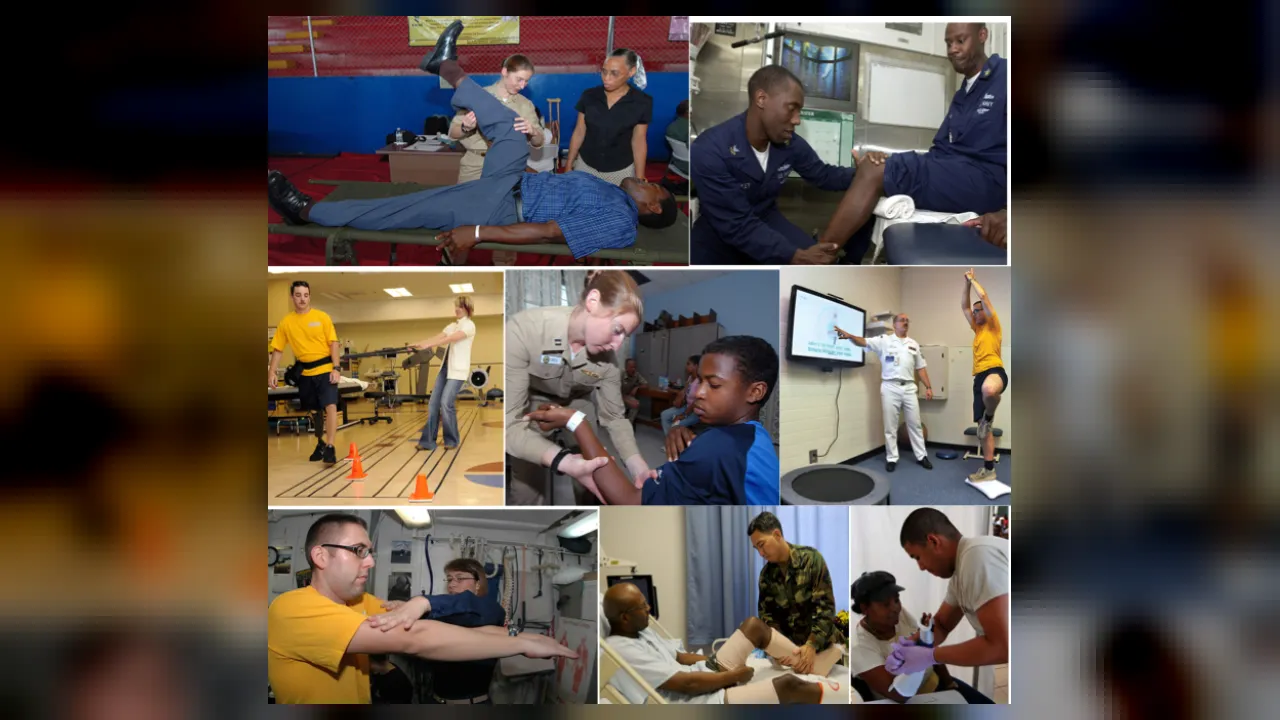
⚡ Everyday Impact SparkHelps injured athletes, growing kids, and recovering patients walk, run, and move pain-free again
🤯 Mind-Blowing Fact • Grade 1
Your body has more than 600 muscles working together every time you run, smile, or kick a soccer ball!
✨ Word Sparks (Grade 1 Glossary)
Tap 🔊 to hear
muscle
Stretchy body tissue that pulls bones
joint
Place where two bones bend together
balance
Staying steady without tipping or falling
🪝
Who helps you jump, balance, and run again after a broken leg heals?
1
Time to Move Again!
Stretch goes the bright rubber band! When a cast comes off a healed leg, can feel stiff and wobbly.
2
Fun Gym Helpers
A physical therapist is a movement doctor who coaches your body back to strength. You might bounce on big balls, walk across beams, or splash in a warm pool!
3
Step by Step
Each game and stretch makes and stronger. Soon you are running and playing pain-free!
1. What does a physical therapist use instead of surgery to help people heal?
2. About how many muscles do you have across your whole body?
🤯 Mind-Blowing Fact • Grade 2
Standing chest-deep in a warm therapy pool takes about seventy-five percent of your body weight off your knees and ankles thanks to water buoyancy!
✨ Word Sparks (Grade 2 Glossary)
Tap 🔊 to hear
goniometer
Angle-measuring tool checking how joints bend
buoyancy
Upward push of water helping things float
flexibility
How smoothly muscles and joints stretch
🪝
Why do physical therapists use warm swimming pools and giant ruler-protractors to help joints bend?
1
Measuring Every Bend
Hold out your elbow while a physical therapist lines up a cool two-armed angle ruler called a ! Just like a math protractor, a goniometer measures how many degrees your knee, shoulder, or ankle can bend today—and how much farther it bends next week.
2
Why Water Feels Like Moon Gravity
Sometimes walking on land hurts a healing knee or hip. Inside a warm aquatic therapy pool, water pushes upward and supports most of your body weight so you can practice walking almost weightlessly!
3
Helping Kids and Grandparents
Physical therapists help toddlers learn to walk, athletes heal sprained ankles, and grandparents stay steady on their feet.
1. Which protractor-like tool does a physical therapist use to measure joint angles in degrees?
2. How does chest-deep water in an aquatic therapy pool help a patient practice walking?
🤯 Mind-Blowing Fact • Grade 3
Your Achilles tendon at the back of your ankle is the strongest tendon in your body—able to handle forces more than three times your body weight every time you sprint!
✨ Word Sparks (Grade 3 Glossary)
Tap 🔊 to hear
tendon
Strong cord attaching muscle to bone
rehabilitation
Guided training to rebuild lost abilities
prosthetic
Engineered artificial limb replacing missing part
🪝
How does a physical therapist figure out why your knee hurts when the real problem actually started in your hip or ankle?
1
Detectives of the Human Kinetic Chain
Watch how one domino tips the next in a long row! Your skeleton, muscles, , and ligaments connect in a 'kinetic chain' from your toes up to your neck. If weak hip muscles or a stiff ankle make your leg twist inward when you run, your knee feels the ache—and a physical therapist spots that hidden clue!
2
Custom Plans Without Extra Pills
Physical therapists—called PTs—design personalized movement prescriptions using resistance bands, foam balance pads, parallel bars, ultrasound warmth, and hands-on joint mobilization to restore painless motion naturally.
3
Teaching New Robotic Limbs to Walk
When someone receives a new leg or recovers from a spinal or brain injury, PTs coach their brain and muscles step by step until walking, climbing stairs, and playing sports feel natural again.
4
Doctors of Physical Therapy
Today's PTs earn a four-year college degree plus a three-year Doctor of Physical Therapy (DPT) degree and pass a national licensing exam.
1. Why might a physical therapist strengthen your hip muscles when your knee is the spot that hurts?
2. What connects a muscle to a bone so pulling the muscle moves your skeleton?
🤯 Mind-Blowing Fact • Grade 4
Your inner ear contains microscopic calcium crystals that help sense gravity, and a specially trained vestibular physical therapist can stop certain kinds of dizziness in minutes just by guiding your head through exact angles!
✨ Word Sparks (Grade 4 Glossary)
Tap 🔊 to hear
kinesiology
Scientific study of human body movement
neuroplasticity
Brain's ability to form new pathways
gait
A person's pattern of walking steps
🪝
How did historic health challenges launch American physical therapy—and how can targeted movement actually rewire the human brain?
1
Born From Courage and Recovery
American physical therapy arose over a century ago during two major challenges: the polio epidemics of the early 1900s, which weakened thousands of children's muscles, and World War I, when 'Reconstruction Aides' led by pioneer Mary McMillan helped injured soldiers walk and work again. In 1921, McMillan founded the national association that grew into today's American Physical Therapy Association!
2
Kinesiology: Levers, Pulleys, and Gait
Doctors of Physical Therapy study —treating bones as mechanical levers, joints as fulcrums, and muscles as force engines! During a check, a PT observes stride length, foot strike, pelvis stability, and posture, often using high-speed video cameras and pressure-sensing floor mats.
3
Neuroplasticity in Action
Physical therapy helps far more than sprained ankles or healing fractures. For children born with cerebral palsy or adults recovering from a stroke or spinal injury, repetitive, task-specific movement triggers —encouraging healthy brain neurons to sprout fresh connections and take over movement pathways so hands can grasp and legs can stride steadily!
4
Pediatric, Sports, and Vestibular PTs
Specialists work across almost every setting imaginable: pediatric PTs turn school and clinic sessions into joyful obstacle-course play, sports PTs test jumping symmetry before clearing athletes for competition, cardiopulmonary PTs strengthen breathing endurance, and vestibular PTs cure room-spinning dizziness caused by tiny displaced inner-ear balance crystals!
1. Who led World War I 'Reconstruction Aides' and founded America's first national physical therapy association in 1921?
2. What brain superpower allows repetitive physical therapy exercises to rebuild movement skills after a nerve or brain injury?
🤯 Mind-Blowing Fact • Grade 5
Modern sports and rehab labs use infrared 3D motion-capture cameras—the exact same technology used to animate movie characters—so physical therapists can measure knee and hip angles at over 200 frames per second!
✨ Word Sparks (Grade 5 Glossary)
Tap 🔊 to hear
torque
Rotational turning force acting around joints
collagen
Strong protein fiber building tendons and ligaments
exoskeleton
Wearable motorized frame assisting human walking
🪝
How do musculoskeletal biomechanics, neuromuscular physiology, and motion-capture technology empower Doctors of Physical Therapy to restore human movement?
1
Engineering Levers Inside the Human Body
Every time you climb a flight of stairs, your quadriceps, hamstrings, gluteals, and gastrocnemius muscles fire in millisecond sequences across third-class anatomical levers! Doctors of Physical Therapy (DPT) analyze these joint , ground-reaction forces, and range-of-motion arcs to pinpoint why movement breaks down after orthopedic surgery, sports trauma, congenital conditions, or neurological injury—restoring function through targeted mechanics rather than invasive procedures.
2
Tissue Remodeling Through Controlled Load
Contrary to the old myth that injured bodies simply need weeks of total bed rest, modern rehabilitation science relies on mechanotherapy—the discovery that graded mechanical loading stimulates tenocytes, myocytes, and chondrocytes to align fresh fibers along lines of stress! Whether guiding an athlete twelve weeks after anterior cruciate ligament (ACL) reconstruction or helping a young gymnast overcome growth-plate inflammation, a PT calibrates progressive resistance so healing tissues strengthen without overloading.
3
Neuromuscular Re-Education and Exoskeletons
In neurological rehabilitation hospitals, PTs harness activity-dependent neuroplasticity. Body-weight-supported treadmills, functional electrical stimulation (FES) pads that cue weakened nerves, virtual-reality balance platforms, and wearable robotic allow patients with spinal cord injuries, cerebral palsy, or stroke recovery to practice thousands of symmetrical steps—reinforcing motor-cortex and spinal circuitry.
4
Cardiopulmonary and Vestibular Specialties
Beyond orthopedics and neurology, board-certified physical therapy specialists work inside intensive care units mobilizing heart- and lung-transplant recipients, inside school districts supporting gross-motor milestones under Individualized Education Programs (IEPs), and inside balance clinics performing canalith repositioning maneuvers for inner-ear semicircular canal disorders.
5
Seven Years of Doctoral Training
Future PTs complete a bachelor's degree in kinesiology, physics, anatomy, and physiology followed by a three-year accredited Doctor of Physical Therapy program with thirty-plus weeks of full-time clinical internships and the National Physical Therapy Examination (NPTE).