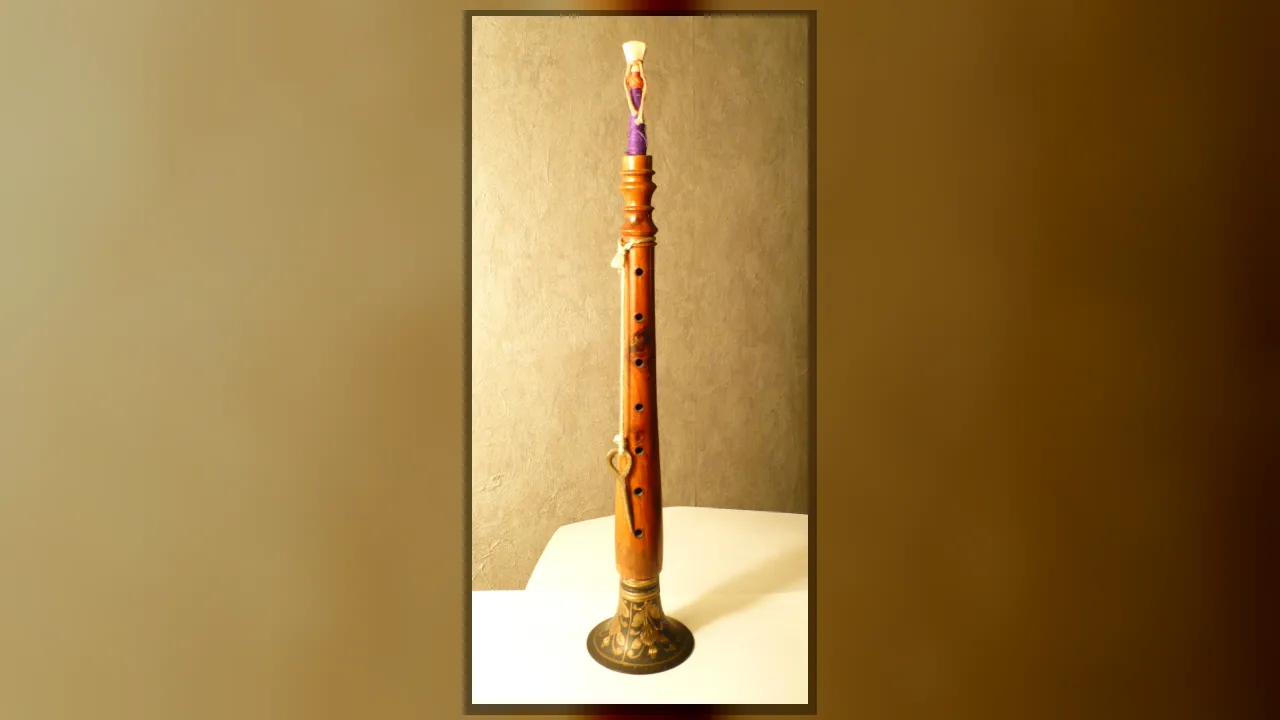
1. What two main materials make up the body and bell of a shehnai?
2. When do people in India traditionally love to hear the shehnai?
🤯 Mind-Blowing Fact • Grade 2
When India celebrated its very first Independence Day in 1947, master musician Bismillah Khan played the shehnai at Delhi's historic Red Fort!
✨ Word Sparks (Grade 2 Glossary)
Tap 🔊 to hear
auspicious
Bringing good fortune and hopeful success
ensemble
Group of musicians performing music together
cone
Shape narrowing at one end and widening
🪝
How can an outdoor horn loud enough to echo across a city also whisper like a gentle singer?
1
Music from Temple Gateways
Imagine standing below an ancient stone arch at sunrise while a radiant, singing horn greets the new day. For centuries, perched above palace and temple gates so the shehnai's clear voice could travel across whole towns.
2
Four Tiny Blades in One Reed
Most reed instruments use one or two thin strips of cane, but a traditional shehnai reed bundles four flattened blades together! Bound tightly onto a tiny brass tube, those blades vibrate with amazing power.
3
No Keys Required
Seven open finger holes line the widening wooden . By changing lip squeeze and breath speed, skilled musicians bend notes smoothly without pressing a single metal key. Every melody rings out with festive warmth and sparkling energy.
1. What makes a traditional shehnai reed unusual compared to a clarinet or oboe?
2. Why did palace musicians play the shehnai from high stone gateways?
🤯 Mind-Blowing Fact • Grade 3
Traditional reeds are harvested from wild marsh grass in eastern India and aged for months before being tied with cotton thread onto a tiny brass tube!
✨ Word Sparks (Grade 3 Glossary)
Tap 🔊 to hear
quadruple
Made up of four matching parts
staple
Small metal tube holding a woodwind reed
beeswax
Natural moldable wax made by honeybees
🪝
Why do shehnai players dab tiny bits of soft wax onto extra holes before a concert?
1
Power of the Widening Cone
Step into a lively festival tent and one soaring, nasal-sweet voice cuts cleanly through booming drums. Unlike a straight bamboo flute, the shehnai's hardwood tube widens steadily into a flared brass bell, amplifying every vibration.
2
Quadruple-Reed Control
Artisans craft the mouthpiece from dried marsh sedge softened in milk or water, pressing two folded layers into a reed tied onto a metal . Because there is no lip-resting disc, the player's lips grip the reed directly to shape every attack and glide.
3
Waxing for the Raga
Along the tube sit seven main finger holes plus one or two extra tuning vents near the bottom. Before performing a specific raga, musicians partially seal those lower vents with to fine-tune the drone and scale.
4
From Processions to Concert Stages
Supported by a companion shehnai holding a steady kharaj drone and twin clay-and-wood duggi drums, Ustad Bismillah Khan proved this ceremonial horn could rival any classical concert instrument. Audiences from Varanasi to Edinburgh marveled at how gently its bright reed could whisper.
1. Why do musicians dab soft beeswax onto lower vents of a shehnai?
2. How does direct lip contact on the reed help a shehnai player?
🤯 Mind-Blowing Fact • Grade 4
South India has a giant cousin of the shehnai called the nadaswaram, which stretches nearly twice as long and booms through grand temple courtyards!
✨ Word Sparks (Grade 4 Glossary)
Tap 🔊 to hear
shawm
Early conical double-reed horn with strong sound
naubat
Traditional royal gateway ensemble of drums and reeds
overblowing
Increasing breath speed to jump to higher harmonics
🪝
How did a keyless outdoor shawm master the whisper-quiet subtleties of Indian classical concert halls?
1
Gateway Ensembles and Royal Roots
Echoing down from towering Mughal gateway arches called khanas, piercing reed horns once marked royal processions, temple rituals, and daily watches across South Asia. Often traced to Persian-Indian roots meaning 'king's flute,' the shehnai evolved from sturdy outdoor into an exquisitely responsive solo voice.
2
Conical Bore Acoustics
Lathed from dense teak or dark sheesham rosewood and capped with a cast-brass bell, the instrument encloses a continuous conical air column roughly forty-eight centimeters long. Because a full cone supports both even and odd harmonics, raises the pitch by a clean octave rather than a twelfth, unlocking a seamless two-octave compass from A3 to A5.
3
Embouchure Gymnastics Without Keys
Taming a stiff quadruple sedge reed requires extraordinary breath pressure and micro-muscular lip control. By subtly loosening or pinching the four cane blades while shading seven open finger holes, virtuosos execute rapid ornamental turns and wide vocal glides that keyed Western oboes cannot easily imitate.
4
Bismillah Khan's Classical Revolution
For generations, scholars dismissed the horn as strictly ceremonial outdoor folk music. That changed in 1937 when young Ustad Bismillah Khan stunned the All India Music Conference in Calcutta, weaving intricate ragas with hushed tenderness alongside crisp tabla rhythms and bringing the humble reed pipe onto prestigious world stages.
1. Why does overblowing a conical shehnai jump cleanly by one octave instead of a wider interval?
2. How did Ustad Bismillah Khan transform the history of the shehnai in 1937?
🤯 Mind-Blowing Fact • Grade 5
By omitting the wooden lip disc used on cousin folk shawms, classical shehnai players gained the direct lip contact needed to bend a single fingered note by up to three semitones!
✨ Word Sparks (Grade 5 Glossary)
Tap 🔊 to hear
pirouette
Small disc supporting lips below a reed
gayaki ang
Instrumental performance style imitating expressive human singing
aperture
Narrow opening through which air passes
🪝
What acoustic marriage allows a quadruple-blade sedge reed and a keyless rosewood cone to balance outdoor projection with vocal delicacy?
1
Organology of the South Asian Conical Reed
Before a bride steps beneath a floral canopy or a dawn raga unfolds along the riverbanks of Varanasi, a radiant, penetrating oboe-like cry parts the morning air. Classified under Hornbostel-Sachs 422.112 (single-pipe reedpipes with conical bore), the North Indian shehnai descends from West and South Asian surnay/zurna traditions, yet diverged sharply from outdoor folk shawms by trading raw volume for supple dynamic nuance.
2
Full-Series Harmonics in a Flared Cone
Turned on a lathe from dense Dalbergia sissoo (sheesham) wood and fitted with an ornamental brass terminal bell, the forty-five-to-fifty-centimeter bore expands conically from a narrow five-millimeter throat. Acoustically, a conical pipe driven by a pressure-controlled reed mirrors the full harmonic series (f, 2f, 3f, 4f) of an open pipe. Consequently, the instrument overblows smoothly at the octave, spanning two chromatic octaves from roughly A3 (220 hertz) to A5 (880 hertz).
3
Mechanics of the Pirouette-Free Quadruple Reed
Many Asian shawms mount their reed above a lip-supporting disc called a , encouraging players to puff their cheeks and blow at constant maximum volume. Crucially, the classical shehnai omits the pirouette; its quadruple reed—fashioned from flattened stems of Eleocharis or Saccharum marsh sedge bound onto a tapered brass staple—sits directly between the musician's lips, granting instant micro-control over reed , timbre, and pitch inflection.
4
Gayaki Ang Without Mechanical Keywork
Pierced by seven equidistant finger holes (plus auxiliary tuning vents stopped with wax), the keyless bore places immense demands on embouchure flexibility. In the (vocal style) perfected in Benares, virtuosos bend pitches up to a minor third through lip pressure alone, seamlessly executing sweeping meend glides, rapid murki turns, and crisp khatka articulations alongside a sustained sur-shehnai drone and intricate khurdak or tabla percussion.
5
Cultural Resonance in Modern India
Elevated to national prominence by Bharat Ratna laureate Ustad Bismillah Khan—whose historic performance at Delhi's Red Fort greeted Indian independence on August 15, 1947, and whose collaborations with violinist N. Rajam and sitarist Vilayat Khan captivated global audiences—the shehnai stands as an enduring sonic emblem of auspicious thresholds and classical mastery.