1. How many finger holes sit on a traditional Japanese shakuhachi?
2. Which part of the giant bamboo plant forms the flared bell at the bottom of a shakuhachi?
🤯 Mind-Blowing Fact • Grade 2
In old Japanese units, 'shaku-hachi' literally translates to 'one shaku and eight sun'—its classic 54.5-centimeter length!
✨ Word Sparks (Grade 2 Glossary)
Tap 🔊 to hear
shaku
Traditional Japanese unit nearly one foot long
utaguchi
Slanted blowing edge carved at the top
mindful
Calmly paying close attention to each breath
🪝
Why is this Japanese bamboo flute literally named after a ruler measurement?
1
Named by Its Exact Length
Imagine calling a ruler-sized flute 'One-Foot-Eight'! In traditional Japanese measurements, one plus hachi (eight tenths) equals about twenty-one and a half inches—giving the classic shakuhachi its exact name!
2
No Whistle Plug Inside
Unlike a recorder, the top of a shakuhachi is completely open from end to end. A player aims breath straight across a sharp, slanted rim edge called an to awaken deep, woody notes.
3
Breathing Like Peaceful Wind
Centuries ago in Japan, wandering Zen monks played slow, peaceful solo pieces on the shakuhachi to practice , calm breathing!
1. What does the Japanese word 'shakuhachi' literally describe?
2. How does the mouthpiece of a shakuhachi differ from a classroom recorder?
🤯 Mind-Blowing Fact • Grade 3
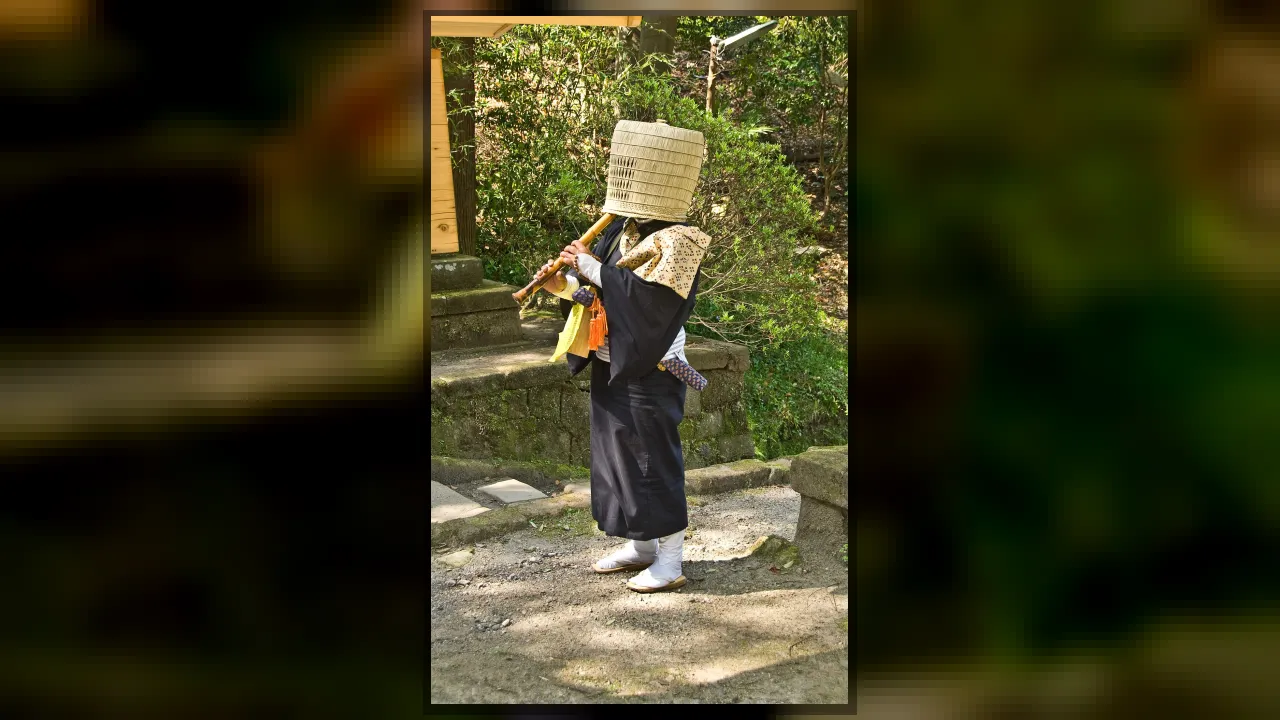
Wandering Edo-period Komusō monks played the shakuhachi while wearing large woven reed baskets called tengai over their entire heads to symbolize letting go of pride!
✨ Word Sparks (Grade 3 Glossary)
Tap 🔊 to hear
pentatonic
Musical scale built from five main notes
urushi
Glossy natural Japanese lacquer coating inner bore
meri
Bowing head downward to lower flute pitch
🪝
How can a bamboo flute with only five holes play every single note on a piano—plus wind storms?
1
Every Breath Tells a Story
Close your eyes as one sustained bamboo note begins like a distant autumn gust, swells into a resonant wooden bell, and melts softly back into silence. On the Japanese shakuhachi, breath rush is treasured right alongside pure melody!
2
Madake Bamboo and Red Lacquer
Master makers harvest dense Madake timber bamboo from steep mountainsides in winter, season it for years, and coat the hollow bore with smooth layers of tree lacquer—often glowing crimson inside—to tune every vibration.
3
Meri and Kari Head Tilts
Five finger holes naturally play a five-note scale. Yet by bowing the chin downward in a move called , or lifting upward in kari, while half-shading holes, a player bends pitch smoothly across every sharp and flat!
4
Blowing Zen
During Japan's Edo period, wandering Komusō monks wore woven basket hats and practiced suizen—'blowing Zen'—treating every single breath through bamboo as moving meditation.
1. How does a shakuhachi player lower a note's pitch and darken its tone color using the 'meri' technique?
2. Why do makers coat the inside bore of a traditional shakuhachi with layers of urushi lacquer?
🤯 Mind-Blowing Fact • Grade 4
Traditional master makers insist that an authentic shakuhachi contain exactly seven natural bamboo growth rings along its fifty-four-centimeter body!
✨ Word Sparks (Grade 4 Glossary)
Tap 🔊 to hear
muraiki
Explosive breath burst sounding like rushing wind
honkyoku
Solo Zen meditative pieces for bamboo shakuhachi
microtone
Tiny pitch step smaller than piano half-steps
🪝
Why do Western flute builders try to erase breath noise while Japanese shakuhachi masters celebrate the roar of raw wind?
1
One Single Sound Worth an Orchestra
In traditional Japanese aesthetics, an ideal called ichion jōbutsu suggests that ultimate beauty and awareness can live inside a single, deeply shaped musical tone. Nowhere does that philosophy ring clearer than in the shakuhachi, where one breath journeys from hushed silk to an explosive tempest called !
2
Oblique Utaguchi and Ji Bore Sculpting
Crafted from the dense, curved root-base of Madake bamboo (Phyllostachys bambusoides), a standard 1.8-shaku (54.5 cm) flute sounds fundamental D4. At the open top rim, artisans inlay a small wedge of water-buffalo horn or acrylic into the oblique utaguchi bevel so the razor-sharp edge never wears dull. Inside modern jinashi ('natural bore') flutes, natural bamboo nodes remain raw; inside precision jiari concert flutes, craftsmen sculpt a hard plaster-and-urushi-lacquer paste (ji) to millimeter tolerances across seven bamboo nodes!
3
Microtonal Mastery Across Five Holes
With four front holes and one back thumb hole tuned to a minor pentatonic pattern (D–F–G–A–C), players command over two and a half chromatic octaves. Tilting the chin downward (meri) brings the lips closer to the edge—increasing acoustic end-loading, flattening pitch up to a whole tone, and veiling upper harmonics in shadow—before snapping upward (kari) into radiant clarity.
4
From Komusō Monks to Global Stages
Arriving from Tang-dynasty China in the eighth century and reshaped by seventeenth-century Fuke Zen monks for solo meditation pieces, the shakuhachi now shines alongside koto harps, shamisen lutes, and international symphony orchestras.
1. Why is a tiny wedge of horn or hard material inlaid into the top blowing edge (utaguchi) of a shakuhachi?
2. How does a 'jiari' concert shakuhachi differ inside from an unlined 'jinashi' flute?
🤯 Mind-Blowing Fact • Grade 5
A solo shakuhachi performance of 'Tsuru no Sugomori' (Depicting Cranes in Their Nest) by master Goro Yamaguchi is currently hurtling beyond our solar system aboard NASA's 1977 Voyager Golden Record!
✨ Word Sparks (Grade 5 Glossary)
Tap 🔊 to hear
suizen
Zen practice of mindful breathing through bamboo
otsu and kan
Lower fundamental and upper overblown shakuhachi octaves
aperture shading
Covering rim opening slightly to lower pitch
🪝
How do variable lip-aperture shading and millimeter-precise lacquer bore profiles let a five-hole bamboo tube command two-and-a-half octaves of microtonal color?
1
Timbre as Melody, Breath as Sculpture
Listen to a master perform Nesting of the Cranes (Tsuru no Sugomori), one of the ancient solo honkyoku masterpieces: fluttering tongue tremolos, roaring breath turbulence (muraiki), and weeping quarter-tone glides unfold from a single stalk of root-end bamboo! Whereas nineteenth-century European wind makers added dozens of metal keys to equalize tone color across every semitone, Japanese shakuhachi masters embraced timbral contrast itself as the soul of musical expression.
2
End-Blown Notch Acoustics and Meri/Kari Impedance
Classified organologically as an end-blown notched open flute with finger holes (Hornbostel-Sachs 421.111.12), the standard 1.8-shaku shakuhachi measures ~54.5 centimeters (one shaku of 30.3 cm plus eight sun of 3.03 cm) and sounds a fundamental of D4 (293.66 Hz), ascending past G6 (~1,568 Hz) across otsu (fundamental), kan (second), and daikan (third) registers. Blowing across the open top aperture toward the 30-degree horn-inlaid utaguchi bevel leaves roughly 60–75% of the top opening uncovered in standard kari posture. When the player bows the head into meri, the lower lip advances over the bore opening while changing jet length and incidence angle—simultaneously increasing acoustic radiation mass (flattening pitch by 100 to 250 cents) and shifting spectral energy away from bright upper partials toward a veiled, breath-rich whisper!
3
Internal Bore Perturbations and Ji-Urushi Engineering
Harvested from mature Phyllostachys bambusoides (Madake) groves, an unfinished stalk tapers irregularly. In modern jiari construction, luthiers layer tonoko clay powder, gypsum, and raw urushi lacquer inside the bore, sculpting localized narrowings and expansions to within 0.1 millimeters so that octaves align precisely across all five finger holes (tuned pentatonically to D4–F4–G4–A4–C5).
4
From Tang Gagaku to Suizen and Sankyoku
Descended from the six-hole Tang Chinese chiba preserved in Nara's eighth-century Shōsōin repository, the five-hole Edo-period Fuke shakuhachi served wandering Komusō monks as a spiritual tool (hōki) for ('blowing Zen'). Following the Meiji government's 1871 abolition of the Fuke sect, secularized guilds integrated the flute into sankyoku chamber trios alongside koto zither and shamisen lute.
5
Contemporary Cross-Cultural Horizons
Championed internationally by Goro Yamaguchi—whose recording sailed aboard NASA's 1977 Voyager Golden Record into interstellar space!—and modernist composer Toru Takemitsu (November Steps, 1967), the shakuhachi resonates from Kyoto temples to the cosmos.