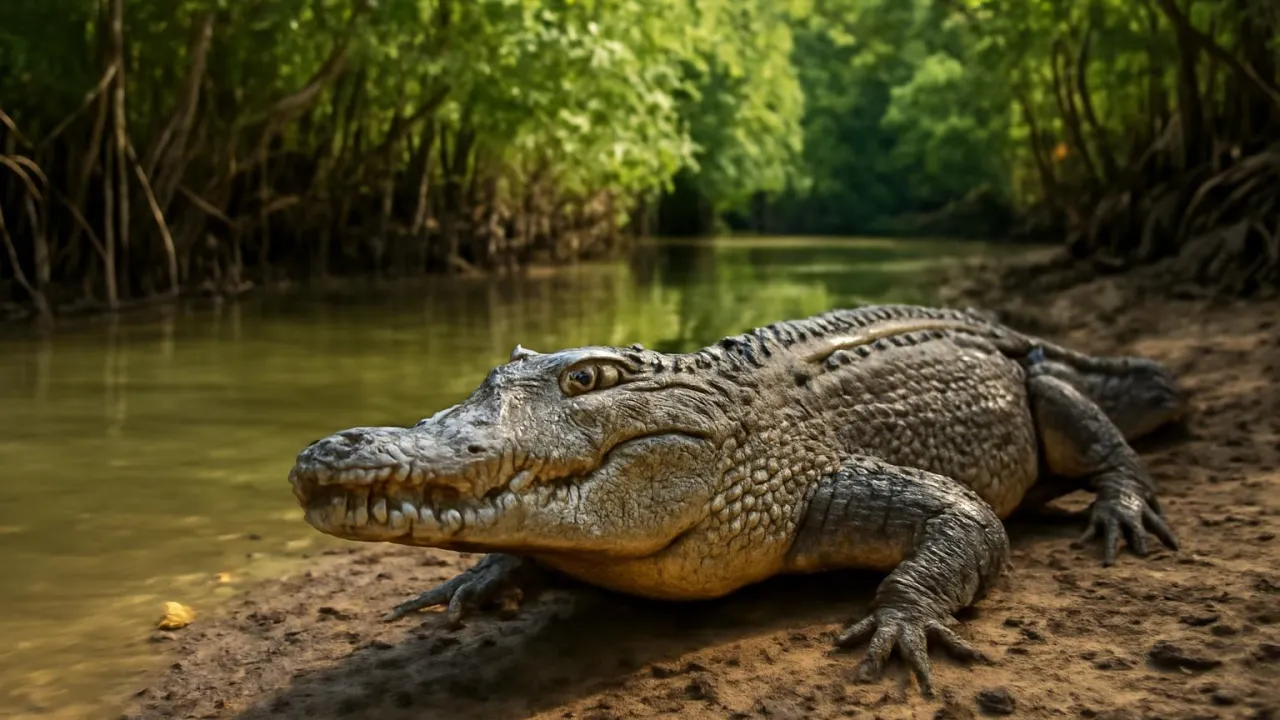
1. Where does the saltwater crocodile like to live?
2. What does the saltwater crocodile eat?
🤯 Mind-Blowing Fact • Grade 2
Saltwater crocodiles can hold their breath underwater for up to two hours!
✨ Word Sparks (Grade 2 Glossary)
Tap 🔊 to hear
estuary
Where river meets the sea
prey
Animals that are hunted for food
protect
To keep safe from harm
🪝
Can you imagine a crocodile that swims in salty and fresh water?
1
Big and Strong
The saltwater crocodile is the largest living reptile in the world. It can grow up to 23 feet long and weigh over 2,000 pounds. Its tough skin helps it from enemies and sharp plants.
2
Home in Water
Saltwater crocodiles live in rivers, estuaries, and coastal mangroves. They can swim in both fresh and salty water. These places give them food and safe spots to rest.
3
Hunters with Sharp Teeth
They eat fish, birds, and mammals like deer or pigs. Their strong jaws have the most powerful bite in the animal kingdom. They wait quietly in water before catching their quickly.
1. What kind of water can saltwater crocodiles live in?
2. What helps saltwater crocodiles catch their food?
🤯 Mind-Blowing Fact • Grade 3
Saltwater crocodiles can swim speeds up to 20 miles per hour using their strong tails!
✨ Word Sparks (Grade 3 Glossary)
Tap 🔊 to hear
camouflage
Colors or patterns that hide animals
apex predator
Top hunter with no enemies
adaptation
Body change to survive better
🪝
How does the saltwater crocodile survive in both rivers and oceans?
1
Huge Reptile with Tough Skin
Saltwater crocodiles are the largest reptiles on Earth, with thick scaly skin that acts like armor. Their skin helps them in muddy water, making it easier to sneak up on prey. They can grow over 20 feet long and weigh more than a small car.
2
Living in Brackish Waters
These crocodiles live in brackish water where fresh rivers meet salty seas, such as mangrove swamps and estuaries. Their bodies adapt to salty water by excreting excess salt through special glands. This helps them survive in both saltwater and freshwater environments.
3
Ambush Predator with Powerful Bite
Saltwater crocodiles are ambush predators that wait patiently underwater for prey. They use and stealth to approach fish, birds, and mammals. Their powerful jaws deliver the strongest bite force of any animal, crushing bones easily.
4
Role in the Ecosystem
As , saltwater crocodiles help control populations of fish and mammals, keeping ecosystems balanced. They also scavenge dead animals, cleaning the environment. Their presence supports healthy food webs in coastal habitats.
1. What helps saltwater crocodiles hide from prey?
2. Why are saltwater crocodiles important in their ecosystem?
🤯 Mind-Blowing Fact • Grade 4
Saltwater crocodiles can leap out of water to catch prey as high as 6 feet above the surface!
✨ Word Sparks (Grade 4 Glossary)
Tap 🔊 to hear
estuaries
Where rivers meet the ocean
apex predator
Top animal hunter with no enemies
conservation
Protecting animals and their homes
🪝
What makes the saltwater crocodile a powerful hunter in rivers and seas?
1
Physical Strength and Camouflage
Saltwater crocodiles have muscular bodies covered with tough, armored scales that protect them from predators and injuries. Their dark green and brown colors blend perfectly with murky waters and mangrove roots, providing excellent camouflage. This physical strength allows them to ambush prey effectively in both freshwater and saltwater environments.
2
Habitat and Geographic Range
These crocodiles inhabit coastal regions, , rivers, and mangrove swamps across the Indo-Pacific, including Australia, Southeast Asia, and India. Their ability to tolerate saltwater is due to special salt glands that remove excess salt from their bodies. This wide geographic range helps them access diverse food sources and breeding grounds.
3
Ecological Role and Food Webs
As , saltwater crocodiles regulate populations of fish, birds, and mammals, preventing overpopulation and maintaining ecosystem balance. They also scavenge carcasses, which helps recycle nutrients in aquatic habitats. Their presence supports complex food webs and contributes to the health of coastal ecosystems.
4
Human Impact and Conservation
Saltwater crocodiles face threats from habitat loss and illegal hunting, but efforts have helped stabilize some populations. Protected areas and wildlife laws aim to preserve their habitats and reduce human conflicts. Understanding their role in ecosystems encourages coexistence and protection.
1. How do saltwater crocodiles survive in salty water?
2. Why is it important to protect saltwater crocodiles?
🤯 Mind-Blowing Fact • Grade 5
Saltwater crocodiles have the strongest bite force ever measured, over 3,700 pounds per square inch!
✨ Word Sparks (Grade 5 Glossary)
Tap 🔊 to hear
osmotic pressure
Water balance in animal bodies
apex predator
Top animal hunter with no enemies
incubation
Keeping eggs warm to hatch
🪝
What fascinating adaptations allow the saltwater crocodile to dominate both freshwater and marine habitats?
1
Taxonomy and Scientific Classification
The saltwater crocodile, scientifically named Crocodylus porosus, belongs to the Crocodylidae family within the order Crocodylia. It is the largest extant reptile species, with a lineage dating back over 200 million years. This species exhibits evolutionary traits that have allowed it to thrive in diverse aquatic environments across the Indo-Pacific region.
2
Physiological Adaptations and Mechanics
Saltwater crocodiles possess specialized salt-excreting glands located on their tongues, which enable them to regulate and survive in saline environments. Their muscular tails provide powerful propulsion for swimming at speeds up to 20 miles per hour, while their robust jaws generate bite forces exceeding 3,700 pounds per square inch, the strongest recorded in any animal.
3
Ecological Role and Conservation Status
As , saltwater crocodiles play a critical role in maintaining balanced food webs by controlling populations of fish, birds, and mammals. Despite facing threats from habitat destruction and poaching, conservation programs and legal protections have improved population stability in many regions, though ongoing efforts remain essential to prevent decline.
4
Botanical and Behavioral Interactions
Saltwater crocodiles inhabit mangrove forests and estuarine ecosystems, where they interact with diverse flora such as mangrove trees that stabilize shorelines. Their nesting behavior involves constructing large mounds of vegetation, which provide heat for eggs. These behaviors demonstrate complex ecological relationships between fauna and flora in coastal environments.
5
Quantitative Comparisons and Records
Adult saltwater crocodiles can reach lengths up to 23 feet and weigh over 2,200 pounds, making them the largest reptiles alive today. They can hold their breath underwater for up to two hours and leap vertically up to 6 feet to capture prey. Their bite force surpasses that of great white sharks and lions, showcasing their extraordinary predatory capabilities.