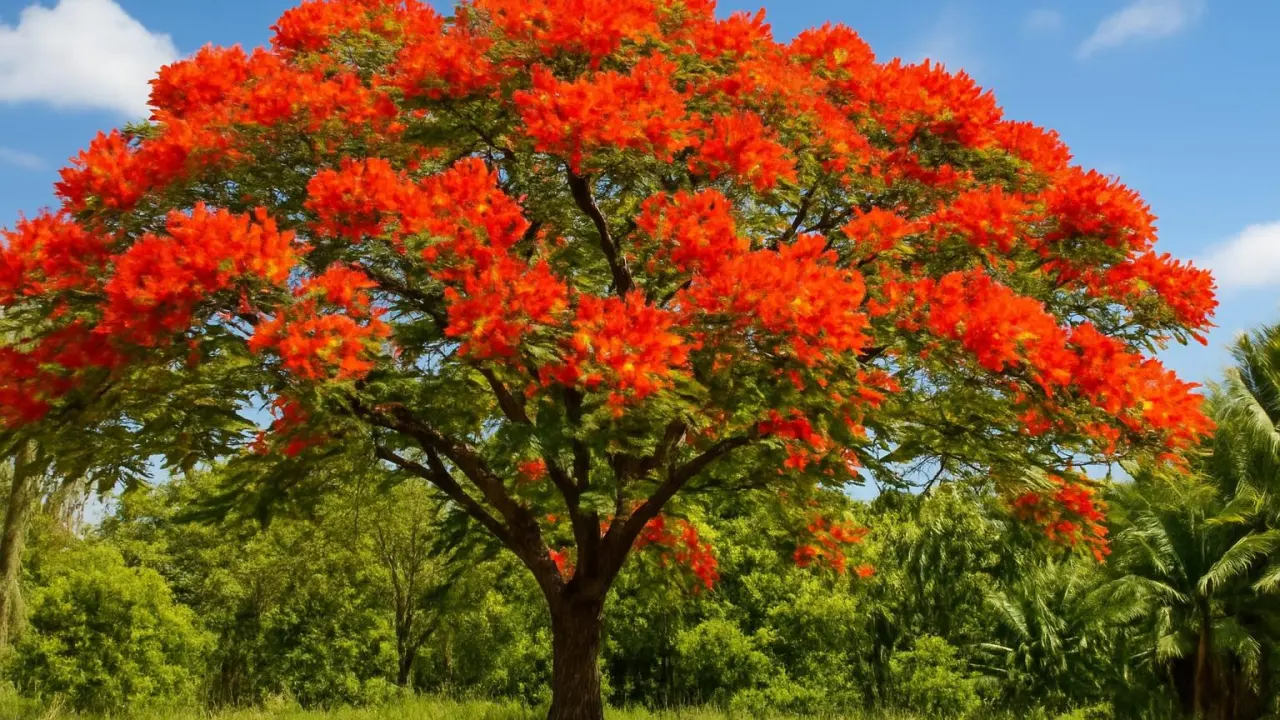
Royal Poinciana flowers cover the whole tree, making it look like a blazing fire!
✨ Word Sparks (Grade 2 Glossary)
Tap 🔊 to hear
pollinated
When bees help flowers make seeds
tropical
Warm places near the equator
shade
A cool spot under leaves or trees
🪝
Have you ever seen a tree that looks like it’s on fire?
1
Flaming Red Flowers
The Royal Poinciana tree has bright red flowers that look like flames. These flowers bloom in summer and attract many bees and birds. The colorful petals help the tree get so it can grow seeds.
2
Tall Tree with Big Shade
This tree can grow very tall, up to 40 feet high. Its many green leaves spread wide to give cool . People often plant it near homes to enjoy the shade on hot days.
3
Warm Places to Grow
Royal Poinciana trees grow best in warm places with full sun. They need regular water but do not like too much wet soil. They are native to Madagascar but grow in many tropical countries.
Royal Poinciana’s bright red flowers act like a beacon to attract pollinators from far away!
✨ Word Sparks (Grade 3 Glossary)
Tap 🔊 to hear
adaptation
A change that helps plants survive better
pollination
When pollen moves to help make seeds
canopy
The top layer of leaves on a tree
🪝
Why does the Royal Poinciana tree look like it’s on fire in summer?
1
Flaming Red Flowers and Pollination
The Royal Poinciana produces bright red flowers that bloom in summer. These flowers attract many pollinators like bees and birds. helps the tree make seeds for new plants. The bright color is an to stand out in its environment.
2
Big Tree and Shade
This tree can grow up to 40 feet tall with a wide . Its large leaves create shade that cools the ground below. This shade helps animals and people stay cool in hot climates. The tree’s structure is an to protect itself and others from heat.
3
Tropical Habitat and Growth
Royal Poinciana trees thrive in tropical regions with full sun and moderate water. They are native to Madagascar but have spread to many tropical areas worldwide. Their roots absorb nutrients and water from the soil to support growth. The tree’s help it survive in warm climates.
4
Seed Pods and Survival
After , the tree produces long seed pods that hold many seeds. These pods dry and split open to release seeds for new trees. This helps the species spread and survive in its ecosystem. The seed pods protect the seeds until they are ready to grow.
1. What helps the Royal Poinciana attract pollinators?
2. How do seed pods help the Royal Poinciana?
🤯 Mind-Blowing Fact • Grade 4
The Royal Poinciana’s bright red flowers not only attract pollinators but also influence local ecosystems by providing shade and shelter.
✨ Word Sparks (Grade 4 Glossary)
Tap 🔊 to hear
ecosystem
A community of plants, animals, and environment
pollination
When pollen moves to help make seeds
dispersal
How seeds spread to new places
🪝
How does the Royal Poinciana’s bright red color help it survive in tropical ecosystems?
1
Bright Flowers and Pollination Success
The Royal Poinciana’s bright red flowers attract many pollinators such as bees and birds, which increases its chances of successful . This cause-and-effect relationship ensures the tree produces seeds to continue its species. The vibrant color also helps the tree stand out in dense tropical forests.
2
Shade Provider in Ecosystems
With its wide canopy and large leaves, the Royal Poinciana provides important shade in tropical . This shade lowers ground temperatures and creates microhabitats for many animals. The tree’s role in the food web includes supporting insects that pollinate it and animals that seek shelter beneath it.
3
Geographic Distribution and Human Impact
Native to Madagascar, the Royal Poinciana has been widely planted in tropical and subtropical regions worldwide. Humans value it for ornamental shade and beauty in parks and streets. However, in some areas, it can become invasive, affecting local plant communities and biodiversity.
4
Seed Dispersal and Survival Strategies
The tree produces long seed pods that dry and split open to release seeds, which are dispersed by wind and animals. This seed strategy helps the species colonize new areas and maintain genetic diversity. The seed pods protect seeds from predators until they are ready to germinate.
1. What effect do the bright red flowers have on the Royal Poinciana?
2. Why is seed dispersal important for the Royal Poinciana?
🤯 Mind-Blowing Fact • Grade 5
Royal Poinciana’s seed pods can grow over 20 inches long, holding many seeds for future trees.
✨ Word Sparks (Grade 5 Glossary)
Tap 🔊 to hear
leguminous
Plants that make pods with seeds inside
compound leaves
Leaves made of many small leaflets
invasive
When a plant spreads too much and harms others
🪝
What makes the Royal Poinciana a remarkable tropical tree with ecological and botanical significance?
1
Scientific Classification and Origin
The Royal Poinciana, scientifically named Delonix regia, belongs to the Fabaceae family, known for trees. Native to Madagascar, it thrives in tropical climates worldwide, admired for its spectacular floral displays. Its classification helps botanists understand its relations to other flowering trees and legumes. This knowledge supports conservation and botanical research efforts.
2
Physiological Adaptations and Flower Mechanics
This tree’s bright red flowers have five petals, including a distinctive upright petal called the standard, which attracts pollinators visually. Its reduce water loss and protect from intense sunlight, while deep roots access underground water during dry seasons. These physiological traits enable survival in tropical environments and contribute to its resilience.
3
Ecological Role and Human Interaction
Royal Poinciana plays a key role in tropical ecosystems by providing shade, food, and habitat for various animals, including pollinators and birds. Humans cultivate it widely as an ornamental tree in urban and rural areas, enhancing biodiversity and aesthetics. However, its introduction outside native ranges requires monitoring to prevent invasiveness and protect native species.
4
Conservation and Botanical History
While not currently endangered, habitat loss in Madagascar threatens wild populations of Royal Poinciana. Botanical gardens worldwide conserve genetic diversity through seed banks and cultivation. Historically, the tree’s striking flowers have inspired art and culture in tropical regions, symbolizing beauty and resilience through centuries of human appreciation.
5
Quantitative Comparisons and Growth Facts
Royal Poinciana trees can reach heights of 40 feet (12 meters) and spread canopies up to 50 feet (15 meters) wide. Their flowers bloom during warm months, lasting several weeks. Seed pods can grow up to 20 inches (50 centimeters) long, containing numerous seeds. These features highlight the tree’s impressive growth and reproductive strategies, supporting its survival in diverse tropical habitats.