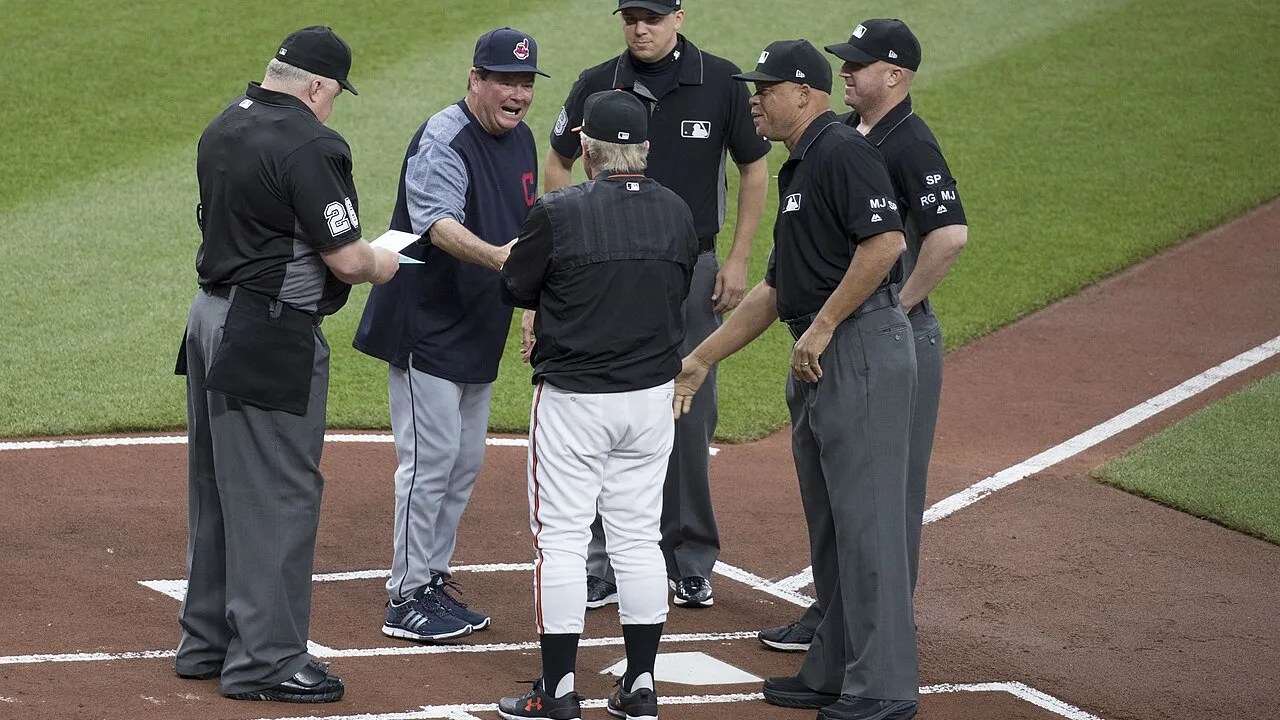
1. Why do referees and umpires use clear hand signals during games?
2. How do referees and umpires treat the two teams in a match?
🤯 Mind-Blowing Fact • Grade 2
Black-and-white vertical stripes became famous for referees in the 1920s so players wouldn't confuse the official with a teammate!
✨ Word Sparks (Grade 2 Glossary)
Tap 🔊 to hear
inspect
To check carefully for safety or rules
protector
Padded gear worn to guard the body
impartial
Fair and not picking a favorite side
🪝
Why are some sports officials called referees while others are called umpires?
1
Two Names for Fair Judges
Swish! A soccer ball rolls right onto the white chalk line—is it in or out? Sports officials watch closely to decide. Sports like basketball, hockey, and soccer use referees, while baseball, softball, and tennis usually call their officials umpires.
2
Running Right Beside the Action
To see plays clearly, officials have to stay fit and fast! Basketball and soccer referees sprint miles up and down the court or field, while home-plate umpires wear padded chest and masks for safety.
3
Calm Voices in Exciting Moments
Even when fans cheer loudly in the bleachers, officials stay calm, fair, and polite. They the playing field before kickoff, keep official game time, and stop rough play quickly so no one gets hurt.
1. Why did referees start wearing striped shirts in the 1920s?
2. Why does a home-plate baseball umpire wear a mask and chest protector?
🤯 Mind-Blowing Fact • Grade 3
A professional soccer referee often runs between 6 and 8 miles during a single 90-minute match to keep pace with fast passes!
✨ Word Sparks (Grade 3 Glossary)
Tap 🔊 to hear
positioning
Standing in the best spot to see
certified
Trained and tested to meet official standards
crew
A team of people working together
🪝
How did deaf baseball player Dummy Hoy help inspire the bold umpire hand signals we still see today?
1
Split-Second Sight and Sound
Crack! A batter sprints hard down the baseline and lunges toward first base just as the thrown ball smacks into the first baseman's leather glove. Baseball umpires listen closely for the crisp pop of the ball while watching the runner's foot touch the white bag, making an honest decision in less than half a second!
2
Signals Everyone Can Understand
Over a century ago, talented deaf outfielder William 'Dummy' Hoy could not hear voiced ball-and-strike calls from center field or the batter's box. Clear hand signals helped deaf players, coaches, and noisy stadium crowds alike see every call right away—a helpful tradition officials use across almost every sport today.
3
Studying the Rulebook
Becoming a referee or umpire takes steady study and practice. Officials attend training clinics, pass written rule exams, and master —standing at the exact field angle where players' bodies will not block their line of sight.
4
Teamwork Among Officials
In championship games, of officials work smoothly together using wireless headsets, boundary flags, and instant video replay to make sure tricky calls are completely fair and accurate.
1. How does smart positioning help a referee or umpire during a play?
2. Why do baseball umpires listen with their ears while watching first base?
🤯 Mind-Blowing Fact • Grade 4
In 1997, Violet Palmer made sports history as the first woman to officiate a National Basketball Association regular-season game!
✨ Word Sparks (Grade 4 Glossary)
Tap 🔊 to hear
neutrality
Refusing to favor either competing side
decisive
Able to make clear, quick choices
poise
Calm confidence during stressful or busy moments
🪝
What does it take to judge a 95-mile-per-hour pitch or a photo-finish goal line play without bias?
1
Inside the Strike Zone
Imagine crouching steadily behind home plate as a stitched baseball hurtles toward you at 95 miles per hour, curving sharply across the corner at the last ten feet! In less than four-tenths of a second, the plate umpire tracks the spinning sphere from the pitcher's hand through an invisible three-dimensional strike zone bounded by the batter's knees and midpoint, calling 'Strike three!' with calm confidence.
2
Neutrality as a Civic Lesson
Much like impartial judges in a courtroom, referees and umpires uphold a shared written code of rules that both teams agree to honor before competition begins. Strict —measuring star players and bench substitutes by the exact same standard, whether playing at home or away—shows communities how fair rules and mutual respect make peaceful, exciting competition possible.
3
Human Eyes Meet High Technology
Modern sports officiating blends sharp human judgment with precision sensor technology. Tennis chair umpires consult high-speed Hawk-Eye ball-tracking cameras, World Cup soccer referees wear goal-line watches that buzz within one second if the whole ball crosses the chalk plane, and basketball or football crews confer with replay centers to verify boundary touches within millimeters.
4
Starting Young in Community Sports
Many certified referees and umpires begin as teenagers officiating Saturday morning youth soccer matches or neighborhood Little League baseball games. Learning to check equipment safety, communicate respectfully with coaches, manage game flow, and make calls under pressure builds remarkable confidence and leadership.
1. How are sports referees and umpires similar to courtroom judges?
2. How does goal-line or Hawk-Eye technology assist modern game officials?
🤯 Mind-Blowing Fact • Grade 5
Word historians trace 'umpire' back to the medieval French phrase 'nonper'—meaning 'not paired,' or an odd third person brought in to settle a tie fairly!
✨ Word Sparks (Grade 5 Glossary)
Tap 🔊 to hear
mechanics
Planned movement and positioning of game officials
infraction
An action that breaks a game rule
de-escalation
Calming tense moments before arguments grow
🪝
How do elite referees and umpires master rulebook edge cases, athletic stamina, and conflict resolution all at once?
1
Forty Thousand Eyes Watching
Under blazing stadium floodlights, two collegiate basketball players leap simultaneously toward the rim and collide midair. Instantly, twenty thousand home fans shout 'Charge!' while visiting supporters roar 'Block!' Yet the baseline referee—heart pumping at 155 beats per minute after sprinting full-court—blows a crisp whistle, checks whether the defender's feet were set outside the restricted arc before upward motion began, signals a blocking foul, and calmly explains the contact angle to both team captains.
2
Mastering Mechanics and Rulebook Nuance
Official league rulebooks span hundreds of pages filled with intricate timing exceptions, penalty enforcements, and interference clauses. Beyond memorizing written text, officials drill '': standardized choreography governing where each member of a three- to eight-person crew stands, which zone of play each pair of eyes monitors without overlap, and how coverage rotates seamlessly whenever possession reverses.
3
Visual Science and Split-Second Perception
Kinesiologists studying elite officials have discovered that veteran umpires and referees rely on 'quiet-eye' visual tracking—anchoring their gaze steadily on anticipated contact points rather than jerking their heads rapidly after fast passes. Because human eyes cannot focus sharply on two separated spots simultaneously, first-base baseball umpires train auditory-visual integration: locking visual focus on the white base bag while listening for the sharp slap of horsehide hitting the fielder's leather mitt.
4
De-escalation and Preventative Officiating
The finest game officials don't merely penalize after the fact; they practice preventative officiating and active . A calm, timely verbal cue—such as 'Keep hands free in the post, blue twenty-four!'—often stops a grab before it disrupts game flow, keeping tempers cool, protecting player safety, and letting athletic skill decide the scoreboard.
5
From Local Fields to World Championships
Advancing from Virginia high school athletic associations to NCAA conferences, Major League ballparks, or Olympic arenas requires years of graded game-film reviews, annual sprint fitness tests, and summer officiating camps. Even for part-time community officials, picking up the whistle offers brisk cardiovascular exercise, supplemental income, and vital civic stewardship of fair youth sports.