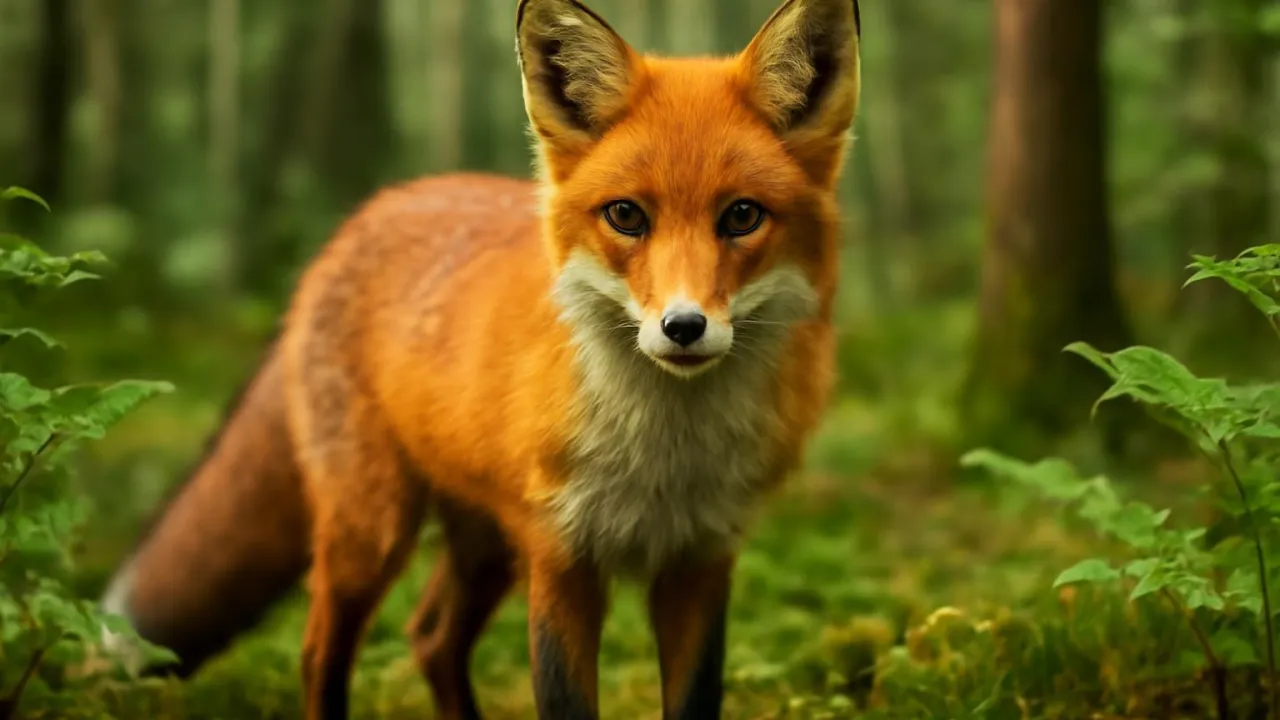
Red foxes can hear a mouse squeak from 100 feet away, even under thick snow!
✨ Word Sparks (Grade 3 Glossary)
Tap 🔊 to hear
camouflage
Colors or patterns that help hide an animal
prey
Animals that are hunted for food
adaptation
A feature that helps an animal survive
🪝
Did you know the red fox uses its sharp hearing to find hidden prey under snow?
1
Habitat and Camouflage
Red foxes live in forests, grasslands, and deserts across the Northern Hemisphere. Their orange fur acts as , blending with autumn leaves and dry grass. This helps them hide from predators and sneak up on .
2
Life Cycle and Growth
Red foxes have a life cycle starting as kits born in a den. Kits grow quickly by learning to hunt small animals and insects. They depend on their mother’s care until they can survive on their own.
3
Amazing Hearing and Hunting
The red fox’s large ears allow it to hear tiny sounds underground. This helps locate mice and other hidden beneath snow or soil. Their hunting skill is a key survival .
4
Body Features and Adaptations
Their bushy tail helps with balance when running and serves as a warm cover when resting. Sharp teeth and claws help catch and eat a variety of foods. These features make the red fox a skilled and adaptable predator.
2. What special sense helps the red fox find prey under snow?
🤯 Mind-Blowing Fact • Grade 4
Red foxes can run up to 30 miles per hour, helping them catch quick prey and escape danger.
✨ Word Sparks (Grade 4 Glossary)
Tap 🔊 to hear
ecosystem
A community of living things and their environment
predator
An animal that hunts other animals for food
conservation
Protecting animals and their homes
🪝
How does the red fox’s clever hunting affect the balance of its ecosystem?
1
Geographic Range and Habitat
Red foxes are found throughout the Northern Hemisphere, including North America, Europe, and Asia. They thrive in diverse habitats such as forests, grasslands, mountains, and deserts. Their ability to adapt allows them to live near human settlements as well, showing great flexibility in where they can survive.
2
Role in the Ecosystem
As , red foxes help control populations of rodents and insects, which benefits plant life by reducing overgrazing. They also serve as prey for larger animals like wolves and eagles, fitting into a complex food web that supports health and balance.
3
Cause and Effect of Adaptations
The red fox’s keen hearing and camouflage fur lead to successful hunting, increasing its survival chances. Their bushy tail helps maintain balance and warmth, allowing them to be active in cold weather. These adaptations directly affect their ability to thrive in many environments and avoid .
4
Human Impact and Conservation
Human activity sometimes threatens red fox habitats through urban expansion and pollution. However, red foxes are highly adaptable and often live near cities. efforts focus on protecting natural habitats and educating people about how to coexist peacefully with wildlife.
1. What role do red foxes play in their ecosystem?
2. Why is the red fox’s bushy tail important?
🤯 Mind-Blowing Fact • Grade 5
Red foxes can hear prey moving beneath 12 inches of snow and run up to 30 miles per hour to catch it!
✨ Word Sparks (Grade 5 Glossary)
Tap 🔊 to hear
thermoregulation
How animals keep their body temperature steady
territory
An area an animal protects as its home
fragmentation
Breaking habitats into smaller, separated parts
🪝
How do the red fox’s physical and behavioral adaptations make it a successful global survivor?
1
Scientific Classification and Distribution
The red fox, scientifically named Vulpes vulpes, belongs to the Canidae family. It is the most widely distributed wild carnivore worldwide, inhabiting diverse regions across the Northern Hemisphere. Its adaptability allows it to thrive from arctic tundra to urban environments and temperate forests.
2
Physiological Adaptations and Mechanics
Red foxes possess acute auditory senses, with ears capable of detecting low-frequency sounds up to 30 kHz, enabling precise prey location underground. Their bushy tail provides by wrapping around their body to conserve heat during cold winters. Their slender legs allow swift running speeds up to 30 miles per hour, aiding in hunting and escape.
3
Behavioral Ecology and Life Cycle
Red foxes are primarily solitary hunters, using stealth and acute senses to capture rodents, birds, and insects. Breeding season occurs in winter, with females giving birth to litters of four to six kits. Juveniles learn hunting skills from parents before dispersing to establish their own territories and hunting grounds.
4
Conservation Status and Human Interaction
Though red fox populations are stable globally, urbanization and habitat pose localized threats. They often adapt to human presence by scavenging in cities and suburban areas. Conservation efforts emphasize habitat preservation and mitigating human-wildlife conflicts to maintain ecological balance and species survival.
5
Quantitative Comparisons and Interesting Facts
Adult red foxes weigh between 6 to 24 pounds and measure 18 to 35 inches tall. They can leap distances of up to 6 feet when hunting. Their hearing range surpasses that of domestic dogs, and their fur color varies geographically, with some populations exhibiting silver or black coats. These variations show their remarkable adaptability.